


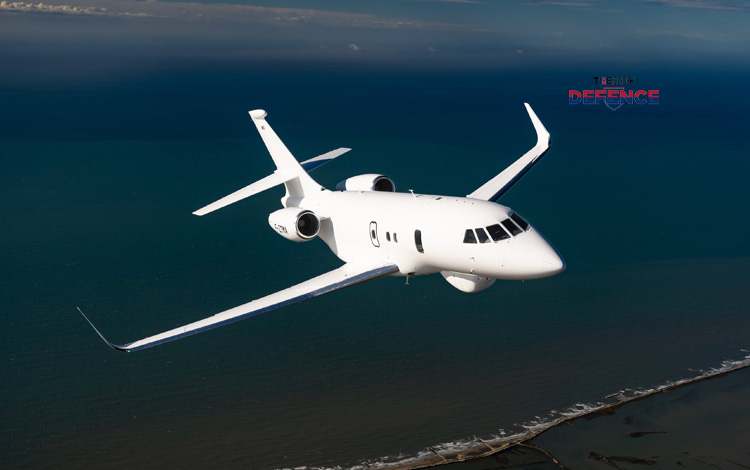
The French Directorate General of Armaments (DGA) has delivered the third Dassault Falcon 2000 LXS Albatros maritime surveillance and intervention aircraft to the French Navy (Marine Nationale), completing France’s scheduled 2026 deliveries under the AVSIMAR (Avions de Surveillance et d’Intervention Maritime) modernization programme.
Handed over following the delivery of the first two aircraft in July 2026 and flight testing conducted with DGA Flight Test and the French Navy’s CEPA/10S operational evaluation unit at Naval Air Station Lann-Bihoué, the third airframe advances the recapitalization of France’s airborne maritime patrol and rescue fleet. Paris has contracted Dassault Aviation for a total of 12 Albatros aircraft—seven ordered in December 2020 and five ordered in September 2025—with subsequent deliveries scheduled at a cadence of two aircraft per year through 2031. Derived from the long-range Falcon 2000LXS business jet, the Albatros replaces the French Navy’s aging Falcon 50M and Falcon 200 Gardian fleets, combining high transit speed, extended overseas patrol endurance, and a specialized multi-sensor and search-and-rescue (SAR) intervention suite to monitor France’s expansive Exclusive Economic Zones (EEZs) in metropolitan waters and overseas territories.
TECHNICAL SPECIFICATIONS: DASSAULT FALCON 2000 LXS ALBATROS ARCHITECTURE
1. Airframe Geometry, Powerplant & Long-Range Patrol Envelope
⚡ Prime Platform Integrator: Dassault Aviation (France), modified from the twin-engine Falcon 2000LXS business jet airframe with structural reinforcements, large observation windows, and external sensor fairings
⚡ Dimensions & Weight Class: Overall length of 20.23 meters (66 ft 4 in), wingspan of 21.38 meters (70 ft 2 in), height of 7.06 meters (23 ft 2 in), and maximum takeoff weight of 19,414 kg (42,800 lbs)
⚡ Propulsion & Range Performance: Powered by two Pratt & Whitney Canada PW308C turbofan engines (~7,000 lbf thrust each), delivering a maximum cruise speed around Mach 0.85–0.86, a maximum range of 7,400 km (4,000 nautical miles), and approximately seven hours of patrol endurance at 200 nautical miles from base
⚡ Fleet Replacement & Cadence: 12-aircraft total order (seven ordered in 2020, five in 2025) replacing legacy Falcon 50M and Falcon 200 Gardian aircraft, with three delivered in 2026 and two per year slated thereafter 
2. Maritime Surveillance Sensors, Mission System & Rescue Intervention
💥 Multi-Domain Sensor Suite: Integrates Thales’s belly/chin-mounted SearchMaster active electronically scanned array (AESA) multi-role maritime surveillance radar alongside Safran’s retractable EuroFLIR 410 high-definition electro-optical/infrared (EO/IR) turret
💥 Tactical Mission Management & Connectivity: Equipped with a Naval Group-developed mission management system fusing radar, EO/IR, Automatic Identification System (AIS), and distress-beacon direction-finding data, supported by satellite communications (SATCOM) and tactical datalinks
💥 Search-and-Rescue (SAR) & Intervention Outfit: Features dedicated lateral observation stations and a pressurized drop chute enabling operators to deploy life rafts, SAR survival chains, and marine smoke/illuminating markers directly to vessels or personnel in distress
TIMES OF DEFENCE ASSESSMENT
The delivery of the third Falcon 2000 LXS Albatros to the French Navy under the AVSIMAR programme highlights three critical shifts in European maritime domain awareness, overseas territorial defense, and business-jet military adaptation:
1. Extending Sovereign Reach Across Vast Overseas Exclusive Economic Zones: With the second-largest maritime EEZ globally spanning the Indo-Pacific, Atlantic, and Indian Oceans, France requires rapid-transit, long-endurance aircraft. Offering a 7,400-km range and seven-hour on-station patrol endurance at 200 nautical miles allows the Albatros to police distant maritime zones far more effectively than legacy Falcon 50M and Gardian airframes.
2. Leveraging Commercial Business-Jet Maturity for Cost-Effective Naval Aviation: Adapting the proven Falcon 2000LXS platform with Thales AESA radar, Safran optronics, and Naval Group mission software lowers lifecycle maintenance costs, improves dispatch reliability, and preserves dedicated heavy P-8/Atlantique 2-class patrol aircraft for anti-submarine warfare.
3. Structuring Phased Manned-Unmanned Maritime Surveillance: Completing the first phase of 12 Albatros aircraft—coupled with France’s planned second AVSIMAR phase incorporating complementary unmanned aerial systems—positions the French Navy to pair manned intervention and rescue responsiveness with persistent uncrewed wide-area monitoring.

