


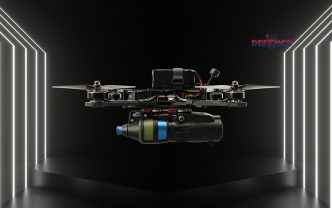
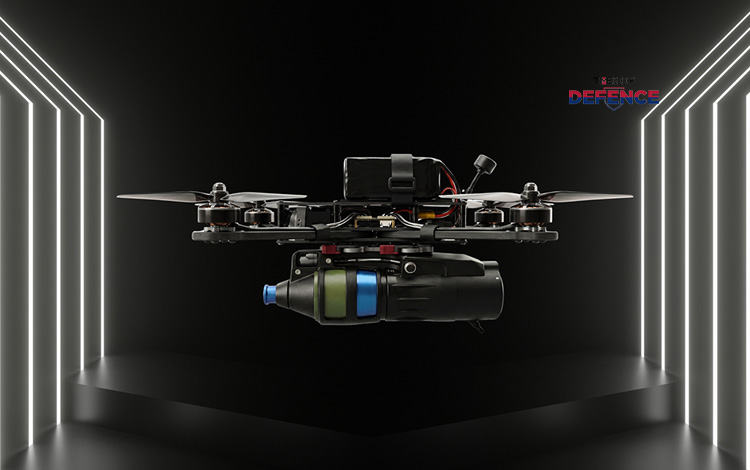
German unmanned-systems firm Cerberon Defence Systems and munitions specialist Dynamit Nobel Defence (DND) announced in mid-November 2026 the successful completion of the first in-flight demonstration verifying the full functional chain of their Modular Lethality Kit (MLK) aboard a flying drone under controlled test-bunker conditions, with additional open-air flight trials scheduled in Thuringia during November 2026 en route to qualification.
Designed as a self-contained, retrofit lethality and safety module that converts compatible unmanned aerial platforms into loitering munitions qualified to relevant NATO safety standards, the MLK packages a warhead, an electronic safety and arming device (eSAD), and dedicated safety electronics supporting late-arming and flight-abort functions within a unified assembly. Under the industrial division of labor, Cerberon leads system architecture, development, and safety/qualification concepts—and plans to produce eSAD units in Germany via a joint venture with Turkish safety-and-arming specialist Artron—while DND provides warhead technology, final assembly, and testing infrastructure in Germany, with integration already underway across several German drone manufacturers.
TECHNICAL SPECIFICATIONS: CERBERON & DND MODULAR LETHALITY KIT (MLK)
1. Industrial Division of Labor, Safety Architecture & Qualification Path
⚡ Prime Developers & Manufacturing Roles: Cerberon Defence Systems (system architecture, development, safety and qualification framework, and planned German eSAD manufacturing via a joint venture with Artron) and Dynamit Nobel Defence (warhead technology, final assembly, and test infrastructure in Germany)
⚡ Integrated Firing & Safety Chain: Combines a warhead, an electronic safety and arming device (eSAD), and supplementary safety electronics within a single modular unit, validated in flight together with a drone platform to prove end-to-end functional interaction
⚡ Late-Arming, Flight Abort & NATO Qualification: Safety electronics incorporate late-arming and flight-abort capabilities to reduce handling and abort risks, enabling compatible drone platforms to be qualified as loitering munitions against relevant NATO safety standards while reducing per-platform safety engineering burden for UAV makers 
2. Mechanical Integration, Drone Compatibility & Test Progression
💥 Modular Mechanical Interface: Mounts to drone airframes via a standardized Picatinny interface, allowing modular attachment and separation between unmanned carrier platforms and lethality payloads
💥 Multi-Platform Loitering Munition Retrofit: Enables drone manufacturers to adopt a pre-engineered lethality and safety module rather than designing bespoke fuzing/safety subsystems from scratch, supporting integration across multiple German UAV designs
💥 Flight-Test & Qualification Roadmap: Follows initial in-flight functional-chain verification inside DND’s controlled test bunker with open-air flight tests planned in Thuringia in November 2026 and ongoing progression toward manufacturer qualification and domestic/export armed-forces adoption
TIMES OF DEFENCE ASSESSMENT
The successful in-flight functional-chain demonstration of the Cerberon–DND Modular Lethality Kit highlights three critical shifts in loitering-munition modularization, NATO safety certification, and European defense-industrial supply chains:
1. Decoupling Drone Airframes From Weaponized Payload Modules: Standardizing a Picatinny-mounted lethality and safety module lets armed forces and drone makers treat airframes and warhead packages more modularly, accelerating adaptation of unmanned platforms into loitering munitions.
2. Embedding NATO-Aligned Safety Functions Into a Shared Module: Integrating late-arming, flight-abort, and eSAD safety electronics directly into the MLK centralizes critical safety compliance and lowers qualification barriers for smaller or faster-iterating drone manufacturers.
3. Combining German Warhead/System Engineering With Cross-Border Safety Specialization: Pairing DND’s warhead and test infrastructure with Cerberon’s architecture and German eSAD production via a joint venture with Artron reflects pragmatic European industrial specialization to scale loitering-munition production.

