

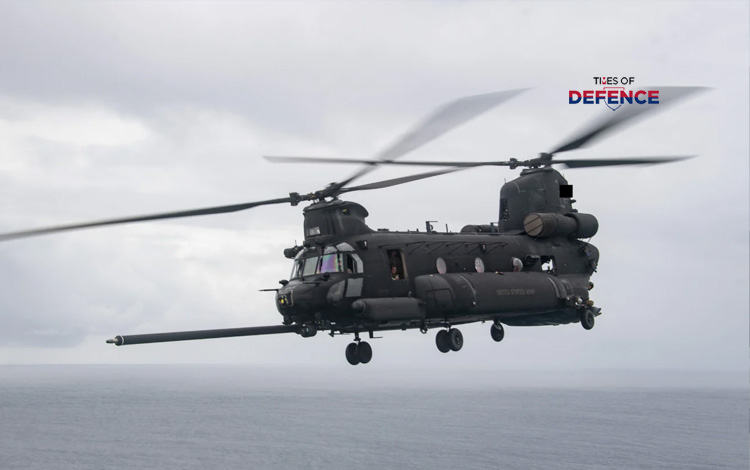
The U.S. Department of War announced on November 23, 2026, that Boeing has been awarded a $197,279,932 firm-fixed-price order modification to procure MH-47G special operations rotary-wing aircraft for U.S. Special Operations Command (USSOCOM), with work scheduled for completion by September 2031.
Issued under delivery order W91215-16-G-0001 / H9224126FE001—which previously received a $19.4 million addition in February 2026—the award obligates 100 percent of its funding at contract award using fiscal 2027 Defense-wide procurement and U.S. Army aircraft procurement funds. While the contracting notice did not disclose the exact aircraft count or specify whether the modification covers new-build or remanufactured airframes, the order advances ongoing heavy-lift special operations fleet modernization for the U.S. Army’s 160th Special Operations Aviation Regiment (Airborne) (“Night Stalkers”) at Boeing’s Ridley Park, Pennsylvania rotorcraft facility alongside multi-year MH-47G Block II rebuild and remanufacturing efforts.
TECHNICAL SPECIFICATIONS: BOEING MH-47G CHINOOK & BLOCK II ARCHITECTURE
1. Contract Structure, Funding & Fleet Modernization Context
⚡ Contracting Authority & Order Vehicle: U.S. Special Operations Command (MacDill AFB, Florida) modifying delivery order W91215-16-G-0001 / H9224126FE001 (following a $19.4 million modification in February 2026)
⚡ Obligation & Completion Horizon: $197,279,932 firm-fixed-price obligation from FY2027 Defense-wide and U.S. Army aircraft procurement funds, performed at Boeing’s Ridley Park, Pennsylvania plant with completion slated for September 2031
⚡ Fleet Baseline & Block II Roadmap: Supports the 160th SOAR (Airborne) special operations heavy-lift fleet (which had 56 MH-47Gs under contract through USSOCOM in late 2025, including 51 Block II aircraft under contract by March 2025 with Block II deliveries scheduled to start in 2027 and fleet-wide modernization targeted around early 2030) 
2. MH-47G / Block II Flight Envelope, Survivability & Mission Systems
💥 Propulsion, Payload & Range: Powered by twin turboshaft engines (T55-GA-714A class) with a maximum gross weight of ~24,494 kg (54,000 lb), useful load capacity exceeding 11,300–12,500 kg, top speed near 302–315 km/h (~163–170 KTAS), extended-range fuel tanks (“fat tanks”), and aerial refueling capability for long-range infiltration and exfiltration
💥 Block II Airframe & Avionics Upgrades: Incorporates a reinforced fuselage structure, redesigned fuel tanks, upgraded drivetrain, Common Avionics Architecture System (CAAS) cockpit, digital flight controls, and open-systems readiness for future mission payloads and manned-unmanned teaming (MUM-T)
💥 Special Operations Sensors & Self-Protection: Equipped with terrain-following/terrain-avoidance radar, degraded visual environment sensors, infrared exhaust suppressors, missile and laser warning systems, radio-frequency countermeasures, and cabin/window defensive armament for low-level, adverse-weather, and night operations
TIMES OF DEFENCE ASSESSMENT
USSOCOM’s $197.3 million MH-47G order modification—with full upfront FY2027 funding obligation and a September 2031 completion window—highlights three critical dynamics in special operations rotary-wing sustainment, heavy-lift endurance, and long-horizon industrial planning:
1. Prioritizing Long-Range Heavy Lift and Survivability for Special Operations: Contested theaters and distributed operating concepts demand heavy-lift rotorcraft capable of moving sizeable assault elements, specialized vehicles, and supplies over long distances at low altitude and in degraded weather.
2. Full Upfront Funding Signals High-Priority Sustainment Through 2031: Obligating the entire $197.28 million at award across FY2027 Defense-wide and Army procurement accounts underscores steady institutional backing for special operations heavy-lift availability across a multi-year manufacturing window.
3. Sustaining Parallel Legacy, Remanufactured, and Block II Fleet Lines: Because the MH-47G fleet spans earlier upgrades, remanufactured airframes, and Block II rebuilds, multi-year contract modifications help Boeing balance shop capacity in Ridley Park while keeping specialized mission systems current.