


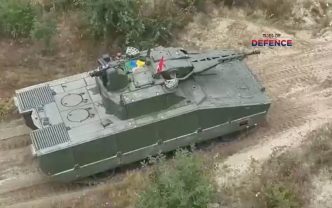
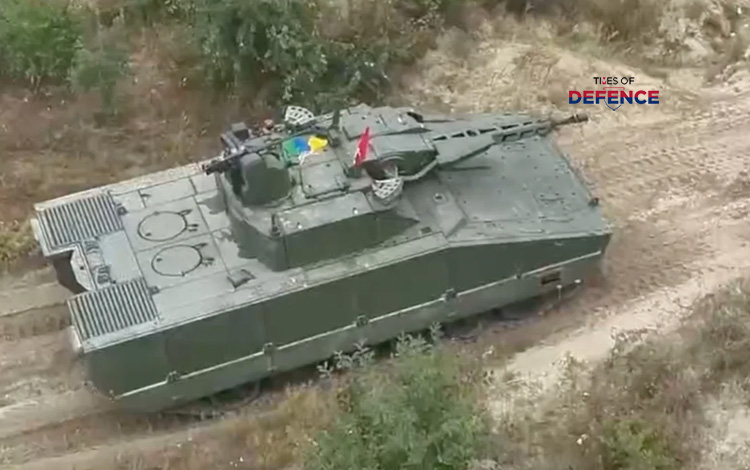
Ukraine’s 18th Army Corps announced on November 24, 2026, that the German government has handed over an initial batch of factory-new Rheinmetall Lynx KF41 infantry fighting vehicles (IFVs) to the Ukrainian Ground Forces’ 21st Separate Mechanized Brigade, where crews trained in Germany have formally placed the tracked armored vehicles into frontline service.
Funded by Berlin under a contract signed in December 2025 and publicly disclosed in January 2026 for an initial five Lynx KF41 vehicles valued in the mid-double-digit million euro range, the deliveries follow field trials of a single test vehicle supplied to Ukraine at the end of 2024 / early 2025. Configured specifically for Ukrainian operational requirements with Rheinmetall’s two-person Lance turret and a 30 mm automatic cannon firing programmable airburst ammunition, the newly delivered vehicles—some arriving straight from German assembly lines with roughly 25 km on the odometer—will support both mechanized infantry assault operations and counter-UAS engagements against FPV drones and Shahed/Geran one-way attack munitions ahead of planned follow-on batches and localized production inside Ukraine.
TECHNICAL SPECIFICATIONS: RHEINMETALL LYNX KF41 (UKRAINIAN CONFIGURATION)
1. Delivery Context, Brigade Integration & Industrial Roadmap
⚡ Prime OEM & Funding Authority: Rheinmetall Landsysteme (Germany), procured and funded by the German government under a December 2025 contract covering an initial batch of five Lynx KF41 vehicles
⚡ Receiving Unit & Crew Training: Assigned to the 21st Separate Mechanized Brigade under Ukraine’s 18th Army Corps after Ukrainian mechanized crews completed accelerated conversion training in Germany
⚡ Industrial Localization Pathway: Follows trials of an initial test unit delivered in late 2024 / early 2025 and precedes planned larger follow-on orders alongside localized assembly and production at Rheinmetall’s Ukrainian manufacturing facility 
2. Lynx KF41 Protection, Firepower & Counter-Drone Capabilities
💥 Platform Weight & Mobility Envelope: Modular tracked armored vehicle in the ~44-tonne combat weight class (scalable up to ~50 tonnes), powered by a ~850 kW (1,140 hp) Liebherr diesel engine paired with a Renk transmission for top road speeds near 70 km/h and high cross-country mobility
💥 Two-Person Lance Turret & Programmable Munitions: Fitted with Rheinmetall’s two-person Lance turret housing a stabilized 30 mm automatic cannon (such as the MK30-2/ABM or Wotan 30) and digital fire-control system capable of firing programmable airburst rounds to defeat troops in cover, light armor, FPV drones, and Shahed/Geran loitering munitions
💥 Survivability & Internal Ergonomics: Combines modular ballistic, mine, and top-attack armor suites with a spacious interior accommodating a three-person crew and up to eight dismounted infantrymen, plus dual gunner/commander weapon control redundancy
TIMES OF DEFENCE ASSESSMENT
Germany’s handover of the first batch of Rheinmetall Lynx KF41 infantry fighting vehicles to Ukraine’s 21st Separate Mechanized Brigade highlights three critical shifts in heavy mechanized warfare, dual-role counter-drone firepower, and European-Ukrainian industrial co-production:
1. Deploying Next-Generation Armor Straight From Factory Lines Into Combat: Unlike refurbished Cold War stocks, the Lynx KF41 enters Ukrainian service directly from new-build production with modern digital fire control, modular survivability, and spacious dismount ergonomics—making Ukraine one of the earliest operational adopters alongside Hungary.
2. Turning 30 mm Programmable Airburst Firepower Into Mobile Counter-UAS Defense: Beyond supporting mechanized infantry assaults, pairing a stabilized 30 mm cannon and modern fire-control optics with programmable airburst ammunition equips frontline brigades to engage both low-flying FPV drones and long-range Shahed/Geran attack UAVs.
3. Bridging Initial German-Built Batches to Domestic Ukrainian Manufacturing: Using a five-vehicle German-funded initial batch to validate crew training, maintenance workflows, and battlefield modifications lays the operational groundwork for larger follow-on orders and localized Lynx production inside Ukraine.

