


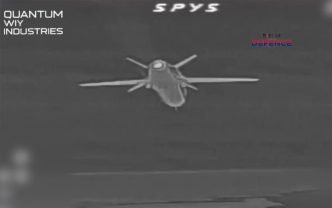
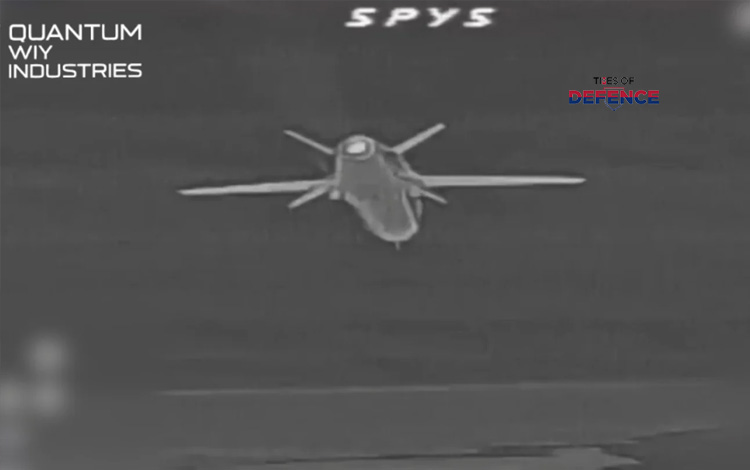
Quantum WIY Industries (QWI)—a German-Ukrainian joint venture established between German unmanned systems firm Quantum Systems and Ukrainian developer WIY Drones under the Build with Ukraine initiative—announced on November 23, 2026, that its upgraded SPYS high-speed interceptor drone successfully intercepted and destroyed a Russian jet-powered Geran-5 K5-K aerial weapon during live combat testing in Ukraine.
Classified by Ukraine’s Defense Intelligence (HUR) as a small cruise missile rather than a conventional propeller-driven loitering munition, the Geran-5 K5-K variant entered operational Russian strikes against Ukrainian cities in early autumn 2026. Featuring a shortened 4-meter fuselage (compared to 6.5 meters on the baseline Geran-5 introduced in early 2026) and a Chinese-sourced turbojet powerplant, the K5-K cruises above 450 km/h (280 mph), climbs to 6 kilometers (3.7 miles), and reaches up to 1,000 km/h (621 mph) during terminal or evasive maneuvers while carrying a 90 kg warhead (including TBBCh-90 thermobaric payloads) over ranges up to 1,000 kilometers. Engineered specifically to defeat Russia’s shift toward turbojet-powered strike drones, the latest SPYS interceptor attains speeds up to 500 km/h (311 mph) across a 45-kilometer (28-mile) engagement radius and can be launched from airborne mother-drones to conserve onboard battery energy for terminal pursuit.
TECHNICAL SPECIFICATIONS: SPYS INTERCEPTOR DRONE & RUSSIAN GERAN-5 K5-K THREAT PROFILE
1. SPYS High-Speed Interceptor Architecture & Industrial Scaling
⚡ Prime Developers & Joint Venture: Quantum WIY Industries (QWI), uniting Quantum Systems (Germany) and WIY Drones (Ukraine) under the Build with Ukraine framework; forms part of an interceptor family progressing from STRILA to SPYS and Skyron
⚡ Kinematic Envelope & Engagement Range: Maximum dash speed of up to 500 km/h (311 mph) and operational reach extended to 45 kilometers (28 miles), enabling pursuit and collision/proximity engagements against jet-propelled aerial targets
⚡ Warhead & Airborne Mothership Launch: Carries a 500-gram fragmentation/explosive warhead and supports deployment from airborne carrier drones to bypass energy-intensive ground climb profiles and preserve battery capacity for terminal intercept
⚡ Ukrainian Manufacturing Scale: Produced locally in Ukraine by QWI, where manufacturing capacity scaled from hundreds to thousands of units per month during 2026 ahead of Quantum Systems’ October 2026 commitment to supply tens of thousands of SPYS interceptors 
2. Target Threat Profile: Russian Geran-5 K5-K Small Cruise Missile
💥 Airframe & Propulsion Evolution: Compact 4.0-meter jet-powered derivative of the 6.5-meter Geran-5 (produced at JSC Alabuga), utilizing a Chinese-origin turbojet engine (such as the Telefly TF-TJ2000A / TRD-200 class) and refined aerodynamics for higher speed and altitude
💥 Flight Performance & Payload: Cruises above 450 km/h (280 mph), operates up to 6 km (20,000 ft) altitude, achieves burst maneuver speeds near 1,000 km/h (621 mph), and delivers a 90 kg warhead (observed with a TBBCh-90 thermobaric charge) out to 1,000 km
💥 Guidance & Foreign Component Dependencies: Recovered wreckage analyzed by Ukrainian intelligence revealed 93 foreign electronic components (including U.S., Chinese, and Swiss microelectronics) alongside electro-optical and microcomputer-based terminal tracking suites
TIMES OF DEFENCE ASSESSMENT
The combat interception of a Russian Geran-5 K5-K small cruise missile by Quantum WIY Industries’ SPYS drone highlights three critical shifts in counter-UAS economics, high-speed drone warfare, and decentralized defense co-production:
1. Closing the Kinematic Gap Against Jet-Powered Strike Drones: Russia’s transition from propeller-driven Shahed/Geran-2 drones to turbojet-powered Geran-5 variants cruising above 450 km/h at 6 km altitude outpaced first-generation FPV interceptors. Raising SPYS speed to 500 km/h and range to 45 km restores an affordable unmanned countermeasure against low-cost cruise-missile-class threats.
2. Conquering Energy and Altitude Limits via Drone-Mothership Launch: Launching high-speed electric interceptors from airborne carrier drones eliminates the steep battery drain of climbing from ground level to multi-kilometer altitudes, preserving energy for high-speed terminal interception.
3. Scaling Joint European-Ukrainian Production at Wartime Speed: Combining German industrial supply chains with Ukrainian frontline engineering inside Ukraine—expanding output from hundreds to thousands of interceptors per month—demonstrates how co-production models adapt rapidly to evolving adversary strike architectures.