


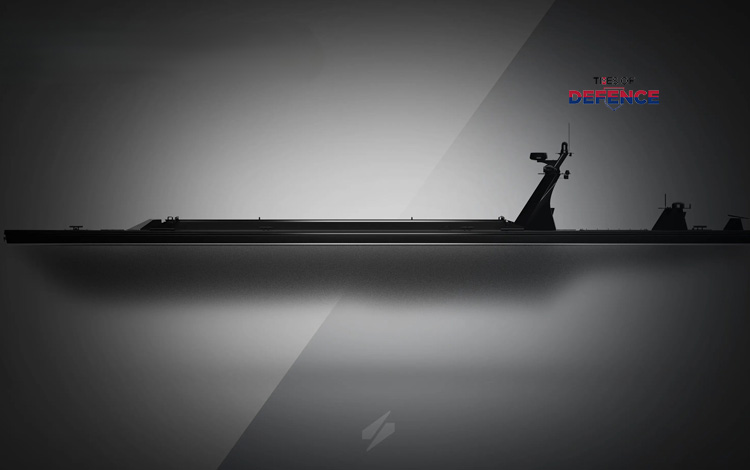
Maritime autonomy specialist Saronic Technologies has been awarded a prototype Other Transaction (OT) agreement by the U.S. Department of War’s Defense Innovation Unit (DIU) to develop and deliver its Autonomous Low Profile Vessel (ALPV) for the United States Marine Corps (USMC).
Engineered to execute resilient, low-signature maritime resupply across contested littoral waters without risking human crews, the ALPV serves as a long-range autonomous logistics connector for dispersed expeditionary forces, such as Marine Littoral Regiments operating within hostile weapons engagement zones. Under the prototyping agreement, Saronic will pair its field-proven autonomy stack and passive perception sensors with a high-maneuverability, beachable hull designed for rapid, scalable production. The effort also encompasses joint government testing and operational doctrine planning to define how the Marine Corps will staff, train on, and sustain the platform in service, building directly upon Saronic’s expanding naval manufacturing footprint—which includes production awards for the 24-foot Corsair, the 180-foot Marauder, and Landing Craft Utility (LCU) vessels at its Port Alpha shipyard.
TECHNICAL SPECIFICATIONS: SARONIC AUTONOMOUS LOW PROFILE VESSEL (ALPV) ARCHITECTURE
1. Autonomy Stack, Passive Perception & Open Architecture
⚡ Autonomous Navigation & Teaming: Powered by Saronic’s mature autonomy software—validated across more than 350,000 nautical miles and 55,000 operational hours—supporting assured navigation under degraded GPS/communications, collaborative multi-vessel teaming, and single-operator supervision of multiple craft
⚡ Low-Signature Survivability: Features a low-freeboard hull profile combined with passive perception sensor arrays to minimize radar, visual, and electromagnetic signatures while transiting contested maritime choke points
⚡ Modular Open Systems Architecture (MOSA): Built with standardized digital and physical interfaces to allow rapid integration of auxiliary mission payloads, communications relays, or defensive countermeasures as operational demands evolve 
2. Cargo Capacity, Range & Littoral Performance Parameters
💥 Payload & Intermodal Carriage: Engineered to meet DIU’s minimum 18,000-pound (8,165 kg) cargo requirement, accommodating six 3,000-pound Joint Modular Intermodal Containers (JMICs), two 5,100-pound containers, standard pallets, or bulk liquid bladders for ship-to-ship and direct-to-shore delivery
💥 Endurance & Sea-State Envelope: Targets a loaded operational range of 1,000 to 2,000 nautical miles (1,852 to 3,704 km) at cruising speeds of at least 12 knots in Sea State 4, alongside 96-hour low-speed loitering, full operation in Sea State 5, and survivability through Sea State 6 conditions
💥 Expeditionary Beachability & Transport: Incorporates a shallow-draft hull capable of autonomous beach landing and withdrawal, while maintaining road-transportable dimensions compatible with commercial and military trailers for rapid strategic deployment
TIMES OF DEFENCE ASSESSMENT
The Defense Innovation Unit’s selection of Saronic Technologies to prototype the Autonomous Low Profile Vessel highlights three critical strategic imperatives in modern expeditionary warfare:
1. Solving the Contested Logistics Dilemma in the Indo-Pacific: Under Force Design concepts, dispersed Marine Littoral Regiments operating inside an adversary’s anti-access/area denial (A2/AD) umbrella cannot rely on large, high-signature amphibious ships for routine sustainment. Low-profile, unmanned connectors allow commanders to push fuel, munitions, and supplies to austere island outposts without exposing high-value hulls or crews.
2. Scaling Attritable Maritime Mass Through Commercial Shipbuilding Models: By pairing a modular, road-transportable vessel design with Saronic’s automated manufacturing infrastructure, the Pentagon aims to transition rapidly from experimental prototypes to high-volume serial production—creating an affordable, attritable logistics fleet capable of absorbing combat attrition.
3. Validating Assured Autonomy in EW-Contested Waters: Operating uncrewed supply craft across 2,000-nautical-mile transit corridors requires resilient onboard perception and navigation capable of functioning without continuous satellite links, setting a benchmark for future autonomous fleet operations.

