


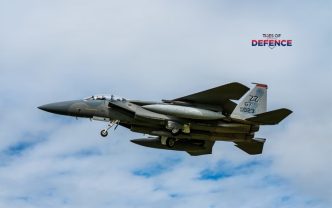
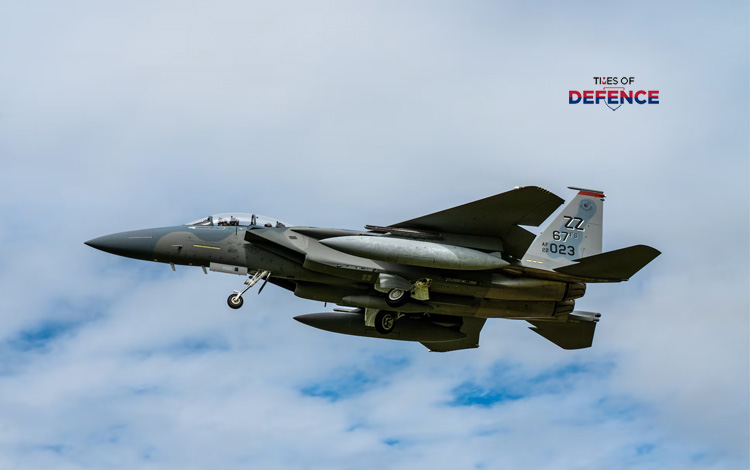
The United States Air Force has officially deployed its first two operational F-15EX Eagle II multirole fighter aircraft, designated EX-22 and EX-23, to Kadena Air Base in Okinawa, Japan.
Marking the historic first deployment of the advanced F-15EX platform outside the continental United States, the arrival significantly bolsters the U.S. Air Force’s tactical air superiority and long-range strike posture across the Indo-Pacific theater. Stationed at one of Washington’s most vital forward-operating hubs in the Western Pacific, the Eagle II fleet is positioned to replace aging legacy F-15C/D airframes, providing enhanced survivability, open-mission-systems computing, and heavy ordnance carriage capabilities in a rapidly evolving regional security environment.
TECHNICAL SPECIFICATIONS: BOEING F-15EX EAGLE II ARCHITECTURE
1. Avionics, Electronic Warfare & Sensor Suite
⚡ Prime Contractor & Airframe: Boeing Defense, Space & Security (St. Louis, Missouri); engineered with a 20,000-hour structural service life and digital fly-by-wire flight controls
⚡ Active Electronically Scanned Array (AESA) Radar: Equipped with the Raytheon AN/APG-82(V)1 AESA radar, providing simultaneous long-range multi-target tracking, high-resolution synthetic aperture radar mapping, and superior electronic protection
⚡ Survivability & Electronic Warfare: Integrates the BAE Systems AN/ALQ-250 Eagle Passive Active Warning Survivability System (EPAWSS), delivering fully integrated radar warning, geolocation, situational awareness, and advanced self-protection jamming against modern air defense networks
⚡ Mission Computing: Powered by the Advanced Display Core Processor II (ADCP II), capable of processing 87 billion instructions per second to support rapid software upgrades via Open Mission Systems (OMS) architecture 
2. Propulsion, Flight Performance & Weapons Carriage
💥 Powerplant & Speed: Powered by twin General Electric F110-GE-129 afterburning turbofan engines (each generating 29,500 lbf of thrust), enabling a top speed exceeding Mach 2.5 and a combat ceiling of 60,000 feet
💥 Payload & Hardpoint Capacity: Features 23 weapon stations capable of carrying up to 29,500 pounds (13,380 kg) of external ordnance, including up to 12 AIM-120 AMRAAM or AIM-9X air-to-air missiles, long-range standoff munitions, and oversized hypersonic strike weapons
💥 Operational Range: Delivers an unrefueled ferry range of approximately 2,400 nautical miles (4,445 km) with conformal fuel tanks (CFTs), optimized for vast Indo-Pacific maritime distances
TIMES OF DEFENCE ASSESSMENT
The inaugural overseas deployment of the F-15EX Eagle II (EX-22 and EX-23) to Kadena Air Base highlights three critical strategic developments in Indo-Pacific airpower:
1. Resolving the Kadena Air Superiority Transition: Following the phased retirement of legacy F-15C/D Eagles at Okinawa, the arrival of the F-15EX restores a permanent, high-end heavy fighter presence at a critical geographic chokepoint near the Taiwan Strait and East China Sea.
2. Delivering High-Capacity Missile Truck Capabilities: Unlike stealth platforms constrained by internal weapons bays, the F-15EX carries massive air-to-air and standoff strike payloads, enabling seamless manned-unmanned teaming and cooperative engagement alongside fifth-generation F-35s and F-22s.
3. Validating Forward Sustainment in Contested Environments: Deploying newly delivered Lot 2 production airframes directly to an operational forward base tests Pacific Air Forces logistics, digital maintenance pipelines, and electronic warfare readiness against peer adversaries.

