


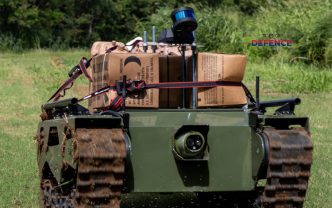
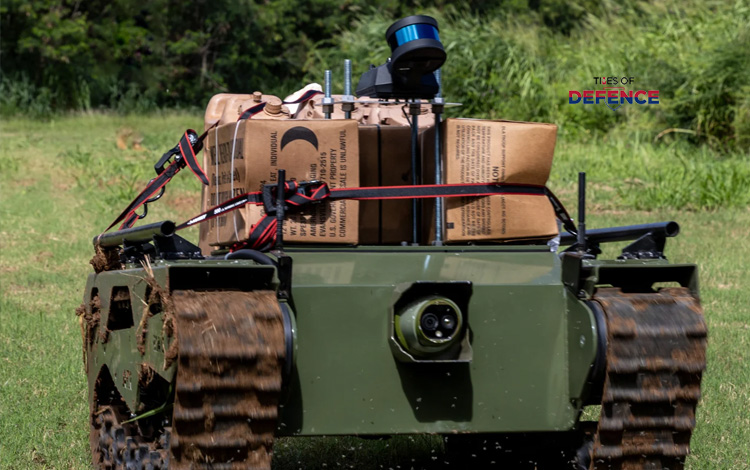
Australian robotics manufacturer BIA5’s All Terrain Robot (ATR) uncrewed ground vehicle (UGV) underwent field trials on November 7, 2026, during the U.S. Army Global Tactical Edge Acquisition Directorate (G-TEAD) USARPAC ACE 27-01 event at Marine Corps Training Area Bellows, Oahu.
Conducted in coordination with U.S. Army Pacific (USARPAC), the Accelerated Capability Event focuses on operationalizing commercial autonomous air, surface, and ground platforms for rapid deployment to distributed island-chain forces across the Indo-Pacific. The ATR platform was evaluated in high-stress operational lanes, including a 4,700-meter contested tactical resupply route, multi-mission casualty evacuation (CASEVAC), and high-intensity electronic warfare (EW) environments featuring GPS-denied navigation and RF signal jamming.
TECHNICAL SPECIFICATIONS: BIA5 ATR & WARFIGHTER UGV ARCHITECTURE
Platform Architecture, Sensor Integration & Payloads
⚡ Lead Integrator & Developer: BIA5 (Brisbane, Queensland, Australia)
⚡ Vehicle Family Baseline: ATR (All Terrain Robot) tracked chassis series
⚡ Sensor & Vision Suite: Integrated multi-camera drive array, optical/infrared sensor mast, remotely controlled pan-tilt-zoom monitor, and Reach Robotics multi-axis manipulator arm compatibility
⚡ Operational Envelope & Environmental Rating: All-terrain continuous rubber track design engineered for heavy mud, 45-degree slope navigation, sand, and dense tropical foliage
⚡ Modular Payload Configurations: Modular deck interfaces supporting patient transport litters, remote weapon stations (RWS), hazmat/EOD sensors, and bulk supply racks
⚡ High-Capacity Variant Baseline (Warfighter Modular UGV):
• Payload Mass Capacity: Up to 330 kg (730 lbs)
• Maximum Operational Range: ~60 km (37 miles)
• Slope Capability: 45° incline/decline traverse baseline 
G-TEAD USARPAC ACE 27-01 Trial Objectives
💥 Tactical Resupply Lane: Autonomous 4,700-meter (2.9-mile) logistics transit carrying ammunition, rations, and water to forward edge elements
💥 Autonomous CASEVAC Lane: Remote and semi-autonomous extraction of wounded personnel under direct fire scenarios
💥 EW & GPS-Denied Survivability: Operates via local inertial navigation (INS), visual odometry, and anti-jam RF links under heavy GPS degradation and active EW jamming
💥 Rapid Fielding Protocol: Competitive evaluation under G-TEAD framework offering $150,000 awards to winning vendors and a direct path to operational fielding within 90 days
TIMES OF DEFENCE ASSESSMENT
The participation of BIA5’s ATR UGV in U.S. Army trials in Hawaii highlights critical operational developments in distributed logistics and autonomous medical extraction:
1. **Solving Indo-Pacific Dispersed Logistics (The “Last-Mile” Problem)**: Operating across isolated island chains (Archipelagic Defense) leaves small, dispersed combat units vulnerable to supply interdiction. Deploying compact, high-payload tracked UGVs like the ATR enables continuous, low-signature resupply along 4.7 km contested lanes without placing crewed transport vehicles or rotary-wing assets in danger of enemy precision fires.
2. **Mitigating Human Attrition in High-Risk CASEVAC Missions**: Lessons from modern high-intensity warfare (notably in Ukraine) demonstrate that human casualty evacuation teams and manned ambulances face extreme attrition from FPV loitering munitions and artillery spotters. Utilizing ruggedized UGVs for frontline litter transport removes medics from high-threat engagement zones and guarantees wounded personnel extraction during active bombardment.
3. **Validating Robustness Against EW and GPS-Denied Warfare**: Modern contested battlefields feature dense RF jamming that severs standard command links and degrades GPS positioning. Testing the ATR UGV under G-TEAD jammed environments validates autonomous optical and inertial navigation suites, ensuring tactical land systems maintain operational momentum when satellite signals are completely lost.

