


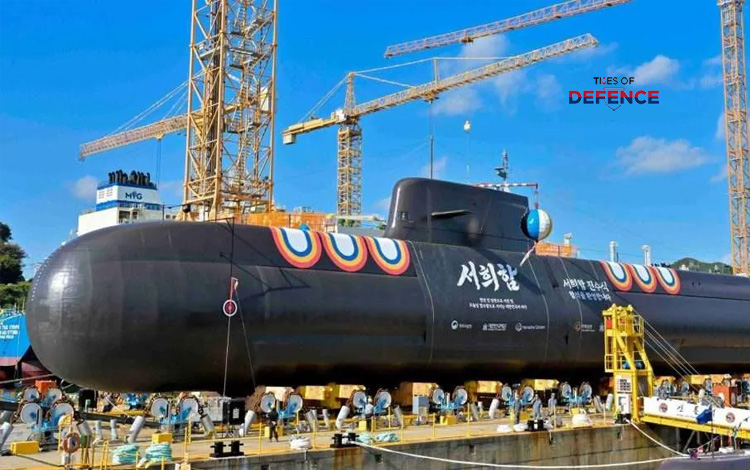
South Korea’s Defense Acquisition Program Administration (DAPA), via its Defense Project Promotion Committee, formally approved the basic acquisition strategy for the “Jang Bogo N” nuclear-powered attack submarine (SSN) program on November 6, 2026.
Exempted from standard multi-year preliminary feasibility studies under national security provisions, the program’s official system development launch is set for 2027. Under the approved framework, domestic shipbuilders—including HD Hyundai Heavy Industries (HD HHI) and Hanwha Ocean—will compete for detailed design and construction contracts. The strategic goal is to launch the lead nuclear-powered attack submarine in the mid-2030s, targeting operational commissioning by the late 2030s. The platform will provide persistent, continuous underwater tracking and strike capabilities as a vital node in South Korea’s “Kill Chain” preemptive strike infrastructure.
TECHNICAL SPECIFICATIONS: JANG BOGO N SSN ARCHITECTURE & PROPULSION MATRIX
Program Governance, Procurement Baseline & Lifecycle Management
⚡ Managing Agency: Defense Acquisition Program Administration (DAPA) / Republic of Korea Navy (ROKN)
⚡ Program Designation: Jang Bogo N (SSN / Nuclear-Powered Attack Submarine)
⚡ Program Execution Timeline:
• Basic Acquisition Strategy Approved: November 6, 2026
• Shipbuilder Selection & Detailed Design Phase: 2027
• Lead Vessel Launch Target: Mid-2030s
• Operational Fleet Introduction Target: Late 2030s
⚡ Program Cost Estimate: ~28.9 trillion KRW (~$23 billion USD) projected multi-vessel lifecycle allocation
⚡ Regulatory Framework: Special Act on Submarine Procurement & Nuclear Safety Oversight (targeted for legislative enactment in late 2026) 
Nuclear Propulsion Architecture & Standoff Ordnance Interoperability
💥 Reactor Propulsion Architecture: Compact Marine Small Modular Reactor (SMR) utilizing High-Assay Low-Enriched Uranium (HALEU) / Low-Enriched Uranium (LEU) fuel enriched to below 20% U-235 to comply with international non-proliferation standards
💥 Submarine Kinetic Payload Matrix:
• Vertical Launching System (VLS): Large-diameter Korean Vertical Launch System (K-VLS II) cells capable of launching Hyunmoo-IV-4 submarine-launched ballistic missiles (SLBMs) and Chonryong land-attack cruise missiles (LACM)
• Torpedo & Anti-Ship Ordnance: 533mm heavy wire-guided torpedoes (Tiger Shark / Beom Sang-eo) and anti-ship missile tubes
💥 Strategic Role in 3-Axis Defense Architecture: Directly supports the “Kill Chain” system by providing persistent, high-speed underwater tracking of adversary Ballistic Missile Submarines (SSBs/SSBNs) and coastal missile sites without the surfacing dependencies of diesel-electric/AIP platforms
TIMES OF DEFENCE ASSESSMENT
The formal approval of the Jang Bogo N SSN acquisition strategy carries major strategic and industrial implications:
1. **Unlocking Continuous High-Speed Submerged Endurance**: While South Korea’s diesel-electric KSS-III (Dosan Ahn Changho-class) submarines feature advanced Air-Independent Propulsion (AIP) and lithium-ion batteries, their submerged transit speed and endurance are constrained. Transitioning to a nuclear-powered Small Modular Reactor (SMR) enables unlimited submerged range at high transit speeds, allowing ROKN attack submarines to continuously shadow North Korean missile-carrying submarines and surface units without battery-charging limits.
2. **Accelerating Procurement Timelines via Feasibility Waivers**: Waiving the standard one-to-two-year preliminary acquisition feasibility study compresses the program schedule, moving industrial shipbuilder selection and design work directly into 2027. This acceleration highlights Seoul’s commitment to closing its underwater endurance gap as regional submarine fleets—such as North Korea’s expanding tactical nuclear submarine assets—rapidly evolve.
3. **Maximizing Sovereign Naval Industrial Capacity**: Selecting competitive bidding over a single-source award leverages competition between HD Hyundai Heavy Industries and Hanwha Ocean. Backed by a domestic civil nuclear power infrastructure, South Korea aims to master the full submarine nuclear lifecycle—from SMR manufacturing to fuel management and decommissioning—establishing sovereign SSN manufacturing capacity in East Asia.

