


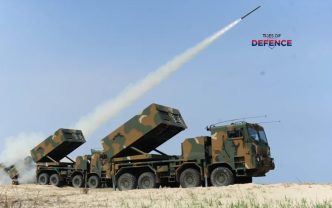
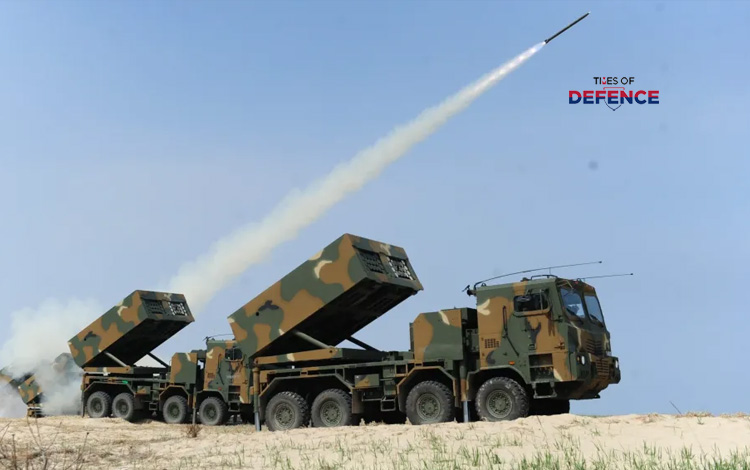
South Korean defense prime Hanwha Aerospace and its U.S. subsidiary, Hanwha Defense USA (HDUSA), announced on November 9, 2026, plans to execute two live-fire test launches of the K239 Chunmoo Multiple Launch Rocket System (MLRS) from a naval vessel off the southern coast of the United States.
The test-firing campaign aims to evaluate the structural integrity, dynamic stabilization, and naval targeting integration of adapting the land-based precision rocket system into a modular, containerized maritime strike platform. The sea-based trials follow an April 2026 agreement between HDUSA and U.S.-based autonomous vessel manufacturer Magnet Defense to co-develop the H38 Medium Unmanned Surface Vessel (MUSV). The effort forms part of Hanwha’s broader strategy to expand its defense footprint within the U.S. market, supported by the ongoing acquisition negotiations for Austal USA and a recently awarded $269 million U.S. Navy Medium Landing Ship (LSM) construction contract via Philly Shipyard.
TECHNICAL SPECIFICATIONS: NAVALIZED CHUNMOO & H38 MUSV ARCHITECTURE
System Configuration & Platform Integration
⚡ OEM / System Developers: Hanwha Aerospace / Hanwha Defense USA (HDUSA) in partnership with Magnet Defense
⚡ Target Platform Integration: H38 Medium Unmanned Surface Vessel (MUSV)
⚡ Fire-Control Adaptation: Containerized modular launcher incorporating shipboard motion-compensation gyroscopes, dynamic deck stabilization systems, and automated naval C4ISR datalink integration
⚡ Munition Interoperability Matrix:
• 227mm Unguided Rockets: Standard NATO MLRS compatibility
• 239mm Guided Rockets: GPS/INS-guided strike rockets (80 km range baseline)
• 290mm CTM290 Tactical Ballistic Missiles: Standoff precision strike variant (up to 290 km operational radius)
• 400mm+ High-Caliber Rocket Modifications: Containerized multi-pod payload configurations 
Industrial Infrastructure & U.S. Market Footprint
💥 U.S. Naval Shipbuilding Base: Acquisition of Philly Shipyard (2024), yielding a $269M TOTE Services contract for U.S. Navy/USMC Medium Landing Ship (LSM) construction
💥 M&A Portfolio Expansion: Advanced due diligence completed for the acquisition of Mobile, Alabama-based Austal USA
💥 Unmanned Surface Capabilities: Autonomous offensive strike packages pairing uncrewed vessel hulls with containerized surface-to-surface precision strike effectors
TIMES OF DEFENCE ASSESSMENT
Hanwha’s sea-based Chunmoo firing tests in the U.S. highlight key trends in naval procurement and uncrewed strike architecture:
1. **Pioneering Low-Cost Containerized Strike for Medium USVs**: Adapting land-based artillery systems like the K239 Chunmoo into standardized, containerized deck payloads provides a rapid path to arm uncrewed surface vessels. Mounting containerized launchers on platforms like the H38 MUSV allows naval planners to distribute long-range precision fires across low-cost, uncrewed hulls without taking up vertical launch system (VLS) cells on primary surface combatants.
2. **Accelerating Korean Defense Industrial Penetration into the U.S. Market**: Executing live-fire tests off the U.S. coast alongside U.S. firms (Magnet Defense, TOTE Services, Philly Shipyard) demonstrates Hanwha’s strategy to enter the U.S. defense procurement ecosystem. Combining U.S.-based shipbuilding assets (Philly Shipyard, potential Austal USA acquisition) with proven Korean precision weapons allows Hanwha to bypass domestic-build restrictions under the Jones Act and Buy American framework.
3. **Validating Modular Standoff Mass for Littoral Deterrence**: Integrating 239mm guided rockets and CTM290 tactical ballistic missiles onto modular naval launchers equips light surface forces with standoff interdiction capabilities. Distributing autonomous strike vessels across littoral sea lines of communication expands offensive options while protecting high-value manned warships.

