


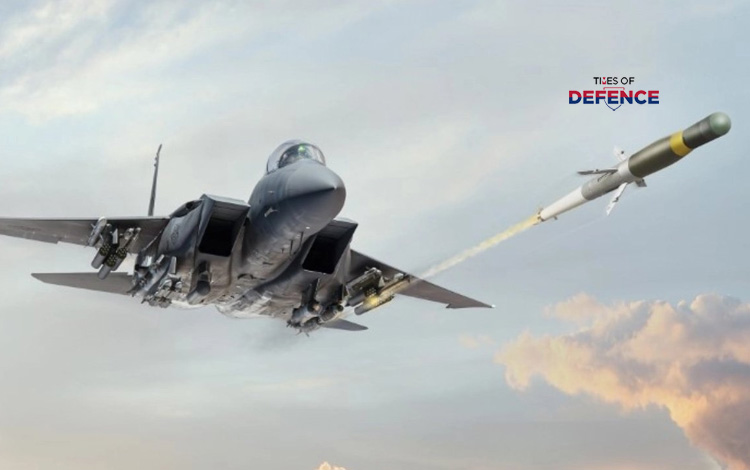
The U.S. Department of State approved a potential Foreign Military Sale (FMS) on November 2, 2026, granting the Government of Jordan up to 1,500 Advanced Precision Kill Weapon System II (APKWS II) guidance kits and associated munitions.
With an estimated total value of $100 million, the package provides WGU-59A/B or B/B Single Variant Block Upgrade guidance sections—available as standalone kits or All-Up-Rounds (AUR). The acquisition enhances the Royal Jordanian Air Force’s (RJAF) capability across air-to-ground, air-to-air, and ground-to-air counter-unmanned aerial system (C-UAS) mission profiles. BAE Systems, Inc. (Nashua, NH) serves as the principal contractor for the program.
TECHNICAL SPECIFICATIONS: BAE SYSTEMS APKWS II GUIDED ROCKET SYSTEM
System Classification, Conversion Mechanics & Integration
⚡ OEM & Lead Contractor: BAE Systems Electronic Systems (Nashua, New Hampshire)
⚡ Guidance Kit Designation: WGU-59A/B & WGU-59B/B Single Variant Block Upgrade
⚡ Conversion Baseline: Mid-body Distributed Aperture Semi-Active Laser Seeker (DASALS) architecture retrofitted onto standard 2.75-inch (70 mm) unguided Hydra 70 rockets
⚡ Procurement Lineage & Items:
• Up to 1,500× WGU-59 APKWS II guidance sections or All-Up-Rounds (AUR)
• LAU-131 / LAU-68 rocket launchers
• Mk-152 high-explosive (HE) warheads & WTU-1/B practice warheads
• MK66 Mod 4 solid-fuel rocket motors & inert practice motors
• Proximity fuzes optimized for counter-drone and air-to-air intercept envelopes
⚡ Unit Physical Profile: Diameter: 70 mm (2.75 in) | Wingspan: 24.3 cm (9.55 in) | Total Mass: ~15 kg (33 lbs) 
Guidance Kinetics & Engagement Envelope
💥 Seeker Technology: 4× mid-body wing-mounted semi-active laser (SAL) sensors; deploys pop-out optical optics instantly upon exiting launch tube
💥 Accuracy & Lethality: Circular Error Probable (CEP) < 0.5 meters; mid-body seeker placement preserves warhead mass and optimizes blast-fragmentation pattern
💥 Operational Engagement Ranges:
• Rotary-Wing Platforms (e.g., AH-1F Cobra / AH-64): 1.1 km to 5.0 km
• Fixed-Wing Tactical Jets (e.g., F-16A/B Block 20 MLU): 2.0 km to 11.0 km
• Ground-to-Air / Mobile C-UAS (e.g., VAMPIRE / EAGLS): Up to 4.0–6.0 km against low-altitude Class 1–3 UAS
💥 Velocity Profile: Maximum velocity of Mach 2.9 (~1,000 m/s) driven by standard MK66 rocket propulsion
TIMES OF DEFENCE ASSESSMENT
The State Department’s approval of the $100 million APKWS II sale to Jordan highlights a major tactical enhancement for Middle Eastern regional air defense and border security operations.
From an aerospace defense and asymmetric warfare perspective, this potential sale offers three key strategic insights:
1. **Low-Cost Counter-UAS and Border Defense**: The inclusion of proximity fuzes and single-variant block upgrades reflects Jordan’s requirement to neutralize low-cost reconnaissance drones, weaponized FPVs, and loitering munitions traversing its borders. Using APKWS II provides a low cost per engagement compared to firing high-end AIM-9X or AMRAAM interceptors from F-16s.
2. **Multi-Domain Platform Interoperability**: The RJAF operates both fixed-wing (F-16A/B Block 20 MLU) and rotary-wing (upgraded AH-1F Cobra SES) assets capable of employing 70 mm rocket pods. The single-variant WGU-59 architecture allows Jordan to pool inventory across jet fighters, attack helicopters, and potential ground-based mobile launchers (such as L3Harris VAMPIRE systems).
3. **Enhancing Sovereign Defense Autonomy**: Providing 1,500 precision-guided rockets strengthens Jordan’s self-defense posture along its Syrian and Iraqi borders. Equipping the JAF with precision stand-off weapons helps secure transit corridors and reduces reliance on direct U.S. military air support for routine border interdictions.

