


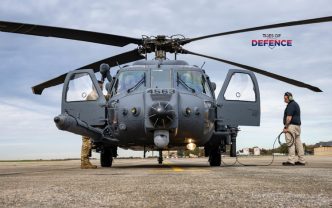
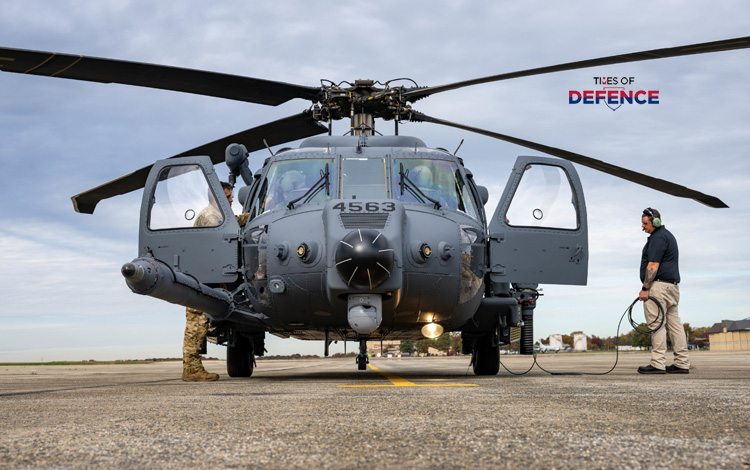
The U.S. Air Force (USAF) reached a major force structure milestone on November 2, 2026, with the arrival of its first Sikorsky HH-60W Jolly Green II combat rescue helicopter at Joint Base Andrews, Maryland.
The aircraft’s delivery marks the beginning of a phased modernization program to replace the legacy Bell UH-1N Huey fleet, which has provided rotary-wing support in the National Capital Region (NCR) since 1971. The newly delivered HH-60W is assigned to the 5th Helicopter Squadron (5 HS)—activated under the 316th Operations Group in late August 2026—which is tasked with cadre training, operational conversion, and fleet stand-up. Concurrently, the legacy 1st Helicopter Squadron (1 HS) will maintain operational readiness with its UH-1N Hueys, ensuring uninterrupted execution of 24/7 Continuity of Government (COVG) and regional defense missions.
TECHNICAL SPECIFICATIONS: SIKORSKY HH-60W JOLLY GREEN II (NCR MISSION PROFILE)
Airframe Architecture, Kinematics & Powerplant Profile
⚡ Aircraft OEM & Systems Integrator: Sikorsky Aircraft (A Lockheed Martin Company / Stratford, Connecticut)
⚡ Platform Baseline: Derived from the UH-60M Black Hawk airframe, optimized for Combat Search and Rescue (CSAR) and specialized transport
⚡ Powerplant & Propulsion: 2× General Electric T700-GE-701D turboshaft engines producing 1,716 shp each, driving a 4-blade titanium-cored main rotor system
⚡ Gross Weight & Fuel Capacity: Maximum Takeoff Weight (MTOW): 22,500 lbs (~10,205 kg) | Internal Fuel Capacity: Expanded crashworthy internal fuel tanks holding up to 644 gallons (2,437 L) to maximize unrefueled endurance
⚡ Operational Flight Envelope: Max Cruise Speed: 155 knots (178 mph / 287 km/h) | Combat Radius: ~195 nm (361 km) unrefueled | Range: >600 nm with internal auxiliary tanks 
NCR-Specific Avionics, Survivability & Missionization
💥 Tactical Communications & C2 Suite: NCR-configured tactical communications architecture featuring secure SATCOM, Link-16 datalink integration, and encrypted multi-band radios for direct connectivity to defense command centers
💥 Defensive Systems & Countermeasures: Integrated Digital Radar Warning Receiver (RWR), Missile Approach Warning System (MAWS), Laser Warning System (LWS), and ALE-47 Countermeasure Dispenser System (CMDS) for chaff/flare ejection
💥 Cockpit & Optical Navigation Architecture: Fully integrated glass cockpit with multi-function display (MFD) units, digital moving map displays, and NVG-compatible electro-optical/infrared (EO/IR) sensor turrets
💥 Cabin Configuration: Specialized cabin layout supporting high-density personnel transport, casualty evacuation (CASEVAC), and senior leadership transport within non-permissive or emergency scenarios
TIMES OF DEFENCE ASSESSMENT
The arrival of the first HH-60W Jolly Green II at Joint Base Andrews highlights a structural shift in the defense posture of the National Capital Region.
From an aerospace procurement and homeland defense perspective, this milestone offers three primary strategic insights:
1. **Closing the Capability Gap of the Legacy UH-1N Fleet**: While the UH-1N Huey has served the National Capital Region for over 50 years, its limited payload, range, speed, and lack of modern defensive systems restricted its operational utility in contested environments. Transitioning to the HH-60W quadruples payload capacity, dramatically increases flight endurance, and provides integrated electronic self-protection.
2. **Dual-Squadron Phased Transition Strategy**: Assigning the incoming HH-60W fleet to the newly activated 5th Helicopter Squadron while keeping the 1st Helicopter Squadron operational on the UH-1N prevents operational gaps during conversion. The 5 HS will build instructor cadre, establish maintenance protocols, and validate local flight profiles before the 1 HS fully converts to the new airframe.
3. **Enhancing Continuity of Government (COVG) Resilience**: In the event of a national crisis, military rotary-wing assets at Joint Base Andrews are responsible for rapid evacuation and secure transport of key government officials. The HH-60W’s expanded internal fuel capacity, all-weather glass cockpit, and secure communications suite ensure reliable execution of no-fail evacuation missions even under degraded operational conditions.

