


Defense technology prime Leonardo DRS, Inc. announced on November 2, 2026, that it has been selected by AeroVironment (AV) as a major integration subcontractor for the U.S. Army’s Enduring-High Energy Laser (E-HEL) production program.
The subcontract builds upon the U.S. Army’s initial production award to AeroVironment in September 2026 for the LOCUST X3 directed-energy weapon system—formally recognized as the Army’s first full-rate production contract for a high-energy laser weapon system. Under the multiyear agreement, Leonardo DRS Land Systems will provide power management, thermal control/environmental conditioning, specialized vehicle integration, and rugged system engineering to enable mobile, ground-based Counter-Unmanned Aircraft System (C-UAS) operations across forward combat units.
TECHNICAL SPECIFICATIONS: AEROVIRONMENT LOCUST X3 / E-HEL SYSTEM ARCHITECTURE
System Classification, Integrators & Industrial Hierarchy
⚡ Lead Program Authority: U.S. Army Short-Range Air Defense (SHORAD) / Directed Energy Project Office
⚡ Prime Contractor & Weapon OEM: AeroVironment, Inc. (AV / Simi Valley, California)
⚡ Subcontractor & Integration Lead: Leonardo DRS Land Systems (Arlington, Virginia)
⚡ Subcontract Scope: Heavy-duty power generation & management, liquid closed-loop thermal cooling, rugged chassis/platform mounting, and environmental protection suites
⚡ Program Designation: Enduring-High Energy Laser (E-HEL) Production Program
⚡ Base Platform Lineage: Rapid prototyping integration demonstrated during 2024–2025 live-fire U.S. government evaluations on armored and light tactical chassis 
LOCUST X3 Laser Weapon & Beam Control Performance
💥 Directed-Energy Effector Class: Scalable 20–35+ kW (nominal 30 kW) Fiber-Optic High-Energy Laser (HEL)
💥 Target Engagement Spectrum: Class 1, Class 2, and Class 3 Unmanned Aerial Systems (commercial quadcopters, weaponized FPVs, loitering munitions, fixed-wing reconnaissance UAVs)
💥 Fire Control & Optics Suite: AV_Halo™ PINPOINT precision fire control software paired with AI-enabled multi-spectral EO/IR tracking sensors and ultra-high-bandwidth beam director
💥 System Architecture & Modular Open Systems Approach (MOSA): MOSA-compliant plug-and-play architecture enabling integration with offboard FAAD C2 (Forward Area Air Defense Command and Control) networks and multi-mode radar/RF cueing sensors
💥 Operational Form Factors:
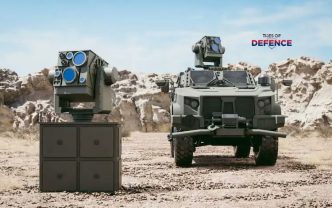
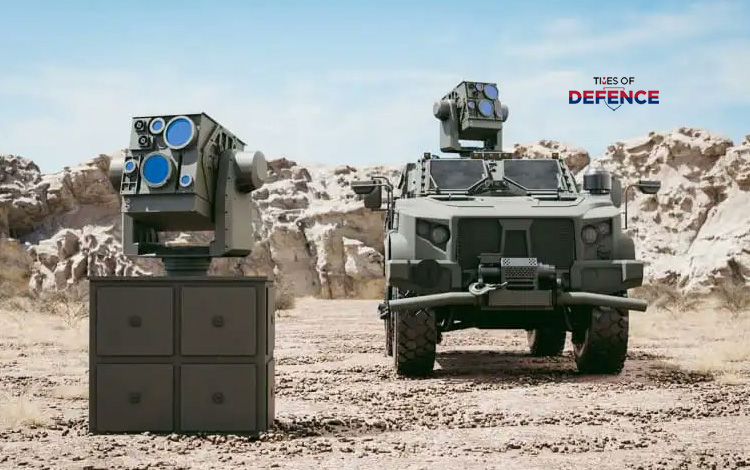
• Mobile Tactical Variant: Direct chassis integration onto standard U.S. Army Joint Light Tactical Vehicles (JLTV)
• Palletized / Containerized Variant: Self-contained palletized modules for static perimeter defense, forward operating bases (FOBs), and shipboard/marinized mounts
TIMES OF DEFENCE ASSESSMENT
The formal partnership between AeroVironment and Leonardo DRS for the E-HEL program highlights a major transition in directed-energy acquisition.
From an aerospace defense engineering and air-defense procurement perspective, this milestone offers three primary strategic insights:
1. **Transitioning Directed Energy from Prototyping to Serial Production**: While high-energy lasers have undergone decades of operational field testing, E-HEL represents the U.S. Army’s first production program of record for a mobile laser weapon system. Establishing a serial production line with AV as prime and Leonardo DRS as integration lead marks the transition of directed energy from experimental technology into standard air-defense unit TO&Es.
2. **Solving the Thermal and Power Management Integration Challenge**: The core operational hurdle of deploying mobile 30 kW class lasers on tactical light vehicles like the JLTV is not generating the beam, but managing extreme electrical draws and heat dissipation. Leonardo DRS’s specialized liquid cooling and power distribution architectures ensure the LOCUST X3 can deliver sustained engagement cycles without overheating the host vehicle or draining baseline power grids.
3. **Optimizing C-UAS Magazine Depth and Cost Per Engagement**: Massed FPV drone attacks across modern battlefields threaten traditional kinetic air defenses with magazine depletion and cost asymmetry. Deploying 30 kW class lasers provides soldiers with a deep, virtually unlimited magazine powered by vehicle fuel, delivering a sub-dollar cost-per-shot capability against Group 1–3 UAS threats to complement kinetic missiles (e.g., Stinger, Harpe) and airburst gun systems.

