


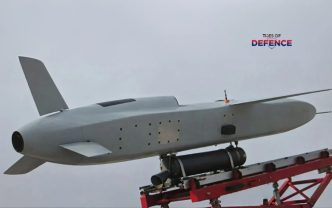
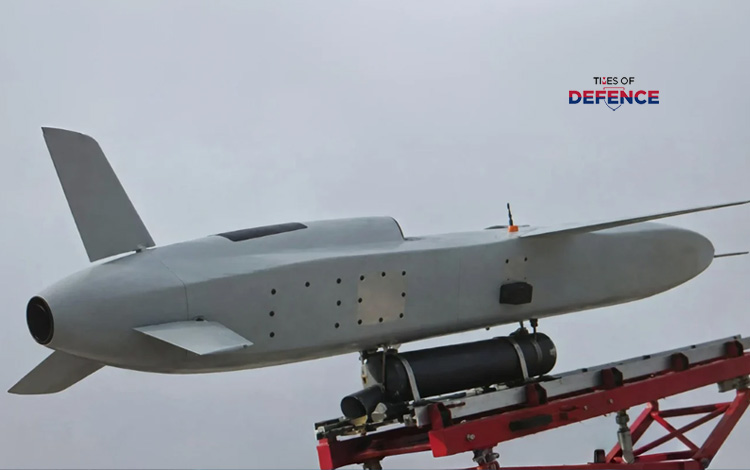
The first operational imagery has emerged showing Russia’s newly fielded Filin (Owl) ground-launched cruise missile mounted on a ground launch rail featuring an integrated solid-propellant boost motor.
Published by Russian military commentators and confirmed by Ukrainian intelligence analysts, the photo provides structural verification of the platform’s launching mechanism. Developed by NPO Molniya (a subsidiary of Tactical Missiles Corporation / KTRV), the Filin represents a new class of low-cost, jet-powered standoff strike weapons designed to bridge the cost and capability gap between long-range propeller-driven kamikaze drones (Geran-2/Shahed-136) and heavy, high-cost air-launched cruise missiles (Kh-101 / 3M14 Kalibr). Ukraine’s Main Directorate of Intelligence (HUR) confirmed the weapon entered operational employment in late summer 2026.
TECHNICAL SPECIFICATIONS: RUSSIAN NPO MOLNIYA “FILIN” CRUISE MISSILE ARCHITECTURE
Developer, Industrial Base & Airframe Construction
⚡ Prime OEM & Developer: NPO Molniya JSC (Moscow, Russia / Tactical Missiles Corporation JSC)
⚡ System Classification: Low-Cost Ground-Launched Tactical Cruise Missile (GLCM)
⚡ Fuselage Geometry & Structural Materials: Carbon-fiber/fiberglass composite fuselage measuring 3.5 meters in length with a 3.0-meter wingspan; structural spars utilize additive manufacturing (3D printing)
⚡ Launch Weight & Envelope: Maximum Takeoff Weight (MTOW): ~210 kg (excluding solid rocket booster assembly)
⚡ Launch Sequence: Under-fuselage solid-propellant rocket booster accelerates the missile from ground rail launchers up to turbojet ignition speed before staging off 
Propulsion, Flight Kinematics & Warhead Options
💥 Engine Architecture: 1× Reynolds LLC R500 miniature turbojet engine (commonality with the S-71K Kover and S-71M Monokhrom air-launched standoff missiles)
💥 Maximum Velocity: Up to 800 km/h (Mach 0.65 / 500 mph)
💥 Operational Altitude Range: Sea-skimming / low-altitude terrain-following up to an operational ceiling of 6,000 meters (20,000 ft)
💥 Reported Standoff Range: 600 km (heavier warhead baseline) to 1,200 km (lightweight warhead baseline)
💥 Warhead Payload Modules: 50 kg or 100 kg modular warheads (High-Explosive Fragmentation, Penetration, or Thermobaric variants)
Guidance, Navigation & Foreign Electronics Component Breakdown
🚀 Guidance Suite Core: Inertial Navigation System (INS) paired with a 16-channel Kometa-16 Controlled Radiation Pattern Antenna (CRPA) satellite navigation receiver for electronic warfare (jamming/spoofing) resistance
🚀 Flight Control Electronics: Onboard avionics and servo actuators manufactured by PLAZ LLC (St. Petersburg, sharing manufacturing commonality with the Harpiya / Geran-2 production infrastructure)
🚀 Component Supply Chain Integration: HUR technical teardowns report 35 U.S.-sourced microelectronic components (e.g., Texas Instruments, Microchip Technology) alongside 22 Chinese-sourced digital modules (e.g., WCH microcontrollers, Mornsun power transceivers)
TIMES OF DEFENCE ASSESSMENT
The unveiling of the Filin ground-launched cruise missile highlights Russia’s ongoing industrial push toward high-volume, lower-cost precision strike platforms designed to overwhelm integrated air defense systems (IADS).
From a guided weapons engineering and threat assessment perspective, the Filin architecture presents three strategic vectors:
1. **Saturation Tactics and Air Defense Attrition**: Heavy strategic cruise missiles (like the Kh-101 or Kalibr) carry 450 kg warheads and cost upwards of $1.2M–$1.5M per unit. With an estimated unit cost of $150,000–$200,000, the Filin allows Russian forces to launch continuous salvos against regional infrastructure (e.g., electrical substations, fuel depots) while forcing defenders to expend high-cost air defense interceptors (PAC-2/3, IRIS-T, NASAMS) against smaller targets.
2. **Mobility and Decoupling from Strategic Aviation**: Operating from ground-based rail launchers via a solid-fuel booster eliminates reliance on Tu-95MS or Tu-160 strategic bombers. Ground units can launch long-range jet-powered salvos from concealed positions near the front lines, reducing launch-notification timelines typically provided by space-based tracking of bomber takeoffs.
3. **Propulsion & Avionics Industrial Standardization**: Re-using the Reynolds R500 turbojet (found in the S-71 series) and PLAZ LLC flight controllers (derived from the Harpiya drone chain) demonstrates rapid sub-system standardization. Combined with 3D-printed composite components, Russia can maintain multi-platform production lines despite Western microelectronics sanctions.

