



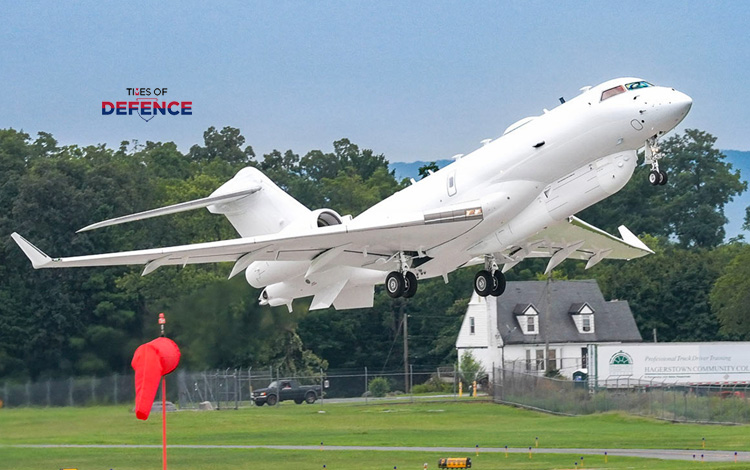
The U.S. Army, alongside lead systems integrator Sierra Nevada Corporation (SNC), announced that HADES (High Accuracy Detection and Exploitation System) Prototype 1 executed its inaugural test flight on September 11, 2026.
The achievement, publicly confirmed by the Army’s Fixed Wing Project Office on October 30, 2026, marks the transition of the service’s flagship deep-sensing aerial Intelligence, Surveillance, and Reconnaissance (ISR) asset into developmental flight testing. Based on the Bombardier Global 6500 business jet (designated ME-11B by the U.S. Army), HADES is engineered to deliver high-altitude, long-endurance signals intelligence (SIGINT) and standoff surface surveillance across contested multi-domain battlefields, replacing legacy turboprop platforms such as the RC-12 Guardrail and EO-5C.
TECHNICAL SPECIFICATIONS: U.S. ARMY HADES (ME-11B / BOMBARDIER GLOBAL 6500) ARCHITECTURE
Program Governance, OEM Prime & Lead Systems Integration
⚡ Procurement Authority: U.S. Army PEO Aviation (Fixed Wing Project Office / Project Director Sensors–Aerial Intelligence)
⚡ Platform OEM: Bombardier Defense (Wichita, Kansas / Montreal, Canada)
⚡ Lead Systems Integrator (LSI): Sierra Nevada Corporation (SNC — Hagerstown, Maryland facility)
⚡ Aircraft Baseline & Service Designation: Modified Bombardier Global 6500 (U.S. Army Designation: ME-11B)
⚡ Fleet Development Status: Prototype 1 in developmental flight test; Prototype 2 integrating advanced radar; Prototype 3 built to “combat credible” operational standard. SNC has acquired a 4th Global 6500 as the fleet’s initial non-prototype airframe 
Airframe Kinematics, Payload Capacity & Flight Envelope
💥 Propulsion Plant: 2× Rolls-Royce Pearl 15 turbofans, producing 15,125 lbf takeoff thrust each
💥 Operating Envelope: Operating Ceiling: Up to 51,000 ft (15,500 m) | Maximum Cruise Speed: Mach 0.90 (516 knots / 956 km/h) | Operational Range: 6,600 nautical miles (12,200 km)
💥 Unrefueled Endurance: 12+ hours continuous on-station endurance at high operating altitudes
💥 Payload Accommodation Margin: Structural payload capacity exceeding 14,000 lbs (6,350 kg) total, designed to host a 6,500 lb Mission Equipment Package (MEP) within open architectural bays
💥 Modular Architecture: Engineered with Modular Open Systems Approach (MOSA) compliance, enabling software-defined payload swaps and rapid sensor upgrades
Sensor Suite, Signals Intelligence & Deep Sensing Capabilities
🚀 Electronic & Signals Intelligence (SIGINT): High-power Communications Intelligence (COMINT) and Electronic Intelligence (ELINT) intercept suites (derived from SNC’s RAPCON-X architecture) for deep threat-frequency detection
🚀 Radar & Surface Moving Target Indicator: Integrated Raytheon ASARS-2B (Advanced Synthetic Aperture Radar System-2B), featuring Synthetic Aperture Radar (SAR) and Ground Moving Target Indicator (GMTI) modes for long-range tracking
🚀 Sensor Fusion & Datalinks: High-bandwidth Beyond-Line-of-Sight (BLOS) SATCOM data links transmitting real-time tracking data directly to Army C4ISR centers and Joint All-Domain Command and Control (JADC2) networks
🚀 Forward Air Manned-Unmanned Teaming: System architecture wired to command and launch small, air-launched uncrewed aerial systems (Launched Effects) directly from the platform to extend sensor reach into contested threat rings
TIMES OF DEFENCE ASSESSMENT
The first flight of HADES Prototype 1 represents a major modernization step for U.S. Army aerial intelligence. Retiring legacy turboprop aircraft (such as the RC-12 Guardrail series) in favor of high-altitude business jets aligns Army intelligence assets with long-range targeting requirements in large-scale multi-domain operations.
From an aerospace engineering and intelligence perspective, the HADES architecture delivers three operational advantages:
1. **Operating Envelope Extensions**: Flying at altitudes above 45,000 ft and cruising at Mach 0.85+ allows the HADES platform to look deeper into adversary territory while operating outside the engagement envelope of tactical ground-based air defenses. The higher operating ceiling significantly extends the line-of-sight horizon for onboard SIGINT receivers and SAR/GMTI radars.
2. **Standardization via Modular Open Systems Architecture (MOSA)**: Integrating MOSA standards ensures that HADES is not locked into rigid hardware configurations. Utilizing open payload bays and digital backbones allows the Army to integrate mature sensors—such as the U-2’s ASARS-2B radar—or update SIGINT algorithms to counter new electronic warfare threats without lengthy recertification cycles.
3. **Synergy with Long-Range Precision Fires (LRPF)**: For commanders deploying Long-Range Hypersonic Weapons (LRHW) or Precision Strike Missiles (PrSM), real-time target identification at extended ranges is essential. HADES functions as an airborne sensor node that feeds targeting data directly into ground artillery units, closing the sensor-to-shooter loop over long distances.

