


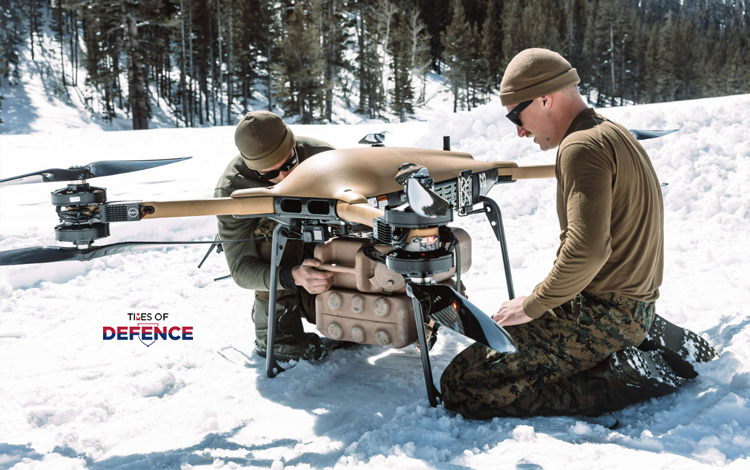
The U.S. Navy’s newly established Direct Reporting Portfolio Manager for Robotic and Autonomous Systems (DRPM RAS) has issued an official solicitation for the Tactical Resupply Unmanned Aircraft System (TRUAS) Increment II program.
Sponsored under the Air Warfare Program Management Office at NAS Patuxent River, the Navy is hosting an Industry Demonstration in Huntsville, Alabama, scheduled from January 25 to February 5, 2027. Applications close on November 30, 2026, with selected participants competing for potential Other Transaction Authority (OTA) prototype agreements under 10 U.S.C. § 4022. TRUAS Increment II seeks a second-generation autonomous aerial resupply platform engineered to execute long-range, tactical “last-mile” logistics for distributed U.S. Marine Corps formations in contested Expeditionary Advanced Base Operations (EABO) environments.
TECHNICAL SPECIFICATIONS: TRUAS INCREMENT II VS. TRV-150C BASELINE
Program Management, Governance & Competition Milestones
⚡ Contracting Authority: Direct Reporting Portfolio Manager for Robotic and Autonomous Systems (DRPM RAS 4.0 Air Warfare PMO)
⚡ Industry Demonstration Venue: Huntsville, Alabama (Jan 25 – Feb 5, 2027)
⚡ Key Program Deadlines: Applications Due: Nov 30, 2026 | Down-select Selections: Dec 18, 2026 | Demonstration Fly-Off: Jan 25 – Feb 5, 2027
⚡ Statutory Procurement Vehicle: 10 U.S.C. § 4022 Prototype Other Transaction Agreement (OTA) with seamless transition path to follow-on production contracts
⚡ Domestic Compliance Regulations: Mandates strict adherence to 10 U.S.C. § 4881 and the American Security Drone Act (ASDA) restricting non-allied component/supply chain usage 
Performance Thresholds & Demonstration Flight Matrix
💥 Primary Operational Threshold (Flight 1): Transport 100 lb (45 kg) payload to a radius of 40 nautical miles (74 km), release cargo autonomously, and return 40 nm empty without refueling (80 nm / 148 km total round-trip unrefueled endurance)
💥 Secondary Operational Threshold (Flight 2): Transport 150 lb (68 kg) payload over a 10 nm (18.5 km) radius and return empty without refueling
💥 Kinematic Constraints: Cruise Speed: ≥50 knots (93 km/h) | Operational Ceiling: <1,000 ft AGL | Max Gross Takeoff Weight (MGTOW) Target: ≤350 lbs (159 kg)
💥 Launch & Recovery Envelope: Vertical Takeoff and Landing (VTOL) or unassisted launch/recovery (Zero catapults, nets, or arresting cables allowed)
💥 Transponder Compliance: Integrated Mode 3/C or Mode 5 IFF capability
Propulsion, Software Autonomy & Form-Factor Requirements
🚀 Fuel & Power Plant Requirements: Heavy-Fuel Engine (HFE) compatible with JP-5, JP-8, or Diesel fuels, or a hybrid-electric (fuel-battery) architecture to align with frontline Marine logistics supply chains
🚀 Command, Control & Multi-UAV Swarming: Single-operator controlling up to four (4) aircraft simultaneously; integrated Natural Language Processing (NLP) accepting voice commands for flight adjustments
🚀 Navigation & Cyber Hardening: GPS-Denied / Assured PNT navigation suite; FIPS 140-3 Level 2 encrypted communications; IP-56 rated environmental sealing
🚀 Transportability & Pack-Out Dimensions: Entire system (airframe, ground control station, accessories) must pack down into a single ruggedized case measuring ≤4 × 3 × 2 ft and weighing ≤150 lbs
🚀 Setup Time & Reliability Metrics: Rapid field setup <20 minutes from storage case to launch | Mean Time Between Failures (MTBF): 30 flight hours (threshold) to 90 flight hours (objective)
TIMES OF DEFENCE ASSESSMENT
The transition from the battery-electric TRV-150C (Increment I) to the heavy-fuel/hybrid-powered Increment II reflects real-world operational lessons learned from Marines conducting distributed logistics in island-hopping scenarios.
From an engineering and tactical doctrine standpoint, Increment II resolves key operational bottlenecks:
1. **Shifting from Battery-Electric to Heavy Fuel**: While the TRV-150C provided initial tactical resupply capabilities, battery charging in forward-deployed austere locations relies on heavy generators or fixed power infrastructure. Requiring heavy-fuel (JP-8/diesel) engines allows cargo drones to burn the exact same fuel used by Marine Joint Light Tactical Vehicles (JLTVs) and tactical generators, eliminating battery-charging delays and extending operational range nearly ninefold (from ~9 miles out to 40 nautical miles).
2. **Empowering Distributed Operations (EABO)**: Small Marine Corps units deployed across isolated islands or riverine environments require persistent resupply without risking crewed rotary-wing platforms (e.g., MV-22B, CH-53K). Carrying 100 to 150 lbs of critical supplies—such as medical kits, 81mm mortar rounds, small arms ammunition, or battery packs—over an 80-nautical-mile round trip provides small-unit commanders with an organic, low-signature logistics line.
3. **Advanced Software Automation & Multi-Drone Control**: Requiring a single operator to manage four drones via voice-directed commands shifts the cognitive load away from manual piloting toward mission oversight. Fusing GPS-denied navigation, natural language interaction, and automated airspace authorization via the Multifunction Air Operations Center aligns uncrewed aerial logistics with modern, high-density battlespace requirements.

