


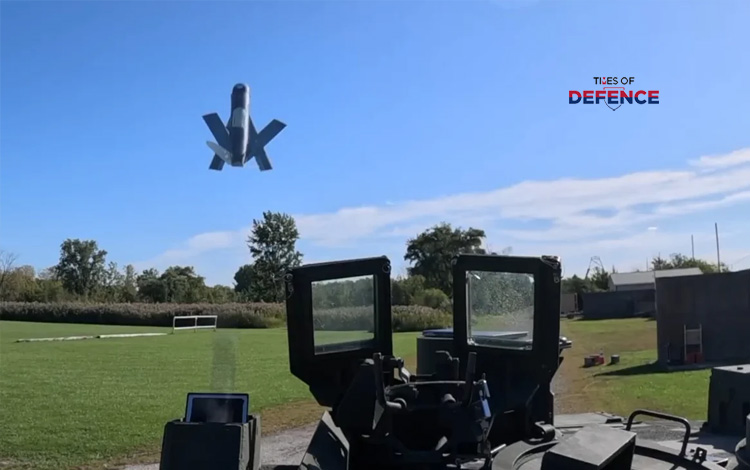
Defense land systems prime General Dynamics Land Systems (GDLS), in partnership with AeroVironment, has officially unveiled the PERCH 2.0 (Precision Effects & Reconnaissance, Canister-Housed) system ahead of the AUSA 2026 exhibition.
Designed as an upgraded, modular bolt-on integration suite, PERCH 2.0 allows armored vehicle crews operating M1A2 Abrams SEPv3 main battle tanks and Stryker 8×8 armored fighting vehicles to launch AeroVironment Switchblade 300 and Switchblade 600 loitering munitions directly from within the hull with hatches securely closed (“under-armor” operation). Building upon data collected during 2025 firing trials at Fort Hood, Texas, the 2.0 configuration incorporates a redesigned canister-based reloading mechanism, gimbaled electro-optical/infrared (EO/IR) reconnaissance sensors, and full integration into existing vehicle C4I architectures. By enabling organic Beyond Line of Sight (BLOS) reconnaissance, target identification, and non-line-of-sight precision strike capabilities, the system extends a heavy armored force’s engagement envelope far beyond the direct-fire range of conventional 120mm main guns or medium-caliber cannon suites.
TECHNICAL SPECIFICATIONS: GDLS PERCH 2.0 SYSTEM & SWITCHBLADE INTEGRATION
Developer, Integrator & System Classification
⚡ Prime Contractor & Vehicle Integrator: General Dynamics Land Systems (GDLS — Sterling Heights, MI)
⚡ Loitering Munition OEM: AeroVironment, Inc. (Arlington, VA)
⚡ System Classification: Modular Under-Armor Canister Launcher for Loitering Munitions / Unmanned Aerial Systems (UAS)
⚡ Host Platform Compatibility: M1A2 Abrams SEPv3 Main Battle Tank (MBT) and Stryker 8×8 Armored Fighting Vehicle (AFV) 
Launcher Engineering & Hull Integration Parameters
💥 Integration Architecture: Modular bolt-on kit utilizing existing external turret/hull mounting hardware; requires zero structural hull cutting or welding
💥 Operational Profile: Full “Hatches-Closed” deployment — launch sequence, flight vectoring, and target engagement controlled entirely via crew workstations inside the armored hull
💥 System Reload Architecture: Redesigned canister-based launcher structure optimized for rapid, ergonomics-friendly field reloading
💥 Sensor Suite: Vehicle-mounted and drone-integrated gimbaled Electro-Optical/Infrared (EO/IR) sensor feeds providing real-time high-definition video telemetry to tank command displays
Integrated Loitering Munitions Specifications
🚀 AeroVironment Switchblade 300 / Block 20:
• Endurance & Range: 20+ minutes flight time | Operational range: 15–30 km
• Lethality & Target Vector: Lightweight anti-personnel / anti-light vehicle warhead featuring user-selectable point of detonation and patented wave-off/recommit capability
🚀 AeroVironment Switchblade 600:
• Endurance & Range: 40+ minutes flight time | Operational range: >40 km | Speed: 115 knots dash
• Lethality & Target Vector: Heavy anti-armor warhead designed to penetrate main battle tanks and hardened defensive structures at steep attack angles
Dynamic Operational Capabilities & Survivability
🚀 Reconnaissance & Targeting: Provides organic RSTA (Reconnaissance, Surveillance, and Target Acquisition) over ridgelines, urban structures, and dense foliage without exposing crew members
🚀 C4I Software Integration: Operates via standard vehicle computer architectures (including GDLS NEXUS and vehicle battle management systems)
🚀 Programmatic Status: Industry-developed technology demonstration with prototypes currently ordered by the U.S. Army under the Abrams System Technical Support (STS) contract for comprehensive evaluation trials
TIMES OF DEFENCE ASSESSMENT
The introduction of PERCH 2.0 by General Dynamics Land Systems and AeroVironment reflects a significant tactical evolution in heavy armored warfare doctrine. High-intensity operational environments have demonstrated the extreme vulnerability of armored vehicles to uncrewed aerial threats, as well as the limitations of relying purely on direct-fire optics and main guns against dispersed anti-tank guided missile (ATGM) teams hidden beyond line of sight.
From an engineering and survivability perspective, PERCH 2.0 solves two core tactical problems for tank and mechanized infantry commanders. First, by allowing crews to launch reconnaissance and loitering strike munitions with hatches completely closed, it preserves crew survivability against artillery airbursts, FPV drones, and sniper fire. Second, integrating Switchblade 300 and 600 munitions directly onto Abrams and Stryker platforms transforms individual combat vehicles into autonomous long-range strike nodes. Crew members can now scout advance movement routes, detect camouflaged ambushes over hill crests, and destroy high-value armor targets up to 40 km away before ever entering the threat ring of opposing direct-fire weapon systems.

