


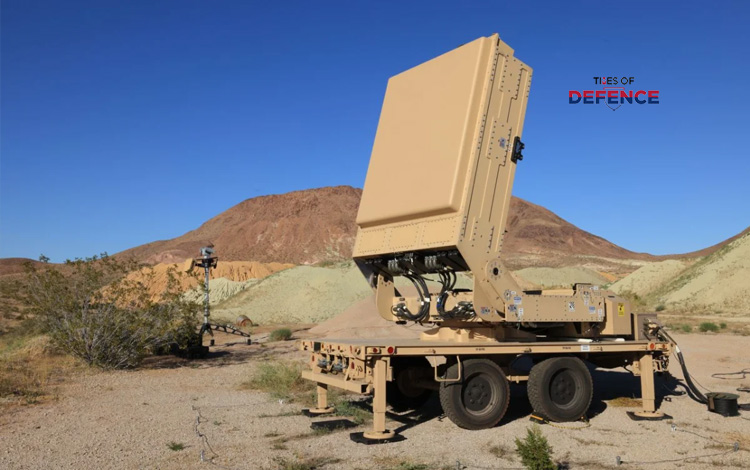
Epirus Inc.’s Leonidas High-Power Microwave (HPM) counter-unmanned aircraft system (C-UAS) has officially been added to the Joint Interagency Task Force 401 (JIATF 401) Counter-UAS Marketplace.
Managed by the U.S. Army-led task force coordinating counter-drone initiatives across the U.S. Department of Defense and federal law enforcement agencies, the digital portal enables streamlined procurement of tested and validated C-UAS effectors. By passing rigorous performance and safety assessments, Leonidas is accessible to U.S. armed services, the Department of Homeland Security (DHS), the FBI, and other federal agencies via pre-negotiated indefinite-delivery/indefinite-quantity (IDIQ) contracts. Powered by a solid-state Gallium Nitride (GaN) array, the software-defined directed energy system delivers precise area-denial capabilities against radio-controlled, autonomous, and hardwired fiber-optic-guided drone swarms.
TECHNICAL SPECIFICATIONS: EPIRUS LEONIDAS HIGH-POWER MICROWAVE (HPM) SUITE
Developer & Manufacturer
⚡ Epirus, Inc. (Torrance, California, USA) 
Procurement & Validation Framework
⚡ JIATF 401 Counter-UAS Marketplace Approval (Streamlined Federal & DoD Procurement Portal)
⚡ Defense Programs: U.S. Army Indirect Fire Protection Capability–High-Power Microwave (IFPC-HPM); U.S. Marine Corps Leonidas Expeditionary (JLTV-mounted)
Emitter & Solid-State Architecture
💥 Power Amplifier Core: Solid-state Line-Replaceable Amplifier Modules (LRAM) utilizing high-power Gallium Nitride (GaN) semiconductors
💥 Emitter Type: Software-defined, long-pulse High-Power Microwave (HPM) phased array
💥 System Advantages: Rapid duty cycles, zero ammunition replenishment costs, and near-instantaneous beam-steering across broad elevation/azimuth sectors
Operational Range & Target Defeat Capabilities
🚀 Defeat Mechanics: High-power electronic overload frying internal microelectronics, flight controllers, and sensor payloads
🚀 Multi-Target Capacity: Area-effect pulse beam capable of simultaneously neutralizing multiple quadcopters, loitering munitions, or mass drone swarms
🚀 Threat Spectrum: Radio-Controlled (RF) UAS, autonomous/GPS-denied drones, and fiber-optic tethered/guided UAVs (neutralizes electronics directly without relying on RF jamming)
🚀 Collateral Management: Precision beam-shaping software prevents fratricide against friendly electronic systems and communications
Platform Variants & Deployment Formats
🚀 Leonidas Base / Semi-Fixed: Containerized/trailer-mounted array for point defense of critical infrastructure, airfields, and FOBs
🚀 Leonidas Mobile: Integrated onto 8×8 Stryker AFVs, 10-ton tracked UGVs (in partnership with GDLS), or 4×4 JLTV platforms for maneuvering force protection
🚀 Leonidas Pod: Compact airborne pod option for EW/C-UAS air-to-air or air-to-ground missions
TIMES OF DEFENCE ASSESSMENT
The inclusion of the Epirus Leonidas HPM system in the JIATF 401 Marketplace highlights a strategic pivot in Western counter-drone doctrine, shifting from expensive one-to-one kinetic interceptors toward scalable directed-energy architectures. Deploying multi-million-dollar missiles or even low-cost kinetic drones against mass quadcopter swarms creates an unsustainable cost-exchange ratio and leaves defense networks vulnerable to magazine exhaustion.
From a technical perspective, Leonidas’ solid-state GaN array solves two major modern battlefield threats. First, its software-defined HPM beam delivers an unlimited magazine capacity with near-zero cost-per-shot, neutralizing mass drone swarms in a single broad pulse. Second, its ability to fry internal printed circuit boards (PCBs) renders it effective against fiber-optic-guided drones. As fiber-optic tethered loitering munitions become increasingly prevalent in contested European theatres to bypass traditional radio-frequency (RF) jamming, non-kinetic microwave weapons capable of directly burning onboard electronic components offer a vital layered defense mechanism for tactical forces.

