


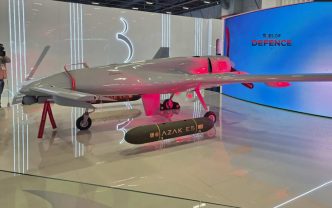
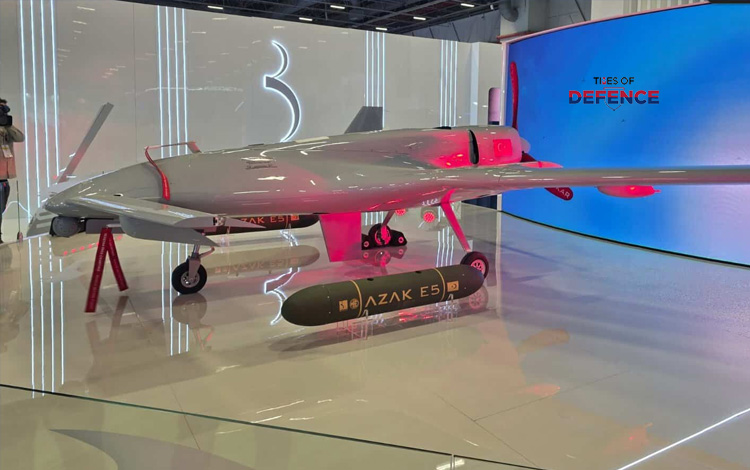
Machinery and Chemical Industry Corporation (MKE) has reportedly initiated initial production deliveries of its newly developed AZAK E5 heavy warhead, purpose-engineered for integration with next-generation long-range loitering munitions and one-way attack unmanned aerial vehicles (UAVs).
While MKE has not publicly published full classified explosive composition details, the AZAK E5 is designed in a standardized cylindrical configuration with an estimated mass of approximately 200 kg (~440 lbs) to maximize payload alignment with the Baykar K2 Kamikaze UAV. Unveiled as the largest platform in its class, the Baykar K2 possesses a maximum takeoff weight (MTOW) of 800 kg, an operational range exceeding 2,000 km, and a payload envelope tailored for deep strategic standoff strikes. The pairing of MKE’s heavy kinetic/blast warhead with the K2’s long-endurance autonomous airframe establishes a low-cost, mass-producible alternative to conventional cruise missiles for theater-level deep-strike missions against fortified command centers, hardened infrastructure, and high-value surface targets.
TECHNICAL SPECIFICATIONS: MKE AZAK E5 WARHEAD & BAYKAR K2 KAMIKAZE UAV INTEGRATION
Warhead Developer & Manufacturer
⚡ Mechanical and Chemical Industry Corporation (MKE – Makine ve Kimya Endüstrisi A.Ş.) 
Primary Delivery Platform
⚡ Baykar K2 Kamikaze / One-Way Attack (OWA) Unmanned Aerial Vehicle
Warhead Architecture & Structural Parameters
💥 Model Designation: AZAK E5 Heavy Blast-Fragmentation / Penetration Warhead
💥 Configuration Geometry: Standardized modular cylindrical envelope (designed for multi-platform integration)
💥 Estimated Mass: ~200 kg (~440 lbs)
💥 Destructive Class: High-explosive blast/fragmentation or penetrator payload capable of neutralizing reinforced hardened structures
Integrated Platform Performance (Baykar K2 Baseline)
🚀 Maximum Takeoff Weight (MTOW): 800 kg | Payload Capacity: 200 kg
🚀 Airframe Geometry: Length 5.1 m | Wingspan 10.0 m | Height 2.1 m
🚀 Operational Slant Range: 2,000+ km (Beyond Line-of-Sight / BLOS satellite connection)
🚀 Flight Endurance: 13+ hours | Cruise Speed: 70 KTAS | Max Speed: 110 KTAS (~200 km/h)
🚀 Propulsion Unit: 100 hp internal combustion piston engine (unprepared strip / short runway take-off compliant)
🚀 Guidance & Targeting Suite: GNSS-independent AI visual matching/image correlation, EO/IR gimbal payload, coordinate-based dive attack, and autonomous swarm algorithms
TIMES OF DEFENCE ASSESSMENT
The commencement of MKE’s AZAK E5 warhead deliveries for the Baykar K2 represents a fundamental milestone in Türkiye’s long-range standoff strike strategy. Traditionally, delivering a 200 kg warhead across a 2,000 km radius required multi-million-dollar air- or ground-launched cruise missiles like the SOM or Tayfun. By mating MKE’s high-yield AZAK E5 warhead with Baykar’s $100K-class piston-powered K2 drone, the Turkish Armed Forces secure a deep strategic strike platform capable of inflicting heavy damage at a fraction of traditional missile procurement costs.
Furthermore, the AZAK E5’s 200 kg explosive mass provides four times the destructive power of standard long-range loitering munitions (such as the Iranian Shahed-136’s 50 kg warhead), elevating the platform from a tactical harassment weapon to a true strategic capability against hardened bunkers, airbase aprons, and naval infrastructure. The modular cylindrical design of the AZAK E5 also creates immediate opportunities for cross-platform integration into heavy surface-to-surface rockets or alternative loitering platforms. Moving forward, validating the warhead’s terminal fuze reliability, insensitive munition (IM) safety standards, and performance against heavily reinforced targets during live-fire testing will be crucial to finalizing operational deployment.

