


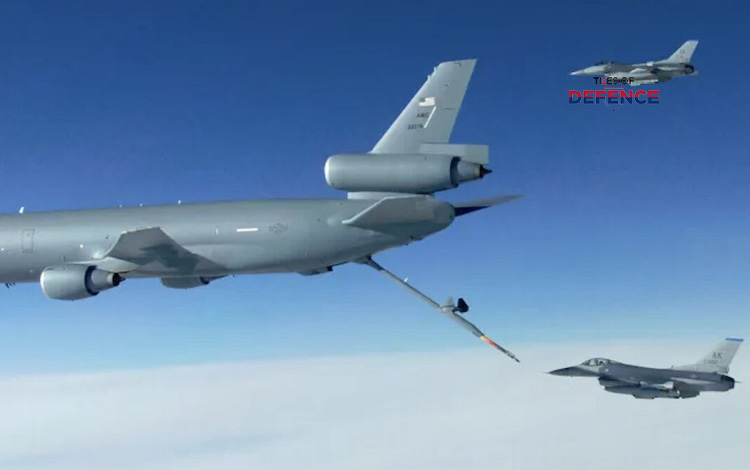
WRIGHT-PATTERSON AFB, Ohio — The U.S. Air Force Life Cycle Management Center (AFLCMC) issued a Sources Sought contracting notice (FA8625-27-R-B001) on October 7, 2026, seeking information from defense contractors capable of regenerating up to four retired Boeing KC-10A Extender aerial refueling aircraft for transfer to an undisclosed partner nation in North Africa.
The prospective Foreign Military Sales (FMS) / Excess Defense Articles (EDA) program encompasses depot-level inspection, mechanical/avionics restoration from 309th Aerospace Maintenance and Regeneration Group (AMARG) storage at Davis-Monthan AFB, one-time flight clearances, ferry delivery, and in-country Contractor Logistics Support (CLS). The final operational USAF KC-10A was formally retired in September 2024. Regenerating the tri-jet platform provides the recipient air force (with industry analysis focusing on Morocco or Egypt) with simultaneous Advanced Air Refueling Boom System (AARBS) flying boom and probe-and-drogue hose-and-drogue capability—a critical operational enabler for extending the combat radius of F-16 C/D Block 52+, F-16V Block 72, or Dassault Rafale strike fighters in high-threat regional maritime and desert theaters.
TECHNICAL SPECIFICATIONS: BOEING KC-10A EXTENDER AERIAL REFUELING TANKER 
* Primary Manufacturer & Derivation: Boeing / McDonnell Douglas (Derived from DC-10-30CF commercial airframe)
* Platform Type: Strategic Advanced Aerial Refueling Tanker / Heavy Logistics Cargo Transport
* Fleet Status & Regeneration Scope: Up to 4 x KC-10A airframes selected from 309th AMARG storage for depot-level restoration
* Physical Dimensions & Structural Limits:
* Length: 55.35 m (181 ft 7 in) | Wingspan: 50.41 m (165 ft 4 in) | Height: 17.70 m (58 ft 1 in)
* Maximum Takeoff Weight (MTOW): 267,620 kg (590,000 lbs)
* Internal Fuel Mass Capacity: ~161,480 kg (356,000 lbs / 52,250 gallons) in integrated wing and lower fuselage tanks
* Propulsion & Flight Performance:
* Powerplant: 3 x General Electric CF6-50C2 (F103) high-bypass turbofan engines (52,500 lbf / 233.5 kN thrust per engine)
* Cruising Speed: Mach 0.82 (870 km/h / 540 mph) | Maximum Speed: Mach 0.89
* Operational Range: ~7,080 km (4,400 miles) with max cargo | Ferry Range: ~18,500 km (11,500 miles)
* Service Ceiling: 12,800 m (42,000 ft)
* Refueling Hardware & Delivery Systems:
* Flying Boom Architecture: Advanced Air Refueling Boom System (AARBS) with fly-by-wire controls (Fuel transfer rate up to 1,100 gpm / 4,160 L/min)
* Hose-and-Drogue Architecture: Centerline Hose Drum Unit (HDU) + Wing Air Refueling Pods (WARPs) (Fuel transfer rate up to 470 gpm / 1,780 L/min per pod)
* Dual-System Advantage: Refuels receptacle-equipped aircraft (e.g., F-16) and probe-equipped aircraft (e.g., Rafale, Mirage F1, C-130) on the same sortie
* Logistics & Dual-Role Transport Capacity:
* Cargo Payload: Up to 77,110 kg (170,000 lbs) or 27 463L military master cargo pallets
* Passenger Capacity: Up to 75 passengers alongside primary cargo loadout
TIMES OF DEFENCE ASSESSMENT:
The U.S. Air Force Life Cycle Management Center’s (AFLCMC) initiative to regenerate four retired KC-10A Extenders for an unstated North African partner highlights the strategic imperative of establishing heavy aerial refueling infrastructure along NATO’s southern flank. Following the complete retirement of the USAF KC-10 fleet in September 2024, transferring these airframes via the Excess Defense Articles (EDA) or Foreign Military Sales (FMS) framework offers a cost-effective route to providing an ally with immediate, heavy-capacity refueling.
From an operational standpoint, the KC-10’s dual-refueling architecture—combining a high-flow fly-by-wire rigid flying boom with hose-and-drogue stations—resolves a major regional capability gap. In the case of the Royal Moroccan Air Force (RMAF), which operates probe-and-drogue KC-130H assets, acquiring boom-equipped KC-10s is essential to fully exploit the extended range of its upgrading F-16 C/D Block 52+ and new F-16V Block 72 fleets without landing to refuel. For the Egyptian Air Force (EAF), the KC-10 would unify aerial refueling support across its diverse, multi-origin fleet—servicing both boom-receptacle F-16s and probe-equipped Rafales.
However, regenerating airframes that have sat in outdoor desert storage at Davis-Monthan AFB poses significant technical and supply-chain challenges. Contractor teams must execute comprehensive depot-level structural inspections, overhaul aging GE CF6-50C2 engines, address wiring/hydraulic degradation, and establish sustainable spare-parts pipelines for an out-of-service military type. The long-term viability of the restored four-ship fleet will ultimately depend on establishing a robust Contractor Logistics Support (CLS) package to maintain flight-readiness in North Africa.

