


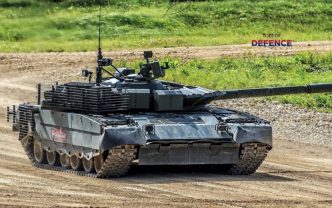
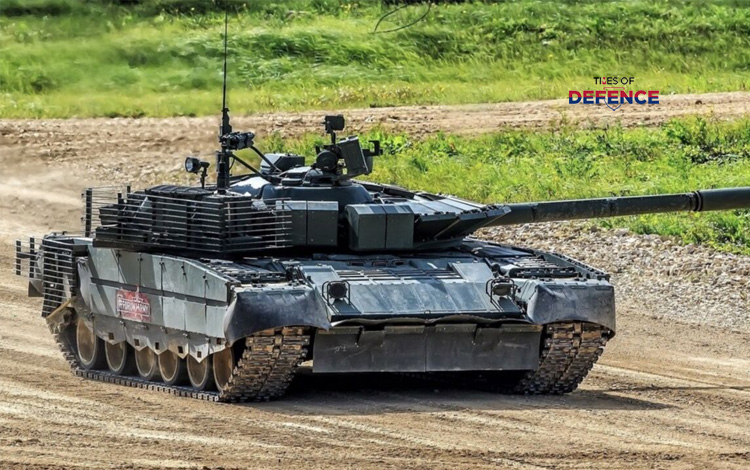
MOSCOW, Russia — State defence conglomerate Rostec outlined updated operational roles and tactical performance profiles for the Russian Ground Forces’ modernized T-80BVM main battle tank (MBT), emphasizing its high-power gas-turbine mobility alongside an indirect-fire “sniper” capability out to 10 kilometers.
Originating as a comprehensive modernization program for legacy Soviet-era T-80BV hulls undertaken by Omsktransmash and Uralvagonzavod, the T-80BVM integrates an upgraded fire control architecture (including Sosna-U or multi-channel 1PN96MT-02 thermal imaging suites) and Relikt Explosive Reactive Armor (ERA) modules. While traditionally deployed as a high-speed, breakthrough armored platform, modern high-intensity warfare in Ukraine has shifted T-80BVM employment toward indirect standoff fire support. Utilizing 125 mm high-explosive fragmentation (HE-FRAG) ordnance or 9M119M Refleks (AT-11 Sniper) gun-launched anti-tank guided missiles (ATGMs) paired with real-time Unmanned Aerial Vehicle (UAV) spotter feeds, T-80BVM units execute high-angle engagements from concealed positions at ranges up to 10 km, mitigating exposure to enemy FPV kamikaze drones and long-range anti-tank guided missiles (ATGMs).
TECHNICAL SPECIFICATIONS: RUSSIAN GROUND FORCES T-80BVM MAIN BATTLE TANK 
* Original Developer & Modernization Integrator: Omsktransmash / Uralvagonzavod (Rostec Subsidiary)
* Base Hull Derivation: T-80BV (Upgraded from legacy 1980s stock)
* Propulsion & Powerplant:
* Engine Type: Kaluga Engine Plant GTD-1250 multi-fuel gas turbine engine
* Power Output: 1,250 hp (919 kW)
* Power-to-Weight Ratio: ~27.1 hp/ton (based on ~46.0 metric ton combat mass)
* Operational Advantage: High cold-weather start reliability (-40°C start capability) and rapid acceleration profile
* Armament & Indirect Fire System Architecture:
* Primary Armament: 1 x 125 mm 2A46M-4 (or 2A46M-1) smoothbore cannon
* Indirect Fire / Standoff Envelope: Up to 10 km range utilizing high-angle HE-FRAG trajectory with real-time UAV corrections
* Guided Missile Capability: 9K119M Refleks-M (AT-11 Sniper) beam-riding ATGM system (Effective direct-fire range ~5.0 km)
* Secondary Armament: 1 x 7.62 mm PKTM coaxial machine gun + 1 x 12.7 mm NSVT / Kord anti-aircraft heavy machine gun
* Fire Control & Optics Suite:
* Primary Sight: Sosna-U multi-channel sight (with laser rangefinder, thermal imager, and missile guidance channel) or mobilization-standard 1PN96MT-02 thermal imager
* C2/C4ISR Linkage: Integrated radio/data link interface for drone-directed indirect artillery-style fire adjustment
* Protection & Modernization Applique:
* Dynamic Protection: Relikt Explosive Reactive Armor (ERA) integrated on turret, hull glacis, and side skirts
* Counter-UAS Adaptations: Field-fitted top-deck slat armor (“cope cages”), anti-drone wire mesh/hedgehogs, and localized anti-FPV electronic warfare jamming suites
TIMES OF DEFENCE ASSESSMENT:
Rostec’s operational framing of the T-80BVM as both a high-speed “stealth assassin” and an indirect-fire “sniper” reflects a pragmatic adaptation to the realities of modern drone-saturated battlefields. The emergence of dense Unmanned Aerial System (UAS) networks and loitering munitions has rendered traditional massed armor charges exceptionally hazardous. By leveraging gun-launched ATGMs and high-explosive 125 mm rounds linked to real-time reconnaissance drone telemetry, Russian armored units effectively utilize the T-80BVM as a self-propelled, heavily armored indirect fire support asset at ranges up to 10 km.
However, this reliance on standoff drone-assisted firing also underscores key technological and structural trade-offs. The T-80BVM’s GTD-1250 gas turbine delivers exceptional power-to-weight performance and cold-weather mobility, but its immense fuel consumption imposes severe logistical burdens compared to diesel-powered T-72B3 and T-90M fleets. Furthermore, while modern ERA packages upgrade protection levels, earlier T-80BV base hulls possess weaker foundational armor than late-Soviet T-80U variants, making survival against modern top-attack munitions heavily reliant on add-on protective cages, soft-kill EW, and avoiding direct visual line-of-sight engagements.

