

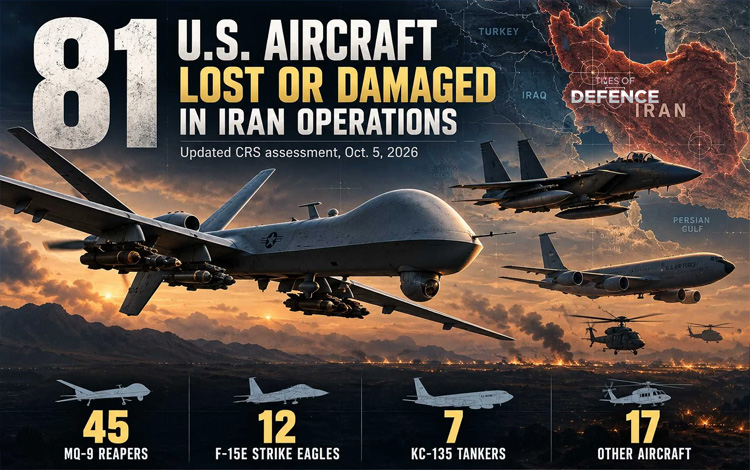
WASHINGTON — An updated Congressional Research Service (CRS) assessment released on October 5, 2026, reveals that 81 U.S. military fixed-wing, rotary-wing, and unmanned aerial platforms have been lost or damaged during combat operations in the Middle East theater since February 28, 2026.
The expanded tally nearly doubles the 42 airframes recorded in the CRS’s May report. The accounting reflects a combination of direct combat losses, friendly-fire engagements, ground strikes by enemy ballistic missiles/drones on regional airfields, accidents, and scuttled airframes. Attrition is heavily concentrated in persistent unmanned ISR platforms and multirole strike fighters, with force-enabling tankers and airborne early warning (AEW) assets also sustaining damage.
OPERATIONAL ATTRITION BREAKDOWN & FLIGHT METRICS 
1. Remotely Piloted & Unmanned Aerial Systems (UAS)
* MQ-9A Reaper: 45 units lost/damaged (Heavy ISR and precision-strike attrition)
* MQ-1-Series UAS: 3 units lost/damaged
* MQ-4C Triton: 1 unit lost/damaged (High-altitude long-endurance maritime surveillance)
2. Fixed-Wing Combat & Special Operations Fleets
* F-15E Strike Eagle: 12 units lost/damaged (Includes 4 combat/friendly-fire losses + 8 damaged during airfield missile strikes and subsequently repaired)
* A-10C Thunderbolt II: 2 units lost/damaged
* MC-130J Commando II: 2 units lost/damaged (Special operations mobility)
* F-35A Lightning II: 1 unit lost/damaged (5th-Gen stealth multirole fighter)
3. Mobility, Command & Control (C2) & Rotary-Wing Assets
* KC-135 Stratotanker: 7 units lost/damaged (Aerial refueling capabilities)
* E-3 Sentry AWACS: 1 unit lost/damaged (Airborne battle management)
* Helicopters: Multiple rotary-wing platforms including AH-64 Apache, MH-60 Seahawk, HH-60W Jolly Green II, and AH-6 Little Bird platforms
4. Financial & Force Regeneration Impact
* Estimated Replacement Value: $1.9 billion to $3.3 billion (per Congressional Budget Office estimates through August 1)
* Operational Implications: Cumulative maintenance strain, reduced persistent ISR coverage over contested airspace, and pressure on high-demand, low-density (HD/LD) enabling fleets