

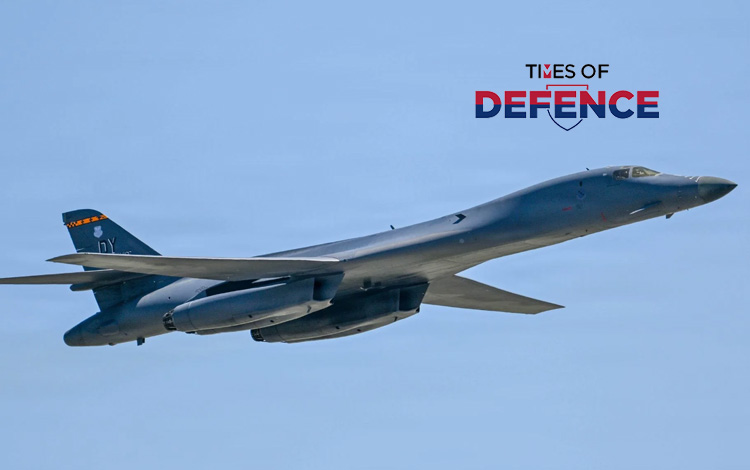
RAF FAIRFORD, U.K. — The United States Air Force officially completed the redeployment of twelve B-1B Lancer strategic heavy bombers from RAF Fairford in Gloucestershire, United Kingdom, back to their home stations in the continental United States (CONUS) on October 4, 2026. The withdrawal concludes a high-tempo Bomber Task Force (BTF) deployment supporting U.S. Central Command (USCENTCOM) strike operations against Iranian targets across the Middle East. The single-day departure ends the forward-staged heavy bomber footprint in Europe while local UK counterterrorism authorities conduct an ongoing investigation into a security incident involving suspicious vehicles and fuel containers discovered near the perimeter of the airfield.
Operating primarily from Dyess Air Force Base (Abilene, Texas) and Ellsworth Air Force Base (Rapid City, South Dakota), the B-1B Lancer fleet provides long-range, high-speed conventional precision strike capabilities. Staging out of RAF Fairford allowed operational planners to reduce aerial refueling tanker requirements and shorten flight transit times to the Middle Eastern theater compared to CONUS-launched missions. With the redeployment, future long-range strike operations against Iranian targets will transition to direct global-power missions supported by KC-135 Stratotanker and KC-46A Pegasus aerial refueling assets, or temporary staging from alternate forward operating locations.
TECHNICAL SPECIFICATIONS: ROCKWELL / BOEING B-1B LANCER STRATEGIC HEAVY BOMBER
* System Classification: Long-Range, Supersonic Variable-Sweep Wing Heavy Conventional Strike Bomber
* Prime Contractors: Rockwell International (Airframe) / Boeing (System Integration & Modernization)
* Operational Service Branch: United States Air Force (USAF Air Force Global Strike Command / AFGSC)
* Home Bases: Dyess AFB (7th Bomb Wing, Texas) & Ellsworth AFB (28th Bomb Wing, South Dakota)
* Forward Staging Base (BTF): RAF Fairford (Gloucestershire, United Kingdom / 501st Combat Support Wing)
* Airframe & Dimensional Metrics:
* Overall Length: 146 feet (44.5 meters) | Height: 34 feet (10.4 meters)
* Wingspan: 137 feet (41.8 meters) fully extended (15° sweep) | 79 feet (24.1 meters) swept back (67.5° sweep)
* Maximum Take-Off Weight (MTOW): 477,000 lbs (216,365 kg)
* Maximum Internal Payload Capacity: Up to 75,000 lbs (34,000 kg / ~34 metric tons) across 3 internal weapons bays
* Propulsion Architecture & Flight Envelope:
* Powerplant: 4x General Electric F101-GE-102 afterburning turbofan engines (~30,000 lbf thrust each w/ afterburner)
* Maximum Speed: Mach 1.2+ (1,448 km/h / 900 mph at altitude)
* Operational Range & Combat Radius: 12,000+ km unrefueled (Intercontinental range; expandable indefinitely via In-Flight Refueling)
* Service Ceiling: 60,000+ feet (18,000+ meters)
* Avionics, Radar & Electronic Warfare Suite:
* Radar Architecture: AN/APQ-164 Passive Electronically Scanned Array (PESA) synthetic aperture radar
* Navigation Suite: High-accuracy Ring Laser Gyro INS fused with jam-resistant GPS / A-PNT
* Self-Protection / EW: AN/ALQ-161A defensive avionics suite, AN/ALE-55 fiber-optic towed decoys, and ALE-47 chaff/flare dispensers
* Precision Ordnance & Payload Capabilities (3x Internal Weapon Bays + External Hardpoints):
* Precision-Guided Direct Attack: Up to 84x Mk-82 (500 lb) or 24x Mk-84 (2,000 lb) General Purpose / GBU-31 JDAM bombs
* Standoff Strike Cruise Missiles: Up to 24x AGM-158A JASSM / AGM-158B JASSM-ER (Extended Range) cruise missiles
* Maritime & Anti-Ship Warfare: Up to 24x AGM-158C Long Range Anti-Ship Missiles (LRASM) or Quickstrike naval mines