

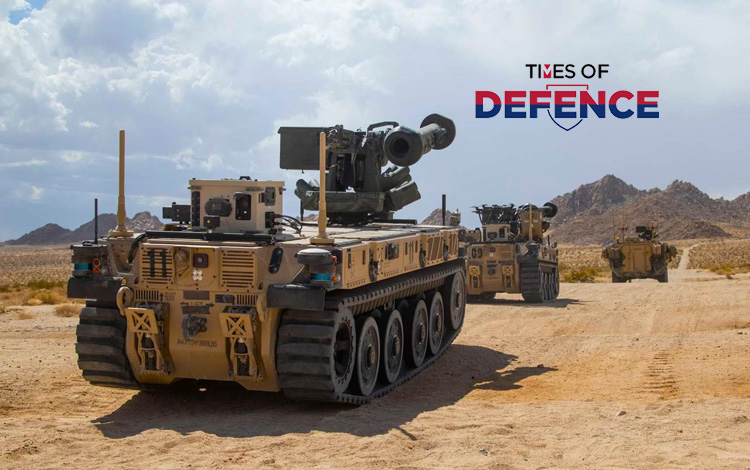
FORT BRAGG, N.C. — The U.S. Army has officially activated the 390A Robotics Technician Military Occupational Specialty (MOS), inducting its first cohort of 10 warrant officers during a ceremony at the U.S. Army John F. Kennedy Special Warfare Center and School (USAJFKSWCS / Special Operations Center of Excellence) on October 2, 2026. Designed to transition the service from basic platform operations to organic technological adaptability, the newly created 390A career field places specialized system architects directly into tactical formations to program, modify, integrate, and sustain uncrewed aerial vehicles (UAVs), uncrewed ground vehicles (UGVs), and autonomous systems in high-intensity electronic warfare (EW) environments.
The establishment of the 390A MOS addresses a major operational bottleneck highlighted in contemporary conflicts: the vulnerability of COTS and military drones to GPS/GNSS jamming, radio-frequency (RF) signal suppression, and cyber interception. Following an intensive 19-week Warrant Officer Basic Course (WOBC), 390A technicians operate as direct advisers to brigade and task-force commanders. Rather than acting as remote pilots, these warrant officers are equipped with advanced software engineering, edge AI/machine learning, CAD/additive manufacturing, and tactical mesh networking skill sets, allowing deployed combat units to rapidly reprogram autonomous guidance codes, 3D-print replacement airframes, and establish GPS-denied navigation solutions at the tactical edge.
TECHNICAL SPECIFICATIONS: U.S. ARMY 390A ROBOTICS TECHNICIAN INTEGRATOR MOS
* System / Career Specialty Classification: Military Occupational Specialty 390A (Robotics Technician Integrator)
* Sponsoring Command & Schoolhouse: U.S. Army John F. Kennedy Special Warfare Center and School (USAJFKSWCS, Fort Bragg, N.C.)
* Initial Operational Capability (IOC): Activated October 1, 2026; inaugural 10 warrant officers inducted October 2, 2026
* Force Structure Alignment: U.S. Army Special Operations Command (USASOC) enterprise with Army-wide scaling across Multi-Domain Task Forces (MDTFs) and Division/Brigade Combat Teams (BCTs)
* Training Architecture & Qualification Pipeline:
* Course Duration: 19-week Warrant Officer Basic Course (WOBC) / Pilot Robotics Integration Course
* Technical Domains: Computing & tactical networking, Edge Artificial Intelligence (AI) & Machine Learning (ML), Computer-Aided Design (CAD), Additive Manufacturing (3D Printing), and RF / EW systems engineering
* Capstone Assessment: Field-conditions tactical scenario requiring rapid prototyping—students design, 3D-print, program, and field-code an autonomous platform to solve an operational mission set
* Tactical Operational Roles & Core Competencies:
* Resilient Autonomy: Configuration of onboard optical/inertial sensor fusion enabling autonomous strike execution, waypointing, and targeting in completely GPS-denied and RF-jammed environments
* Tactical Mesh & Network Resiliency: Deployment of self-healing tactical mesh networks and anti-jamming communication links across uncrewed systems
* Rapid Field Prototyping: On-site physical repairs, localized software patches, and custom ordnance/payload integration using 3D printing and edge programming
* Command Advisory: Serving as primary technical adviser to task-force commanders for robotic force synchronization, C-UAS vulnerability assessment, and battlefield countermeasure development