

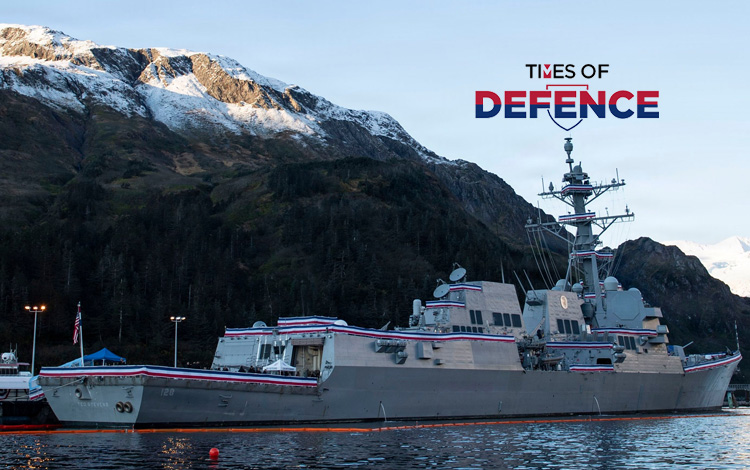
WHITTIER, Alaska — The U.S. Navy officially commissioned its newest Flight III Arleigh Burke-class guided-missile destroyer, USS Ted Stevens (DDG 128), during a formal ceremony in Whittier, Alaska, on October 3, 2026. Built by Huntington Ingalls Industries (HII) Ingalls Shipbuilding division in Pascagoula, Mississippi, DDG 128 is named in honor of the late U.S. Senator Ted Stevens, a decorated World War II Army Air Forces pilot who flew C-46 and C-47 transport missions over “The Hump” in the China-Burma-India theater. Following post-commissioning activities, the vessel will transit to its assigned homeport at Naval Station Norfolk, Virginia, to join the U.S. Atlantic Fleet.
As the second Flight III variant entering active operational service, USS Ted Stevens incorporates major structural, power architecture, and sensor upgrades designed for high-density, multi-domain environments. The platform’s combat capability centers on the Raytheon AN/SPY-6(V)1 Air and Missile Defense Radar (AMDR)—a 3D Active Electronically Scanned Array (AESA) radar—paired with Lockheed Martin’s Aegis Baseline 10 combat system. To support the significantly higher power and thermal demands of the AN/SPY-6(V)1 array, the Flight III hull features a redesigned electrical power system with three 4,000 kW, 4,160-volt AC gas turbine generators and enhanced High-Capacity Air Conditioning (HEAC) plants.
TECHNICAL SPECIFICATIONS: USS TED STEVENS (DDG 128) FLIGHT III DESTROYER
* System Classification: Flight III Guided-Missile Destroyer (DDG)
* Shipbuilder: HII Ingalls Shipbuilding (Pascagoula, Mississippi)
* Operational Homeport: Naval Station Norfolk, Virginia (U.S. Fleet Forces Command)
* Key Program Milestones: Keel Laid: March 9, 2022 | Launched: August 15, 2023 | Commissioned: October 3, 2026
* Hull & Dimensional Metrics:
* Full Load Displacement: ~9,700–9,900 metric tons
* Overall Length: 509.5 feet (155.3 meters) | Beam: 66 feet (20.1 meters) | Draft: 31 feet (9.4 meters)
* Shipboard Complement: Approximately 300 to 330 officers and enlisted crew
* Powerplant, Electrical Grid & Propulsion Envelope:
* Primary Propulsion: 4x General Electric LM2500 gas turbines producing 105,000 shp (78,000 kW) across 2 shafts
* Speed Envelope: Excess of 31 knots (~57 km/h)
* Flight III Electrical System: 3x Rolls-Royce AG9160 4,000 kW gas turbine generators operating at 4,160V AC
* Radar, Sensors & Combat System Core:
* Main Air & Missile Defense Radar: Raytheon AN/SPY-6(V)1 AESA radar (4-face array w/ GaN Radar Modular Assemblies)
* Combat Direction System: Aegis Baseline 10 (integrating simultaneous AAW and Ballistic Missile Defense / IAMD)
* Surface Search & EO/IR: AN/SPQ-9B surface radar & Mk 20 Electro-Optical Sight System (EOSS)
* Anti-Submarine Warfare (ASW): AN/SQQ-89(V)15 suite w/ AN/SQS-53C bow sonar & TB-37U multi-function towed array
* Armament Suite (96 Mk 41 Vertical Launching System Cells):
* VLS Ordnance Options: RIM-161 SM-3, RIM-174 SM-6 Dual II, RIM-66 SM-2MR, quad-packed RIM-162 ESSM Block II, BGM-109 Tomahawk land-attack cruise missiles, and RUM-139 VL-ASROC
* Deck Armament: 1x 5-inch (127 mm)/62 Mk 45 Mod 4 main gun, 1x 20 mm Phalanx Block 1B CIWS, 2x 25 mm Mk 38 Mod 3 autocannons, and 2x Mk 32 triple torpedo tubes
* Aviation Capability: Double hangar deck accommodating 2x MH-60R Seahawk LAMPS III maritime helicopters