


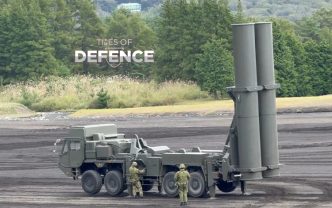
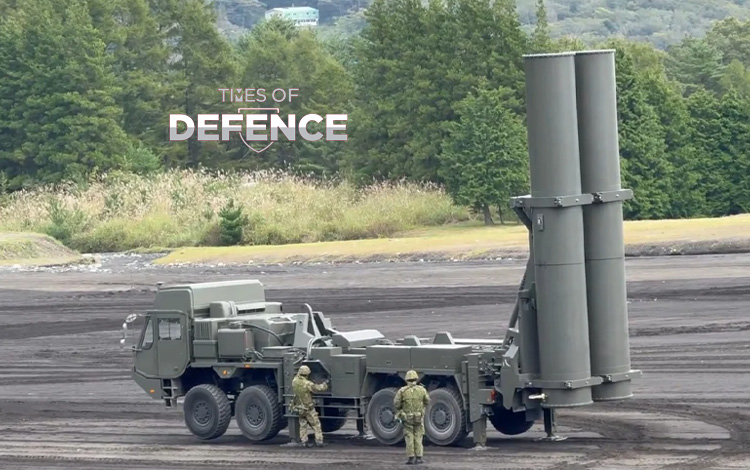
GOTEMBA, Japan — Newly released imagery from JGSDF Camp Fuji in Shizuoka Prefecture shows Japan’s homegrown standoff hypersonic strike asset—the Type 25 Hyper Velocity Gliding Projectile (HVGP)—executing transport and positioning drills. Developed by Mitsubishi Heavy Industries (MHI) under the Acquisition, Technology & Logistics Agency (ATLA), the Type 25 HVGP system forms a core pillar of the Japan Ground Self-Defense Force’s (JGSDF) standoff defense capability, designed specifically to conduct high-speed counterstrike operations and defend remote southwestern islands (Nansei Islands arc).
The HVGP system utilizes a multi-axle Transporter Erector Launcher (TEL) platform to launch a solid-fuel booster rocket that accelerates a hypersonic glide vehicle (HGV) to high supersonic/hypersonic velocities at upper-atmospheric altitudes. Following booster separation, the unpowered glide warhead executes non-ballistic, high-maneuverability trajectories to evade enemy integrated air and missile defense (IAMD) systems before delivering high-density kinetic/penetration or multi-option warheads against amphibious invasion forces, naval vessels, and contested island strongholds from standoff ranges exceeding 500 to 1,000 km.
TECHNICAL SPECIFICATIONS: MITSUBISHI TYPE 25 HYPER VELOCITY GLIDING PROJECTILE (HVGP)
* System Classification: Surface-to-Surface Hypersonic Glide Vehicle (HGV) / Standoff Island Defense Missile Complex
* Development & Manufacturing: Acquisition, Technology & Logistics Agency (ATLA) / Mitsubishi Heavy Industries (MHI)
* Operational Service Branch: Japan Ground Self-Defense Force (JGSDF / Rikujō Jieitai — Standoff Missile Units)
* Operational Status: Initial fielding & operational evaluation at JGSDF Camp Fuji and Camp Kengun
* Launch Vehicle Architecture:
* Platform Type: Heavy multi-axle (8×8) tactical Transporter Erector Launcher (TEL) truck
* Canister Payload: Dual-cell rectangular missile launch canisters w/ hydraulic elevation mechanism
* Propulsion & Trajectory Mechanics:
* Boost Phase: Multi-stage solid-propellant rocket motor accelerating payload to high-hypersonic speeds
* Glide Phase: Lifting-body Hypersonic Glide Vehicle (HGV) executing low-altitude unpowered atmospheric glide and dynamic lateral maneuvers
* Speed Envelope: Mach 5+ (Hypersonic regime)
* Estimated Engagement Range: Block 1 (500–1,000 km for island defense) | Block 2 planned variants targeting extended standoff ranges (2,000+ km)
* Guidance, Navigation & Targeting Suite:
* Navigation Architecture: Inertial Navigation System (INS) fused with jam-resistant Satellite Navigation (GPS/QZSS)
* Terminal Guidance: High-resolution seeker integration (Millimeter-Wave MMW radar / Imaging Infrared IIR) optimized for dynamic maritime targets and land installations
* Warhead Configurations:
* Anti-Surface / Anti-Ship: High-density armor-piercing kinetic energy warhead for target deck penetration
* Land Attack / Area Denial: High-Explosive Fragmentation (HE-FRAG) or specialized shaped-charge payload