

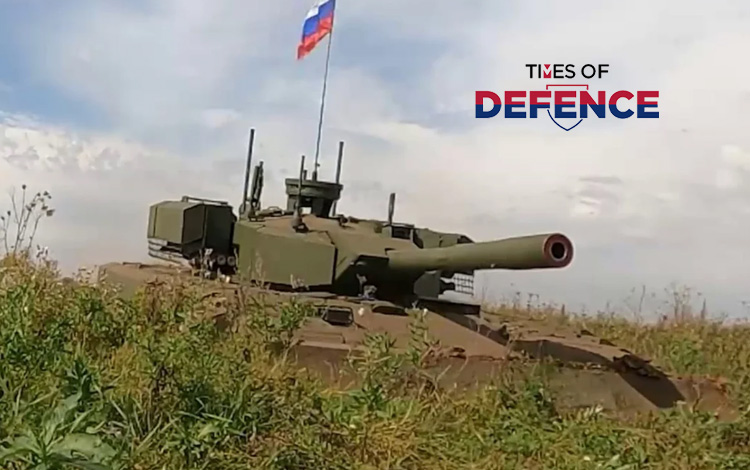
NIZHNY TAGIL, Russia — The Russian Armed Forces’ newly developed “Shturm” heavy robotic assault system experienced severe operational setbacks during its high-profile field debut at the Tsentr-2026 strategic military exercises. Developed by UralVagonZavod (Nizhny Tagil) on a modified T-72 main battle tank chassis, the uncrewed ground vehicle (UGV) repeatedly lost its remote command-and-control datalink during live maneuvering drills, forcing exercise directors to put a backup human driver into the vehicle for a VIP demonstration before the platform ultimately bogged down and got stuck in deep mud.
The public failure underscores persistent technical bottlenecks facing Russia’s heavy combat robotics program, reminiscent of earlier operational command-link losses suffered by the Uran-9 UGV during combat trials in Syria. Defense analysts and armor experts noted that in addition to electronic warfare and datalink vulnerabilities, the modified T-72 chassis design leaves critical upper engine compartments and the low-profile turret roof largely unprotected against modern top-attack FPV drone strikes, raising questions regarding the system’s operational survivability on high-intensity battlefields.
TECHNICAL SPECIFICATIONS: URALVAGONZAVOD SHTURM ROBOTIC ASSAULT TANK (T-72 UGV)
* System Classification: Heavy Robotic Combat Vehicle (HRCV) / Uncrewed Ground Vehicle (UGV) Assault Complex
* Prime Contractor: UralVagonZavod (UVZ, Nizhny Tagil, Russia)
* Operational Debut: Tsentr-2026 Strategic Command-Post Exercises (October 2026)
* Base Chassis & Architectural Modifications:
* Platform: Heavily modified T-72 Main Battle Tank (MBT) chassis
* Crew Configuration: Uncrewed / Remote-controlled (equipped with manual backup driver controls for emergency/ferry operations)
* Urban Mobility Features: Shortened main gun barrel / truncated ordnance profile designed for tight urban maneuvering; integrated front-mounted dozer blade for obstacle breaching
* Propulsion & Mobility Envelope:
* Powerplant: V-92S2F V-12 multi-fuel supercharged diesel engine (~1,130 hp)
* Curb Mass: ~42–45 metric tons
* Speed Envelope: Up to 60 km/h (paved road) | Reduced cross-country mobility in soft soil/mud conditions
* Command, Control & Datalink Suite:
* Remote C2 Architecture: Multi-band radio remote control link with automated return-to-base / fail-safe software protocols
* Sensor Suite: 360-degree electro-optical/infrared (EO/IR) camera array for remote driver situational awareness
* Performance Failure Mode: Susceptible to severe datalink degradation, line-of-sight loss, and RF suppression under active EW conditions
* Armament & Turret Configuration (Shturm Family Variants):
* Primary Direct-Fire Variant: 125 mm short-barrel smoothbore cannon firing specialized HE-FRAG & thermobaric munitions
* Support Variants: Quad-launchers for 220 mm TOS-1A Solntsepek thermobaric rockets or twin 30 mm 2A42 automatic cannons w/ Shmel-M thermobaric rocket pods
* Vulnerability & Protection Profile:
* Armament Armor: Contact-5 / Relikt Explosive Reactive Armor (ERA) across front and side hulls
* Survivability Deficits: Unprotected engine cooling grilles, thin turret roof plating, and high vulnerability to top-attack FPV loitering munitions