

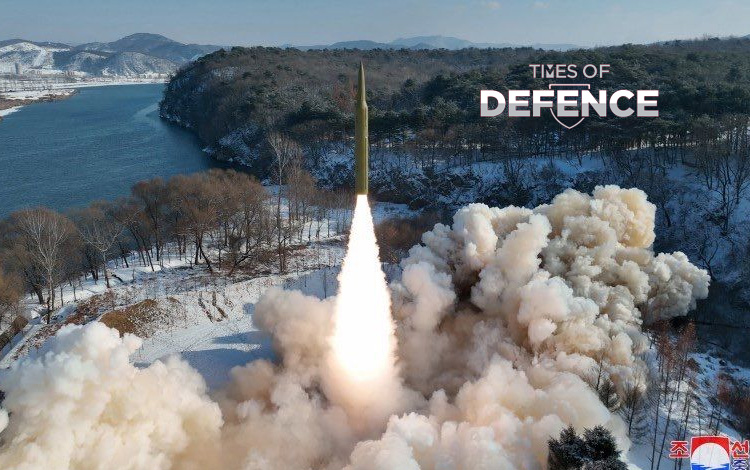
PYONGYANG / TOKYO — State media agency Korean Central News Agency (KCNA) has confirmed that the Democratic People’s Republic of Korea (DPRK) conducted a test launch of an advanced Intermediate-Range Ballistic Missile (IRBM) system integrated with an artificial intelligence (AI) terminal guidance suite and a maneuvering reentry vehicle (MaRV). Monitored by the Japanese Ministry of Defense, Republic of Korea (ROK) Joint Chiefs of Staff, and U.S. Indo-Pacific Command (INDOPACOM), the missile was launched from an eastern coastal site (Wonsan sector) and executed a semi-ballistic trajectory before impacting designated sea target coordinates in the Sea of Japan (East Sea of Korea).
The test highlights Pyongyang’s push to fuse AI-driven autonomous processing with hypersonic gliding and MaRV technologies. According to statement releases, the integrated AI guidance processor utilizes onboard electro-optical and terrain contour matching algorithms to dynamically recalculate low-altitude trajectory corrections during the terminal phase, designed specifically to degrade and defeat regional integrated air and missile defense (IAMD) networks—including Japanese Aegis BMD destroyers, Patriot PAC-3 MSE batteries, and regional THAAD architectures.
TECHNICAL SPECIFICATIONS: DPRK AI-GUIDED IRBM / MARV STRATEGIC MISSILE SYSTEM
* System Classification: Solid-Fuel Intermediate-Range Ballistic Missile (IRBM) with Maneuvering Reentry Vehicle (MaRV)
* Operational Authority: Missile General Bureau (MGB) / Korean People’s Army (KPA) Strategic Force
* Launch Configuration: High-mobility multi-axle Transporter Erector Launcher (TEL) with canisterized cold-launch architecture
* Flight & Trajectory Parameters:
* Trajectory Type: Standard depressed/boosted trajectory with low-altitude terminal skip maneuvers
* Flight Distance: ~700–1,000 km (boost-phase test envelope into the Sea of Japan)
* Speed Envelope: High-hypersonic boost-phase entry (Mach 10+) transitioning to high-supersonic/hypersonic terminal maneuvers
* Guidance, Navigation & AI Processing Architecture:
* Primary Navigation: High-precision Inertial Navigation System (INS) + Satellite Navigation (GNSS) update
* Mid-Course & Terminal Guidance: Onboard neural network AI processor integrating optical sensor fusion and terrain/coastal matching algorithms
* Terminal Maneuverability: Aerodynamic control surfaces (canards/fins) on the MaRV nose cone enabling high-g evasion maneuvers
* Countermeasure & Penetration Capabilities:
* Electronic Warfare (EW): Resilient against directional RF jamming via closed-loop onboard optical AI matching
* BMD Evasion: Non-ballistic terminal dive trajectories optimized to breach hit-to-kill engagement envelopes of Aegis (SM-3/SM-6) and THAAD systems