

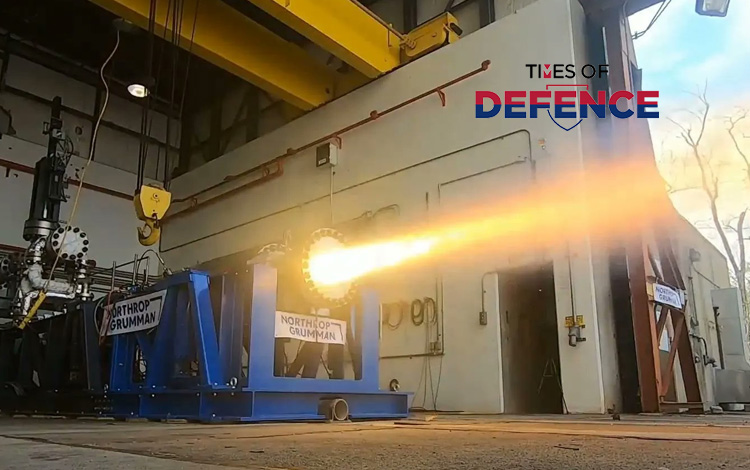
REDSTONE ARSENAL, Ala. — Northrop Grumman has received an $18.8 million development contract from the U.S. Army Combat Capabilities Development Command Aviation & Missile Center (DEVCOM AvMC) to design and test an advanced air-breathing propulsion system for the eXtended Range Counter-Unmanned Aircraft System (XRC) program. The contract focuses on integrating Solid Fuel Ramjet (SFRJ) technology into next-generation short-to-medium-range interceptor prototypes, extending engagement range and kinetic performance for forward-deployed air defense forces.
Unlike conventional Solid Rocket Motors (SRMs)—which rely on heavy onboard chemical oxidizers mixed with fuel—Solid Fuel Ramjets ingest ambient atmospheric oxygen during flight to combust solid fuel grain. By eliminating the internal oxidizer volume requirement, SFRJ engines accommodate substantially more fuel within the same airframe footprint, delivering higher specific impulse, sustained thrust, and superior end-game maneuvering capability. Designed to bolster the U.S. Army’s Stryker-based Maneuver Short Range Air Defense (M-SHORAD) capability, the XRC interceptor will also maintain mechanical and electrical compatibility with the Stinger Vehicle Universal Launcher (SVUL) to defeat advanced unmanned aerial systems (UAS), cruise missiles, and low-altitude aircraft at extended standoff ranges.
TECHNICAL SPECIFICATIONS: NORTHROP GRUMMAN / U.S. ARMY XRC SOLID FUEL RAMJET INTERCEPTOR
* Program Designation: eXtended Range Counter-Unmanned Aircraft System (XRC)
* Contracting Authority: U.S. Army Combat Capabilities Development Command Aviation & Missile Center (DEVCOM AvMC)
* Lead Developer & Integrator: Northrop Grumman (Tactical Propulsion Division)
* Procurement Structure & Value: $18.8 million development contract covering prototype design, ground test firing, and flight demonstration
* Primary Propulsion Technology: Air-Breathing Solid Fuel Ramjet (SFRJ) Engine
* Combustion Principle: Supersonic inlet air ingestion using atmospheric oxygen as the primary oxidizer, maximizing internal solid fuel volumetric capacity
* Propulsion & Kinetic Performance Advantages:
* Range Extension: Multi-fold range increase over legacy short-range solid rocket motor (SRM) interceptors
* Velocity Profile: Sustained high-supersonic cruise velocity with high residual kinetic energy during terminal intercept
* Maneuverability: Superior end-game acceleration and G-load tolerance against high-speed, evasive airborne threats
* System Integration & Multi-Platform Compatibility:
* Primary Armored Platform: U.S. Army Stryker A1 8×8 Maneuver Short Range Air Defense (M-SHORAD) system
* Universal Launcher Integration: Form-factor compatible with the Stinger Vehicle Universal Launcher (SVUL)
* Target Engagement Spectrum: Group 3 to Group 5 Unmanned Aerial Systems (UAS), low-altitude cruise missiles, attack helicopters, and tactical fixed-wing aircraft