


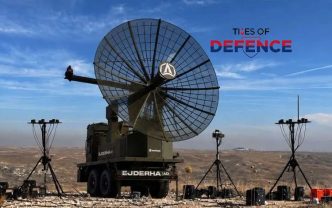

ANKARA — Defense contractor ASELSAN has field-tested its multi-tiered counter-unmanned aerial system (C-UAS) architecture during live-fire evaluation trials at the Gölbek Shooting and Test Center. The demonstration evaluated the combined operational effectiveness of the KANGAL FPV 100 soft-kill electronic warfare jammer and the EJDERHA AD 210 High-Power Electromagnetic (HPEM) directed-energy weapon system against a broad spectrum of airborne asymmetric threats, including first-person view (FPV) kamikaze drones, fixed-wing loitering munitions, tethered platforms, and internal combustion engine electronics.
The field evaluation highlighted a layered defense model designed to defeat modern autonomous and operator-controlled drone swarms. The KANGAL FPV 100 utilizes software-defined reactive RF jamming across command, control, and telemetry links, while the EJDERHA AD 210 delivers directional high-power electromagnetic pulses to induce circuit-level disruption, system reboots, or permanent hardware burnout on incoming threats. Operating in tandem, the dual-system suite provides comprehensive point and area air defense for fixed critical infrastructure and maneuvering tactical military formations.
TECHNICAL SPECIFICATIONS: ASELSAN C-UAS ELECTRONIC WARFARE ARCHITECTURE
* Systems Evaluated: KANGAL FPV 100 Jamming System & EJDERHA AD 210 HPEM System
* Prime Contractor: ASELSAN (Türkiye)
* Evaluation Site: Gölbek Shooting and Test Center, Ankara
TECHNICAL SPECIFICATIONS: KANGAL FPV 100 C-UAS JAMMING SYSTEM
* System Classification: Software-Defined Reactive RF Jamming / Dazzling Countermeasure System
* Core Subsystems: KANGAL RF Jamming Unit + MİRKET 200 RF Target Detection Unit
* Threat Engagement Target Set: Group 1/2 micro/mini UAVs, FPV kamikaze drones, observation quadcopters, and wireless video-relay platforms
* Interception Frequency Bands: Command-and-Control (C2), GNSS navigation, VTX analog/digital video links, and telemetry data channels
* Coverage & Signal Processing: 360-degree omnidirectional spherical coverage; software-defined programmable signal architecture for rapid threat-library updates
TECHNICAL SPECIFICATIONS: EJDERHA AD 210 HIGH-POWER ELECTROMAGNETIC (HPEM) SYSTEM
* System Classification: Directed Energy High-Power Electromagnetic (HPEM) Anti-UAV Countermeasure System
* Operating Principle: Directional narrowband high-power electromagnetic energy emission causing Electronic Control Unit (ECU) / circuit suppression, forced reboot, or permanent component destruction
* Detection & Tracking Suite:
* Acquisition Radar: Integrated active pulse radar for 3D aerial target detection
* Tracking Sensor: High-resolution Electro-Optical / Infrared (EO/IR) optronics suite
* Beam Steering & Operational Modes: Narrow-beam tracking or wide-area scanning options
* Neutralized Target Profiles: Tethered FPV drones, wired/wireless multirotor UAVs, fixed-wing loitering munitions, and internal combustion engine control systems
* Logistics & Mobility: Tactical rapid deployment framework with integrated Built-In Test (BIT / CİT) diagnostics and event data logging