

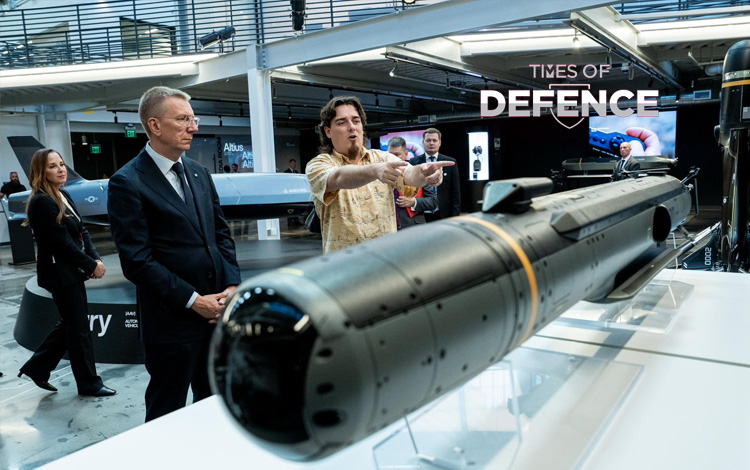
COSTA MESA, Calif. — Latvian President Edgars Rinkēvičs oversaw the signing of a strategic Memorandum of Understanding (MoU) between U.S. defense prime Anduril Industries and Latvian defense technology firm Origin Robotics during an official trade mission to the United States. The agreement formalizes the technical integration of Origin’s BLAZE autonomous counter-drone interceptor into Anduril’s Lattice command-and-control (C2) operating system, delivering a multi-layered Counter-Unmanned Aerial System (C-UAS) capability for Latvia and NATO’s eastern flank.
Concurrently, President Rinkēvičs confirmed that the Ministry of Defence of Latvia is advancing towards final procurement of Anduril’s Barracuda family of autonomous air-breathing long-range cruise missiles. The dual-track cooperation pairs localized, AI-driven kinetic drone defense with long-range precision standoff deterrence, reinforcing Latvia’s national air defense architecture through cost-effective, high-volume production platforms.
The integration connects Origin’s BLAZE interceptors—currently fielded across several European armed forces—directly into the Lattice battle management software. Lattice fuses multi-domain radar, optical, and acoustic sensor feeds to automate target cueing, track threats, and assign optimal kinetic interceptors, significantly reducing air defense operator workload and engagement timelines against incoming drone swarms and loitering munitions.
TECHNICAL SPECIFICATIONS: ORIGIN ROBOTICS BLAZE C-UAS INTERCEPTOR
* Platform Classification: Man-Portable Autonomous Counter-Drone Interceptor / VTOL Hunter-Killer
* Total Mass & Payload: < 6.0 kg gross take-off weight; carries an 800 g High-Explosive (HE) fragmentation warhead
* Operational Range & Speed: Exceeds 10 km (~6.2 miles) engagement radius; high-speed vertical takeoff and transition to horizontal thrust flight
* Engagement Envelope: Designed for one-to-one or swarmed airburst/kinetic destruction of Class 1 and Class 2 UAVs, loitering munitions, and fast-moving aerial threats
* Guidance & Targeting Architecture: Initial radar-guided navigation via networked C2, transitioning to autonomous terminal tracking via onboard dual-band Electro-Optical/Infrared (EO/IR) sensors and AI computer vision
* Command & Control Platform: Fully integrated into Anduril Lattice software suite for automated sensor-to-shooter pairing, threat prioritization, and real-time operator wave-off/override control
* Safety & Compliance: STANAG-compliant Electronic Safe and Arm Device (ESAD) with geofence self-destruct protocols and rapid <5-minute setup time
TECHNICAL SPECIFICATIONS: ANDURIL BARRACUDA MISSILE FAMILY (AGM-189 CLASS)
* Platform Classification: Autonomous Air-Breathing Long-Range Standoff Cruise Missile / Autonomous Air Vehicle (AAV)
* Propulsion & Speed: Single 150-lbf class turbojet engine producing maximum cruise speeds of Mach 0.75 (500 knots / ~930 km/h)
* Modular Family Configurations:
* Barracuda-100: Air-launched range >160 km (85 nm) / Ground-launched range >110 km (60 nm); 16 kg (35 lb) payload
* Barracuda-250: Air-launched range >370 km (200 nm) / Ground-launched range >280 km (150 nm); 16 kg (35 lb) payload
* Barracuda-500: Air-launched range >930 km (500 nm); >45 kg (100 lb) warhead payload; optimized for internal bay or C-130/C-17 palletized launch
* Guidance & Autonomy: Open-architecture autonomous mission computer capable of collaborative swarming, automated route planning, and high-G terminal evasive maneuvers
* Production Architecture: Built using commercial-off-the-shelf (COTS) components designed for rapid, low-cost, high-rate mass production to maintain magazine depth