

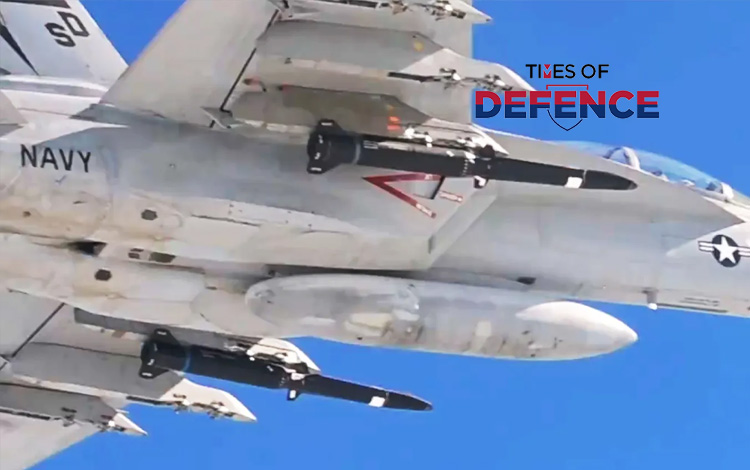
PATUXENT RIVER, Md. — The United States Navy has released initial flight-test footage confirming airborne carriage and flight evaluations of the “Blackbeard” hypersonic strike missile under the wings of an F/A-18E/F Super Hornet combat jet. Developed by defense technology startup Castelion under the Navy’s Multi-mission Affordable Capacity Effector (MACE) program, Blackbeard is engineered as a low-cost, mass-producible standoff weapon designed to equip carrier air wings with a high-speed strike capability against heavily defended surface vessels and land targets.
The commencement of flight-testing follows a series of rapid procurement and integration awards, including an initial $43.65 million production delivery order for 444 All-Up Rounds (AURs) within a broader $200 million production framework. Facing deep-stockpile replenishment requirements and high-threat Anti-Access/Area-Denial (A2/AD) operational environments in the Indo-Pacific and Middle East, the U.S. Navy aims to achieve Early Operational Capability (EOC) with Blackbeard by 2028 at the latest, establishing “affordable mass” and expanding carrier strike group magazine depth.
TECHNICAL SPECIFICATIONS: CASTELION BLACKBEARD HYPERSONIC MISSILE (MACE PROGRAM)
* System Classification: Low-Cost Air-Launched Hypersonic Standoff Missile / Multi-mission Affordable Capacity Effector (MACE)
* Developer / Prime Contractor: Castelion
* Target Speed & Flight Dynamics: Hypersonic velocity exceeding Mach 5; utilizes a high-thrust solid rocket booster paired with an unpowered Hypersonic Glide Vehicle (HGV) or second-stage strike payload
* Operational Standoff Range: Approximately 200 to 500 nautical miles (~370 to 900 km)
* Primary Mission Profiles: Maritime strike / anti-surface warfare (ASuW) against high-value naval combatants and standoff suppression of hardened land infrastructure
* Guidance & Seeker Suite: Multi-mode navigation architecture incorporating passive Imaging Infrared (IIR) terminal optical homing for resistance against radio-frequency (RF) electronic jamming
* Airframe Architecture: Compact missile body with cruciform control fins, longitudinal chine lines, and a low-RCS nose aperture profile
* Launch Platform Integration:
* Primary Initial Platform: Boeing F/A-18E/F Super Hornet (external pylon carriage)
* Planned Air Platforms: F-35A and F-35C Joint Strike Fighters (designed for up to 4 internal weapons bay rounds)
* Surface Platforms: U.S. Army ground-based tactical launcher variant (HIMARS-compatible chassis)
* Manufacturing & Unit Cost Objectives: Built using commercial manufacturing processes and vertically integrated components; unit procurement targeted at low-hundred-thousand-dollar threshold