

Latvia is moving toward acquiring Anduril Industries’ Barracuda family of long-range cruise missiles, potentially giving one of NATO’s Baltic states a new ground-launched deep-strike capability.
Latvian President Edgars Rinkēvičs announced the development following a visit to Anduril, where he met company founder Palmer Luckey and witnessed new defense-industry cooperation agreements involving Latvia.
Rinkēvičs said he was looking forward to completing the acquisition of Barracuda long-range missiles and expanding Latvian-U.S. defense-industry cooperation. However, the announcement did not specify the exact missile variant, number of weapons, acquisition cost or delivery schedule.
This means the programme should currently be described as an emerging acquisition, rather than a completed purchase.
Barracuda-500M Is the Likely Candidate
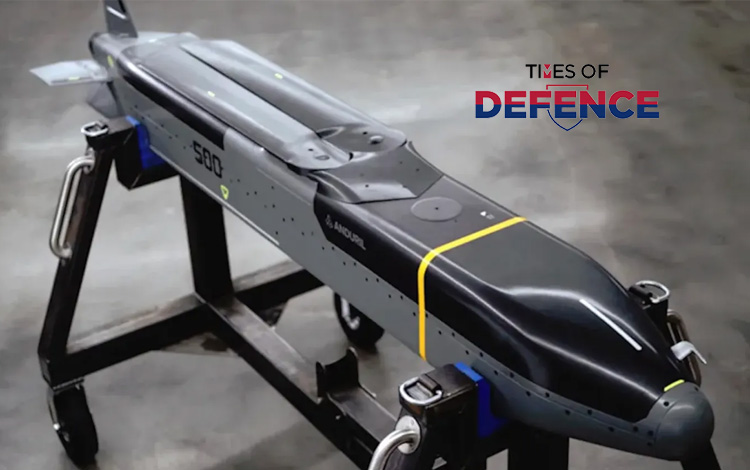
The most likely weapon for Latvia is the surface-launched Barracuda-500M (SLB-500M).
Anduril describes the SLB-500M as a long-range, mass-producible cruise missile designed for stand-off precision strike. The company lists a range of more than 500 nautical miles, equivalent to more than 926 kilometers, and a 100-pound-class payload.
The missile is designed for a containerized launch system. Anduril says a standard 20-foot ISO container can accommodate up to 16 all-up rounds, while the launcher can be transported and emplaced without requiring a large permanent infrastructure footprint.
The Barracuda family is also designed around a modular architecture intended to allow components and software to be upgraded without redesigning the entire weapon. In September 2026, Anduril announced that Barracuda had passed independent U.S. Air Force verification for compliance with the Weapon Open Systems Architecture (WOSA) standard.
A Major Increase in Latvia’s Strike Range
Latvia has already ordered U.S.-made ATACMS missiles for its M142 HIMARS systems, with the capability expected to enter Latvian service in 2027. ATACMS provides a ground-launched precision-strike capability with a range of approximately 300 kilometers depending on missile variant.
A Barracuda-500M would add a substantially longer-range weapon to that architecture.
With a publicly stated range exceeding 500 nautical miles, the missile would extend Latvia’s potential conventional strike reach to approximately 930 kilometers or more.
This would move Latvia beyond a primarily tactical fires model toward a more substantial operational-level deep-strike capability.
Why Ground Launch Matters
A ground-launched cruise missile gives Latvia an option that does not depend on maintaining aircraft over contested airspace.
The launcher can potentially be dispersed, relocated and concealed, while the missile itself provides stand-off reach against targets well beyond the immediate battlefield.
For a small Baltic state, this creates a different form of military capability: rather than relying exclusively on fighter aircraft or allied airpower for long-range strike, Latvia could potentially field a mobile ground-based weapon capable of threatening targets at operational depth.
The system would also complement rather than replace HIMARS and ATACMS.
HIMARS/ATACMS would provide ballistic missile fires, while Barracuda-500M would add a longer-range cruise-missile option with a different flight profile.
Barracuda-500M Technical Snapshot
| Feature | Barracuda-500M / SLB-500M |
|---|---|
| Type | Surface-launched cruise missile |
| Manufacturer | Anduril Industries |
| Range | 500+ nautical miles / 926+ km |
| Payload | 100 lb / ~45 kg |
| Launch system | Containerized ground launcher |
| Container capacity | Up to 16 missiles |
| Guidance/autonomy | Modular navigation and mission-autonomy architecture |
| Target set | Land and maritime targets |
| Production concept | Mass-producible / lower-cost |
| U.S. production agreement | Minimum 3,000 systems under 2026 framework |
| First U.S. deliveries | Planned for first half of 2027 |
The 3,000-system figure refers to the U.S. Department of War/Army procurement framework, not Latvia’s planned purchase. Anduril has said the U.S. programme calls for at least 1,000 SLB-500M systems per year, with more than 60 launchers beginning in 2027.
A Different Approach to Cruise-Missile Production
Barracuda is also notable for its production philosophy.
Anduril says the SLB-500M uses approximately 70 percent commodity components, with the remaining components supported by competing open-architecture designs.
The company says the missile can be assembled in approximately 30 hours using 10 common hand tools, with production intended to scale into the thousands. These are manufacturer claims rather than independently verified battlefield production rates.
Anduril has already moved Barracuda into large-scale production for U.S. customers. The company said in September that it plans to produce several thousand Barracuda systems annually over the coming years, with initial customer deliveries beginning in early 2027.
European Industrial Dimension
The Latvian move comes as several European NATO members seek to rebuild long-range conventional strike capacity.
Poland has already signed an agreement with Anduril and Polish defense company WZL-2 to establish Barracuda-500M production in Poland.
Latvia has not yet announced a comparable domestic production or assembly arrangement.
However, Latvian defense-industry representatives are seeking cooperation in areas including joint development, testing, manufacturing, system integration and supply chains.
What Remains Unknown
Several important details remain undisclosed:
- Exact Barracuda variant
- Number of missiles Latvia intends to buy
- Number of launchers
- Acquisition cost
- Delivery schedule
- Latvian basing arrangements
- Exact warhead configuration
- Final command-and-control architecture
- Whether Latvia will receive local production or assembly capability
Consequently, the reported 500+ nautical-mile range should be treated as the published capability of the Barracuda-500M, not as a confirmed specification of a Latvian configuration.
Strategic Significance
If finalized, the acquisition would give Latvia one of the most significant new long-range strike capabilities among the Baltic states.
More importantly, it would illustrate a broader transformation of NATO’s eastern flank: long-range precision strike is increasingly moving beyond Europe’s largest militaries and becoming a capability sought by smaller frontline states.
For Latvia, the combination of HIMARS/ATACMS and potentially Barracuda-500M would create a layered ground-launched fires architecture spanning tactical and much longer operational ranges.
The key development is therefore not simply Latvia buying another missile. It is the potential emergence of a mobile, long-range cruise-missile capability in one of NATO’s smallest frontline states.