

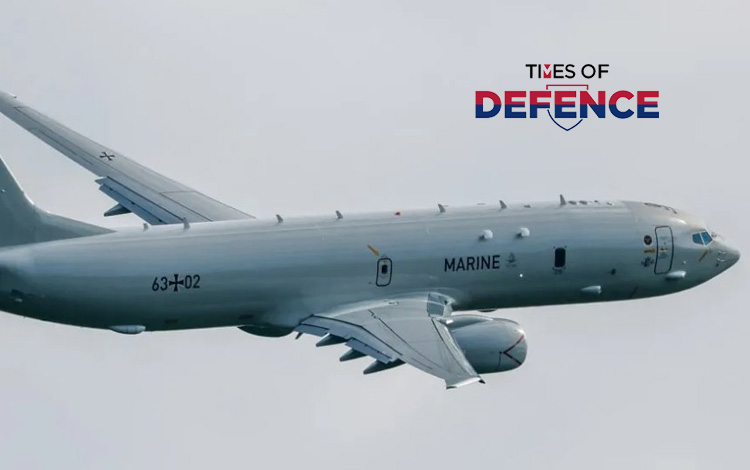
Israel is seriously considering acquiring the Boeing P-8 Poseidon maritime patrol aircraft as the Israeli Navy looks to extend its ability to conduct long-range maritime surveillance and anti-submarine warfare beyond the country’s immediate borders.
According to Israeli outlet Walla, Israeli Navy Commander Maj. Gen. Eyal Harel met with a senior Boeing executive several weeks ago to discuss the company’s latest developments and advanced weapon systems. An Israeli Defense Ministry source told Walla that the Navy is seriously considering the P-8 and that the requirement could be incorporated into the Navy’s strategic plan for the coming decade.
No purchase contract has been announced. The proposal remains under consideration and would require further approval and acquisition decisions.
A New Dimension for Israel’s Maritime Surveillance
The P-8A Poseidon is a long-range, multi-mission maritime patrol aircraft derived from the Boeing 737-800 airframe.
Its primary missions include anti-submarine warfare (ASW), anti-surface warfare (ASuW), intelligence, surveillance and reconnaissance (ISR), maritime-domain awareness and search and rescue. The U.S. Navy describes it as its long-range maritime patrol and reconnaissance aircraft.
For Israel, the most significant capability would be the ability to search enormous maritime areas from the air while combining radar, acoustic sensors, electro-optical systems, electronic-support measures and networked command-and-control.
The aircraft can deploy sonobuoys to build an underwater acoustic picture and can process information from those sensors to detect, classify and track submarines.
Boeing describes the P-8’s ASW architecture as combining acoustic sensors, sonobuoys, electronic-support measures, inverse synthetic-aperture radar and torpedo delivery.
The P-8 Is More Than a Submarine Hunter
Although ASW is the aircraft’s defining mission, the P-8 is designed as a multi-domain platform.
Its sensors can support the detection and tracking of surface vessels, while its communications and data links allow it to share information with other forces.
The aircraft can also conduct overland ISR and battlespace command and control using its mission system, datalinks and electro-optical/infrared sensors. Boeing lists Link 11 and Link 16 connectivity as part of the P-8’s communications architecture.
The P-8 can also carry weapons for anti-surface warfare and submarine engagements. The U.S. Navy lists torpedoes and cruise missiles among its armament, while Boeing identifies the Mk 54 torpedo and Harpoon as compatible weapons.
Long Endurance and Aerial Refueling
The P-8’s 737-derived airframe gives it significantly greater speed and endurance than many traditional turboprop maritime patrol aircraft.
Boeing lists a maximum speed of 490 knots, approximately 850 km/h, and a service ceiling of 41,000 feet.
The aircraft also has an in-flight refueling system, allowing its endurance to be extended for particularly long missions.
Walla reported that the aircraft could remain airborne for extremely long missions with aerial refueling. The exact endurance of a specific mission depends on fuel load, mission profile, altitude, payload and tanker support, so the often-repeated figure of approximately 30 hours should not be treated as a standard unrefueled endurance figure.
P-8A Technical Snapshot
| Feature | P-8A Poseidon |
|---|---|
| Primary role | Maritime patrol / ASW / ASuW / ISR |
| Base aircraft | Boeing 737-800 |
| Engines | 2 × CFM56-7B |
| Thrust | 27,300 lbf / 121.4 kN each |
| Maximum speed | 490 kt / ~850 km/h |
| Service ceiling | 41,000 ft / 12,496 m |
| Length | 39.5 m |
| Wingspan | 37.6 m |
| Maximum gross takeoff weight | 85,820 kg |
| Crew | 9 |
| Sensors | Radar, acoustic/sonobuoy systems, ESM, EO/IR |
| Weapons | Mk 54 torpedoes, cruise/anti-ship missiles depending configuration |
| Networking | Link 11, Link 16 and satellite communications |
| Aerial refueling | Yes |
The U.S. Navy confirms the nine-person crew, CFM56-7B engines, 85.8-tonne maximum gross takeoff weight and torpedo/cruise-missile armament.
Why Israel Is Looking at the P-8
The potential acquisition comes as Israel assesses changes in the maritime environment around the Mediterranean, Red Sea and Gulf and examines the future structure of its submarine force.
Walla reported that Israel currently operates six submarines, with two additional boats in planning and construction. The question of whether the future fleet will ultimately grow to eight boats or remain at six after older submarines are retired has not yet been settled.
A dedicated long-range maritime patrol aircraft would complement—not replace—Israel’s existing maritime and intelligence capabilities.
The Israeli Air Force already operates the Gulfstream G550-based “Eitam”/”Nachshon” family for advanced intelligence missions. The P-8 would bring a different specialization: persistent maritime surveillance combined with dedicated underwater search and anti-submarine weapons.
Potential Regional Significance
If the acquisition eventually goes ahead, Israel would become the first Middle Eastern operator of the P-8, according to Walla’s report.
The aircraft is already operated or selected by the United States, India, Australia, the United Kingdom, Norway, New Zealand, South Korea, Germany and Canada. Boeing says more than 200 P-8 aircraft are either in service or under contract across nine countries.
For Israel, the platform could provide a new long-range layer linking airborne surveillance, submarine detection, surface tracking, intelligence collection and networked command-and-control.
But the most important caveat remains the status of the programme:
Israel is considering the P-8; it has not publicly announced a final purchase contract.
If the requirement enters the Navy’s strategic plan and subsequently receives government and U.S. approval, the P-8 could become one of the most significant additions to Israel’s maritime surveillance and anti-submarine warfare architecture.