

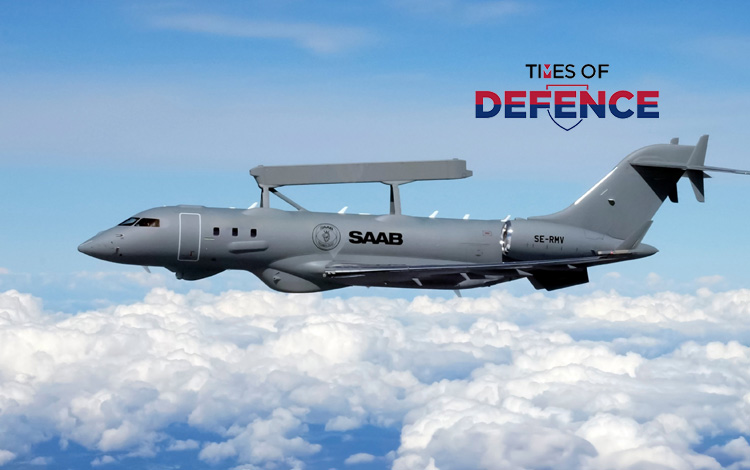
Canada has taken another step toward establishing its first dedicated airborne early warning and control capability after Saab and the Canadian Defence Investment Agency (DIA) signed a non-binding term-sheet agreement covering the potential acquisition of the company’s GlobalEye AEW&C system for the Royal Canadian Air Force (RCAF).
Signed on September 25, 2026, the agreement establishes the framework for detailed negotiations covering the Canadian configuration, industrial participation, capability development, training, support and programme execution. It is not a purchase contract and does not constitute a commitment by Canada to procure the aircraft.
Under the proposed programme, Canada intends to acquire six GlobalEye aircraft, together with associated systems, training and support.
Saab was identified as Canada’s preferred supplier for the future AEW&C capability on May 27. The Canadian government said at the time that the selection was intended to strengthen long-range airborne surveillance and command-and-control capabilities, particularly across the Arctic and in support of NORAD.
GlobalEye: An Airborne Sensor and Command Node
The GlobalEye is based on the Bombardier Global 6500, a Canadian-manufactured business jet. Saab integrates the aircraft with its Erieye Extended Range (ER) radar, additional passive and active sensors and a multi-domain command-and-control system.
The resulting platform is designed to monitor and coordinate activity across the air, maritime and land domains, providing commanders with a common operational picture rather than functioning solely as a conventional airborne radar aircraft.
The Canadian government says the capability will be able to detect, track and prioritize threats including aircraft, missiles and drones, while providing airborne command and control for operations over the Arctic and other remote regions.
Canada previously stated that the proposed GlobalEye solution could track objects and signals at distances of up to approximately 650 km, although actual detection range varies with target characteristics, altitude, radar mode and environmental conditions.
Erieye ER Radar
At the centre of the system is Saab’s Erieye ER active electronically scanned array (AESA) radar.
Unlike a conventional rotating radar, the Erieye antenna is mounted in a fixed dorsal fairing above the fuselage. Electronic beam steering allows the radar to rapidly search and track targets across a wide area.
The system is designed to detect and track airborne targets while also supporting maritime and ground surveillance. Its networking and sensor-fusion architecture allows information to be distributed to other aircraft, ships, ground units and command centres.
This is particularly relevant to Canada because the GlobalEye would not operate as an isolated sensor. Its role would be to contribute to a wider NORAD and allied surveillance and command network.
Why the Global 6500 Matters
Using the Global 6500 as the aircraft platform provides GlobalEye with a combination of endurance, speed and long-range connectivity while retaining the advantages of a business-jet-derived airframe.
For Canada, there is also an industrial dimension.
The aircraft itself is manufactured by Bombardier in Canada, and Ottawa says the programme is intended to create opportunities for Canadian companies in missionization, technology integration, training, research and development, in-service support and the wider supply chain.
Canada has also stated that it wants to establish the country as a centre for future missionization and support activities for Canadian-built GlobalEye aircraft, potentially supporting future exports.
Technical Snapshot
| Feature | Saab GlobalEye |
|---|---|
| Role | Airborne Early Warning & Control / multi-domain surveillance |
| Base aircraft | Bombardier Global 6500 |
| Primary radar | Saab Erieye ER AESA |
| Radar architecture | Fixed dorsal antenna with electronic beam steering |
| Sensor coverage | Air, maritime and land domains |
| C2 | Multi-domain command-and-control system |
| Canadian requirement | 6 aircraft |
| Package | Aircraft + associated systems + training + support |
| Canadian mission focus | Arctic surveillance, NORAD, continental defence |
| Publicly cited detection distance | Up to ~650 km under stated conditions |
Exact Canadian sensor configuration, communications equipment, electronic-warfare systems, weapons-related capabilities and other mission-system details remain subject to the ongoing negotiations.
A Capability Canada Does Not Currently Operate
The programme would represent a major change in Canada’s airborne surveillance architecture.
Rather than relying exclusively on ground-based sensors and allied airborne surveillance assets, the RCAF would gain a sovereign AEW&C fleet capable of remaining airborne over large areas and continuously distributing a real-time operational picture.
For the Arctic, this is particularly significant. Canada’s northern approaches cover enormous distances, while ground-based radar infrastructure cannot provide the same flexibility as an airborne sensor.
A GlobalEye can reposition its surveillance coverage, operate above weather and terrain limitations and pass information to other elements of the defence network.
The aircraft could therefore serve simultaneously as a long-range sensor, airborne command node and communications gateway.
The Deal Is Not Final Yet
The September term sheet is an important programme milestone, but it should not be described as Canada having already purchased six GlobalEyes.
The document establishes the framework for negotiations. The final aircraft configuration, industrial arrangements, programme schedule, delivery timeline and financial terms still have to be negotiated.
Neither Saab nor the Canadian government has disclosed a final contract value or delivery schedule in the September announcement.
If the negotiations result in a final contract, Canada would become another major GlobalEye operator and would add a dedicated AEW&C capability to its air-defence architecture at a time when Arctic surveillance and NORAD modernization are becoming increasingly important.
The aircraft purchase itself is not yet final. But the term sheet moves Canada’s GlobalEye programme from preferred-supplier selection into detailed acquisition negotiations.