

For decades, one of the most difficult signatures for a nuclear-powered submarine to suppress has been the noise generated by its propulsor.
A conventional propeller can become increasingly vulnerable to cavitation as loading and rotational speed rise. When local water pressure falls sufficiently, vapor bubbles form and subsequently collapse, producing broadband noise and strong pressure fluctuations that can compromise a submarine’s acoustic signature.
The pump-jet propulsor was developed to address part of this problem.
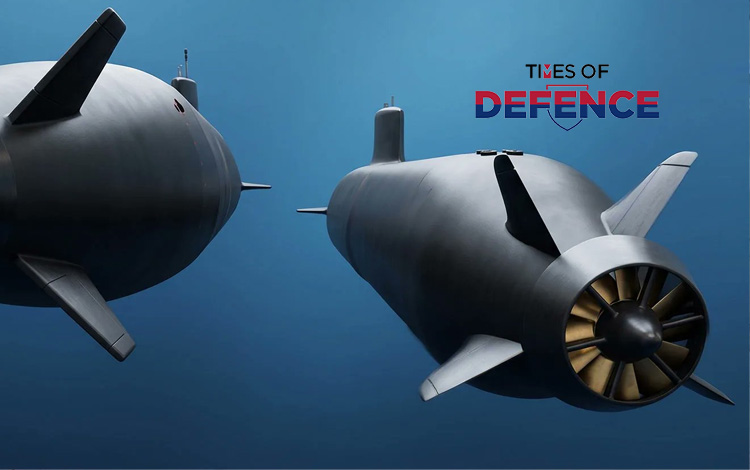
Instead of leaving the rotor exposed, a pump-jet places the rotating blades inside a duct and uses stationary stator blades to manage the flow entering or leaving the rotor. The duct can increase the local pressure around the rotor and delay cavitation, while the stators can recover or control rotational flow and improve propulsive efficiency under appropriate operating conditions.
But the architecture creates another hydrodynamic challenge: the interaction between stationary and rotating components.
Rotor-stator interaction, tip-clearance leakage and duct-wall pressure fluctuations can generate their own vortices and acoustic signatures. Research has therefore moved beyond simply designing quieter rotor blades and toward actively controlling the flow around the entire propulsor.
China Is Working on the Stator Itself
A 2026 paper published in the Chinese Journal of Ship Research by researchers from Huazhong University of Science and Technology examines a particularly unusual approach: replacing the conventional metallic leading edge of the pump-jet stator with a porous material.
The objective is not conventional acoustic absorption.
Instead, the porous structure allows the researchers to modify the flow around the stator, reducing the interaction between the stator wake and the inner surface of the duct. The study used large-eddy simulation and acoustic-analogy methods to examine how different porosities and operating conditions affect the resulting flow and noise.
The researchers reported reductions in low-frequency pressure fluctuations and far-field radiated noise. The maximum reported sound-pressure-level reduction was 5.52 dB at a monitoring direction perpendicular to the propeller shaft.
That is significant, but it is important not to turn a laboratory or numerical result into a claim about an operational submarine.
The study concerns a research configuration; it does not demonstrate that China’s Type 095 has porous stator blades or that an operational submarine has achieved a 5.52 dB acoustic reduction.
The 12.5 dB Figure Needs a Caveat
The frequently cited 12.5 dB figure should therefore not be presented as the result of this particular 2026 porous-stator study.
The published paper I located gives 5.52 dB as its maximum SPL reduction.
Different experimental or numerical configurations can produce very different reductions depending on the frequency, observation point, operating condition and acoustic metric being measured. A reduction in one tonal component also does not automatically mean an equivalent reduction in the submarine’s overall radiated-noise signature.
Type 095 Brings the Technology Into the Real World
The research is particularly interesting because China is now publicly showing a next-generation SSN with a pump-jet.
Satellite imagery analyzed by Janes in September 2026 provides clear evidence that China’s Type 095 nuclear-powered attack submarine uses a shrouded pump-jet propulsor. The imagery also shows a distinctive X-shaped stern control arrangement.
Janes previously estimated the submarine at approximately 110 meters long and 12 meters in beam. The propulsion system was initially partially obscured, but later imagery from a dry dock provided a much clearer view of the shrouded propulsor.
The adoption of a pump-jet is consistent with China’s broader effort to improve the hydrodynamic and acoustic characteristics of its nuclear submarines.
However, there is still a major distinction between observing the propulsion architecture and knowing its actual acoustic performance.
China has not publicly released reliable figures for the Type 095’s radiated-noise level, cavitation inception speed, pump-jet efficiency or acoustic advantage over the Type 093 family.
The Real Problem: Managing the Water Before It Becomes Noise
The significance of China’s research is therefore not simply that it has adopted pump-jets.
The more interesting development is the growing focus on flow manipulation.
A pump-jet contains several interacting phenomena:
- Rotor blade loading
- Stator wakes
- Rotor-stator interaction
- Tip-clearance vortices
- Duct-wall pressure fluctuations
- Cavitation
- Structural vibration
- Tonal and broadband acoustic radiation
Changing one of these variables can affect the others.
Research into porous stator leading edges represents an attempt to intervene before organized vortices and pressure fluctuations develop into stronger acoustic sources. Other research has examined different approaches to controlling pump-jet wakes, tip clearance and rotor-duct interaction.
This is why modern submarine propulsion research increasingly resembles a problem in precision fluid dynamics rather than simply a problem of making a quieter propeller.
From Propeller Blades to Fluid-Flow Control
The United States, United Kingdom, France and Russia have all developed advanced pump-jet propulsion for nuclear submarines.
China is now clearly pursuing the same technological direction.
The Type 095 provides the most visible evidence of that transition, while Chinese academic research shows that engineers are investigating increasingly sophisticated methods of controlling the flow inside the propulsor itself.
The objective is straightforward: reduce the hydrodynamic disturbances that eventually become acoustic signatures.
The important caveat is that none of the publicly available research allows an independent assessment of how quiet the Type 095 actually is.
What can be said is that China’s submarine-propulsion research has moved beyond simply enclosing a propeller. Researchers are now investigating how the geometry and material properties of individual stator surfaces can manipulate vortices and pressure fluctuations before they propagate into underwater sound.
In submarine warfare, that distinction matters.
The future of quiet propulsion may not be about eliminating the noise after it is created — but controlling the water flow that creates it in the first place.