

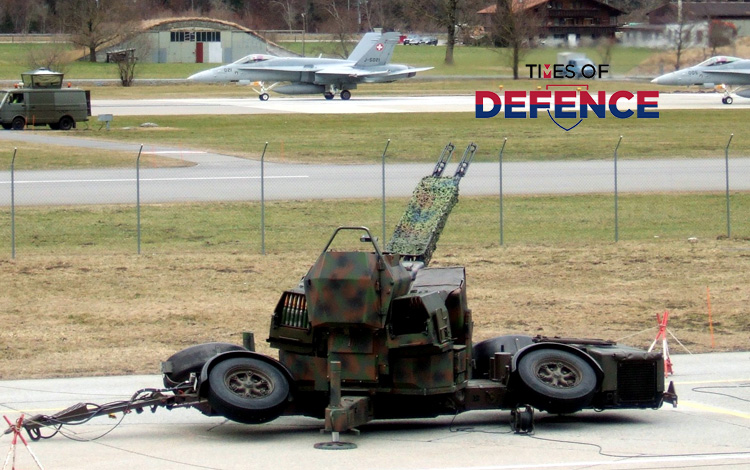
Germany’s Rheinmetall Oerlikon Skynex air-defense system is now being used by Ukrainian forces to counter Russian aerial threats, including attack drones and cruise missiles.
The system combines a networked command-and-control architecture with radar sensors and 35mm automatic cannons firing programmable AHEAD airburst ammunition. Rheinmetall says Skynex is designed primarily for very-short-range air defense and can engage a wide range of low-altitude aerial threats.
Ukrainian Air Command West has previously released footage showing a Skynex system engaging a Russian cruise missile. According to the Ukrainian unit, the system had also destroyed 34 Shahed-type attack drones and two Kh-101 cruise missiles. These figures are Ukrainian military claims rather than independently verified engagement statistics.
How Skynex Works
Skynex separates the sensor and command layer from the individual weapon systems.
Its Oerlikon Skymaster battle-management system receives the air picture from sensors such as the X-TAR3D tactical acquisition radar and assigns targets to connected effectors. Rheinmetall’s architecture can integrate different sensors and weapons, allowing the system to be configured for specific missions.
The Skynex gun system uses the Oerlikon Revolver Gun Mk3, a remotely operated 35mm cannon equipped with its own X-band tracking radar and electro-optical sensor suite. The gun can receive target information from external 2D/3D search radars or conduct its own sector search.
Why the 35mm AHEAD Ammunition Matters
The system’s most important feature is its programmable 35mm ammunition.
The AHEAD projectile is programmed shortly before leaving the barrel. At the calculated intercept point, it releases a cloud of sub-projectiles in the target’s flight path rather than relying on a conventional direct hit.
This makes the system particularly suited to small and maneuvering targets such as drones. Rheinmetall also highlights the ammunition’s resistance to electronic countermeasures after firing because the projectile’s trajectory cannot be altered by jamming.
Compared with using expensive surface-to-air missiles against every small drone, gun-based air defense can offer a lower-cost-per-engagement option, although the overall economics depend on ammunition expenditure, target type and engagement conditions.
Technical Snapshot
| Feature | Skynex |
|---|---|
| Manufacturer | Rheinmetall / Oerlikon |
| Role | Very-short-range air defense |
| Main gun | Oerlikon Revolver Gun Mk3 |
| Caliber | 35mm |
| Ammunition | Programmable AHEAD airburst |
| Fire control | Radar + electro-optical tracking |
| Command system | Oerlikon Skymaster |
| Search radar | X-TAR3D / compatible sensors |
| Typical targets | UAVs, cruise missiles and other low-altitude threats |
| Architecture | Networked, modular and scalable |
Rheinmetall states that Skynex can incorporate multiple sensors and effectors and can be connected to existing air-defense fire units, making it part of a broader layered air-defense network rather than simply a standalone gun vehicle.
Ukraine’s Air-Defense Network
For Ukraine, the system fills a different niche from long-range missile systems such as Patriot or SAMP/T.
Its value is concentrated at the short-range end of the air-defense layer, where rapid-fire guns and programmable ammunition can be used against relatively small or low-flying targets.
Rheinmetall says Skynex and the related Skyranger 35 system have been supplied to Ukraine and that Ukrainian forces are using them against drones and cruise missiles.
The exact number of Skynex batteries currently operational, their deployment locations and their complete ammunition inventories are not publicly disclosed by Ukraine or Germany.
The key lesson from the Ukrainian battlefield is that modern air defense increasingly relies on layered systems: long-range missiles for high-value threats, shorter-range interceptors and guns for lower-cost targets, and networked sensors and command systems to coordinate them.