

South Korea has officially entered the era of indigenous supersonic fighter operations.
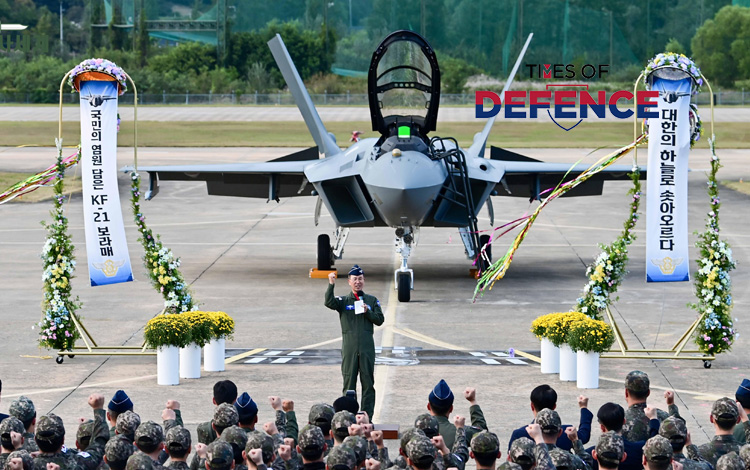
On September 22, 2026, the Republic of Korea Air Force (ROKAF) formally received its first serial-production KF-21 Boramae, marking a major milestone in the country’s decades-long effort to build an advanced domestic combat aircraft.
The aircraft, serial 26-001, was handed over by Korea Aerospace Industries (KAI) and flown from the company’s Sacheon facility to Yecheon Air Base, where the reactivated 156th Fighter Squadron will begin conversion training and establish the infrastructure required to operate the new fighter.
The delivery comes just over two years after KF-21 serial production began in June 2024.
From Six Prototypes to Series Production
The KF-21 development program began in December 2015.
KAI subsequently built six flight-test prototypes, which conducted roughly 1,600 flight tests covering more than 13,000 test conditions.
The test campaign included weapons employment and South Korea’s first indigenous fighter aerial-refueling trials.
In May 2026, the Defense Acquisition Program Administration (DAPA) granted the KF-21 its final “combat suitable” certification, completing the final major stage of system development. DAPA subsequently announced that system development had officially concluded in June.
The aircraft delivered to the ROKAF is a Block I, two-seat configuration.
KF-21 Boramae — Key Technical Data
| Feature | KF-21 |
|---|---|
| Manufacturer | Korea Aerospace Industries (KAI) |
| Configuration | Twin-engine multirole fighter |
| Generation | 4.5-generation |
| Engines | 2 × GE F414 |
| Maximum speed | Approx. Mach 1.8 |
| Crew | 1 or 2, depending on variant |
| Radar | Hanwha Systems AESA |
| Sensors | AESA radar, IRST, EO/IR systems |
| Electronic warfare | Integrated EW suite |
| Weapons stations | 10 external hardpoints |
| Primary initial role | Air-to-air combat |
| Initial production order | 40 Block I aircraft |
The KF-21 combines a modern AESA radar, infrared search and track capability, electronic warfare systems and networked mission architecture with a low-observable-inspired airframe.
However, it should not currently be classified as a full fifth-generation stealth fighter.
A 4.5-Generation Fighter — With a Stealthier Future in Mind
The KF-21’s airframe incorporates features intended to reduce radar observability, including carefully shaped surfaces, canted vertical tails and weapons-placement considerations.
But the initial production aircraft carry weapons externally.
That means their radar signature is significantly higher than that of a fighter carrying weapons inside an internal weapons bay.
This is where the KF-21’s future development becomes particularly important.
South Korea has pursued later configurations intended to increase the aircraft’s low-observable characteristics, including an internal weapons carriage concept. However, internal weapons carriage should not be described as a feature already being introduced with Block II. The currently entering-service Block I and planned Block II aircraft use external weapons carriage.
AESA Radar and Korean Technology
One of the program’s most important achievements is the development of a domestic fighter AESA radar.
Hanwha Systems developed the KF-21’s radar in cooperation with South Korea’s defense industry, giving Seoul greater control over one of the most critical elements of a modern fighter’s kill chain.
The aircraft also integrates domestically developed electronic warfare and infrared sensing technologies.
This matters beyond the KF-21 itself.
Developing the aircraft required South Korean industry to build expertise across radar, electronic warfare, mission computers, flight control, structures, weapons integration and systems engineering.
That industrial knowledge can subsequently be applied to future aircraft programs.
Air-to-Air First, Multirole Later
The first 40 production aircraft are primarily focused on air-to-air operations.
KAI’s longer-term production plan calls for an additional 80 aircraft with expanded air-to-ground capabilities, including long-range air-to-ground weapons, with deliveries planned through 2032.
This creates a phased development path:
Block I → air-to-air capability
Block II → expanded multirole capability
Future configurations → greater low observability and potentially internal weapons carriage
The exact configuration and timetable for a future internal-weapons variant remain subject to development.
What Happens Next?
The handover does not mean the KF-21 is immediately entering full operational deployment.
The ROKAF is now beginning the next stage: pilot conversion, maintenance training, logistics development and squadron-level integration.
The Air Force has said the KF-21 is expected to be declared operational in the second half of 2027.
South Korea ultimately plans to field more than 100 KF-21s in phases during the early 2030s.
The aircraft therefore represents more than the replacement of aging F-4 and F-5 fighters.
It gives South Korea an indigenous platform around which it can develop future sensors, weapons, electronic warfare systems and increasingly autonomous mission technologies.
The Bigger Picture
The first production KF-21 does not make South Korea a fifth-generation fighter operator.
Instead, it demonstrates something potentially more important for the country’s aerospace industry: South Korea can now design, test, certify and produce a modern supersonic fighter domestically.
The Boramae is therefore both an operational aircraft and an industrial stepping stone.
Its first flight was in 2022.
Its development campaign involved six prototypes and roughly 1,600 test flights.
Now, in September 2026, the first production aircraft belongs to the ROKAF.
The Boramae era has officially begun.