


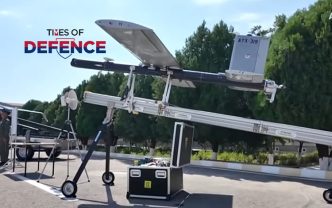
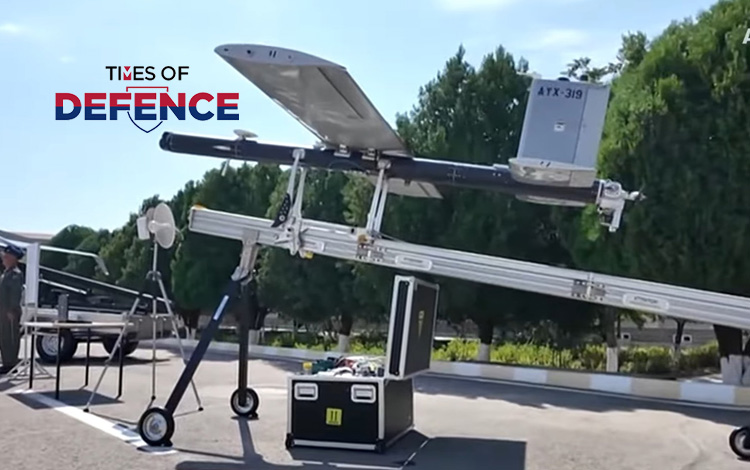
Azerbaijan is moving toward local production of Baykar’s new Sivrisinek loitering munition, a long-range one-way attack UAV designed to provide deep-strike capability without relying on conventional runways.
The system was publicly unveiled by Baykar in 2026 and subsequently demonstrated in autonomous swarm operations. Baykar describes Sivrisinek as a next-generation loitering munition with an operational range exceeding 1,000 kilometers.
However, while Azerbaijan and Türkiye have announced plans to manufacture the system in Azerbaijan, there is currently no comparable public Azerbaijani government announcement confirming a formal operational inventory entry. The distinction is important: production and field demonstration are confirmed, while formal Azerbaijani service entry remains insufficiently documented in open sources.
A Long-Range One-Way Attack UAV
Sivrisinek is designed primarily for attacks against ground targets.
Baykar offers the system in two configurations:
- Sivrisinek-UM
- Sivrisinek-UMX
The UM variant is optimized for extended-range operations, with a company-published operational range of 1,000 km, while the more advanced UMX is listed at 900 km. The UMX adds AI-assisted electro-optical guidance and expanded communications capabilities.
The distinction means the headline figure of “1,000 km” applies specifically to the UM configuration rather than every Sivrisinek variant.
Technical Specifications
| Feature | Sivrisinek UM | Sivrisinek UMX |
|---|---|---|
| Operational range | 1,000 km | 900 km |
| Endurance | 9+ hours | 8+ hours |
| Cruise speed | 55 KIAS / ~102 km/h | 55 KIAS / ~102 km/h |
| Maximum speed | 70 KIAS / ~130 km/h | 70 KIAS / ~130 km/h |
| MTOW | 76 kg | 78 kg |
| Payload capacity | 20 kg | 20 kg |
| Warhead | 20 kg | 20 kg |
| Operational altitude | 4,000 ft | 4,000 ft |
| Service ceiling | 10,000 ft | 10,000 ft |
| Launch | Catapult | Catapult |
| Propulsion | Internal-combustion engine | Internal-combustion engine |
| Length | 3.8 m | 3.8 m |
| Wingspan | 3.2 m | 3.2 m |
| Terminal guidance | GNSS | GNSS + AI-assisted EO |
These figures come from Baykar’s published technical data.
Designed for GPS-Denied Warfare
One of Sivrisinek’s most significant features is its ability to operate in environments where satellite navigation is degraded or denied.
Baykar demonstrated Sivrisinek using AI-assisted visual navigation during a swarm demonstration in which GNSS-independent navigation, automatic target detection and attack capabilities were showcased.
The concept uses visual information from the environment to support positioning rather than depending entirely on satellite navigation.
This is particularly relevant in an electronic-warfare environment, where GNSS jamming and spoofing can interfere with conventional UAV navigation.
Swarm Networking
Sivrisinek is also designed to operate as part of a larger unmanned network.
According to Baykar, multiple platforms can exchange information within the swarm and share detected targets. The UMX variant can use Bayraktar TB2, TB3 or AKINCI as communication relays, extending connectivity beyond the UAV’s own direct communications range.
Baykar demonstrated a mixed unmanned formation involving:
5 K2 Kamikaze UAVs + 10 Sivrisinek + 1 TB2 + 1 TB3 + 1 AKINCI
The demonstration showcased autonomous swarm behavior, target detection and GNSS-independent navigation.
Azerbaijan Connection
Azerbaijan’s connection to the program goes beyond simply purchasing a Turkish-made UAV.
At SAHA 2026, Baykar CEO Haluk Bayraktar stated that UAVs displayed at the exhibition would be manufactured at factories in Azerbaijan, including Sivrisinek. Azerbaijani media subsequently reported that Türkiye and Azerbaijan would jointly produce the system.
This could give Azerbaijan a domestic production pathway for a relatively small, long-range strike system while further integrating Turkish-designed unmanned technology into its defense-industrial ecosystem.
Why the 1,000-km Range Matters
At approximately 55 knots, a 1,000-km flight represents a long-duration mission rather than a rapid strike.
The combination of:
1,000-km operational range + 9+ hours endurance + 20-kg warhead + catapult launch
creates a system intended to provide deep operational reach from relatively small launch elements.
Unlike a conventional cruise missile, Sivrisinek is a reusable aircraft until the terminal attack phase and can potentially loiter, receive updated mission information and search for an appropriate target before committing to the final attack.
Baykar also describes autonomous operation and AI-assisted target recognition as key elements of the system.
Not Yet an Operational Combat Record
Despite its impressive published specifications, Sivrisinek should not yet be described as a combat-proven system.
The publicly documented 2026 activities demonstrate flight, swarm coordination, autonomous navigation and attack demonstrations. They do not establish a combat deployment or a confirmed operational kill record.
Likewise, specific details about the warhead design, seeker architecture, target-identification database, electronic-warfare resistance, communications encryption and real-world effectiveness remain undisclosed.
Bottom Line
Sivrisinek represents a different class of Baykar unmanned system: a small, catapult-launched, long-range loitering munition designed to combine deep reach, autonomy and relatively low logistical requirements.
For Azerbaijan, the more significant development may ultimately be not simply acquiring the system, but participating in its local production.
The 1,000-km figure is confirmed for the Sivrisinek-UM configuration, while the UMX is officially listed at 900 km. And although Azerbaijan-linked production is documented, a formal public confirmation that the Azerbaijani Armed Forces have already placed Sivrisinek into operational service has not been established in the sources reviewed.