

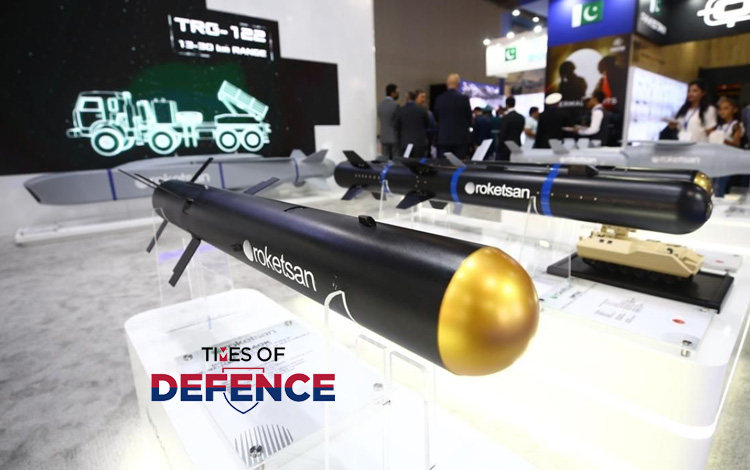
Türkiye’s KARAOK anti-tank missile has successfully engaged an aerial target for the first time, marking a new expansion of the ROKETSAN-developed weapon’s demonstrated target set.
Developed by Turkish missile manufacturer ROKETSAN, KARAOK was originally designed as a man-portable short-range anti-tank weapon. The latest test demonstrates that the missile’s guidance and engagement architecture can also be used against an airborne target.
The development is significant because KARAOK was not originally introduced as a dedicated surface-to-air missile. Its primary mission remains the engagement of armored ground targets.
From Anti-Armor Weapon to Airborne Target Engagement
KARAOK uses an imaging infrared (IIR) seeker, allowing it to operate during both day and night.
According to ROKETSAN, the missile can engage stationary and moving targets and uses a fire-and-forget operating concept. Its warhead is a tandem armor-piercing design, while the missile can attack targets using either direct impact or a top-attack trajectory.
The successful aerial-target test therefore represents a new demonstrated application rather than a complete change in KARAOK’s primary mission.
The exact type of aerial target used in the latest test, as well as the engagement range, flight profile and seeker performance during the interception, have not been publicly detailed.
KARAOK Technical Profile
| Parameter | KARAOK |
|---|---|
| Manufacturer | ROKETSAN |
| Category | Short-range anti-tank missile system |
| Caliber | 125 mm |
| Missile + launch tube weight | <16 kg |
| Published range | 2.5 km |
| Guidance | Imaging infrared seeker |
| Warhead | Tandem armor-piercing |
| Attack modes | Direct attack / top attack |
| Operating concept | Fire-and-forget |
| Day/night capability | Yes |
| Primary targets | Stationary and moving ground targets |
| Newly demonstrated capability | Aerial-target engagement |
These are ROKETSAN’s published specifications. The company has not publicly released a separate performance specification for an air-defense version of KARAOK.
Why the IIR Seeker Matters
The missile’s imaging infrared seeker is central to its ability to operate without continuous guidance from the launch team.
After launch, the seeker can track the thermal signature of the selected target, enabling the operator to leave the firing position rather than continuously guide the missile.
For its original anti-tank role, this is particularly useful against moving armored vehicles.
Against an aerial target, however, the engagement problem becomes considerably more demanding.
An airborne target can change speed, altitude and direction rapidly. The missile therefore has to acquire and maintain a valid infrared track while dealing with a much more dynamic target geometry.
The successful test indicates that the KARAOK system has now demonstrated the ability to complete such an engagement, although the publicly available information does not reveal the precise test conditions.
A New Layer for Short-Range Threat Engagement
The development could have implications for the broader Turkish counter-UAS and short-range air-defense ecosystem.
Small unmanned aircraft are increasingly forcing militaries to consider lower-cost interceptors and weapons alongside conventional surface-to-air missiles and guns.
A compact, man-portable missile with an imaging infrared seeker could potentially provide another option against selected airborne threats.
However, it would be inaccurate to describe KARAOK as a dedicated anti-drone or air-defense missile based solely on this test.
ROKETSAN continues to officially classify KARAOK as a short-range anti-tank weapon system.
The latest aerial-target engagement should therefore be viewed as a demonstrated additional capability rather than evidence that the missile has already been redesigned or certified as a dedicated surface-to-air system.
Development Continues
KARAOK has already undergone multiple successful test campaigns.
In April 2026, ROKETSAN reported that the missile had successfully hit targets in four different test scenarios, reinforcing its performance against its intended ground-target mission set.
The system was also used for the first time in EFES 2026, according to ROKETSAN, giving Turkish forces an opportunity to employ the short-range anti-tank system within a major multinational exercise environment.
The latest aerial-target test adds another data point to that development path.
The Bigger Picture
The most important aspect of the test is not that KARAOK has suddenly become a conventional air-defense missile.
Instead, it demonstrates how an existing missile architecture can potentially be adapted to address additional target classes.
Its compact form, autonomous infrared guidance and relatively low system weight could make the concept interesting for future applications against selected low-altitude aerial threats.
But important questions remain unanswered.
ROKETSAN has not publicly disclosed the target type, engagement altitude, interception distance, hit probability, seeker configuration used against the aerial target or whether a dedicated air-defense variant is being developed.
For now, the confirmed milestone is straightforward:
KARAOK, a missile designed primarily for short-range anti-armor warfare, has successfully demonstrated its ability to hit an aerial target for the first time.
That gives ROKETSAN another potential pathway for expanding the utility of its existing missile technology without changing the weapon’s officially stated primary role.