

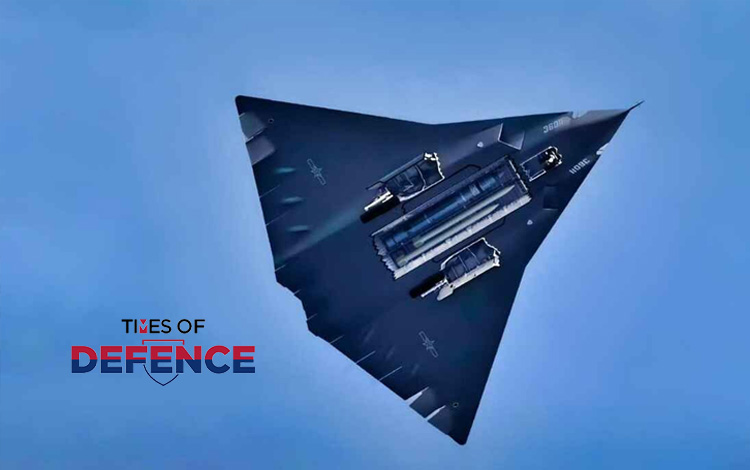
BEIJING — China’s sixth-generation fighter development program has reached a major milestone as the Chengdu Aircraft Corporation (CAC) advances flight-testing of its heavy stealth aircraft, unofficially designated the J-36. Recent daylight flight-test activity, combined with the public unveiling of a full-scale structural mock-up and dedicated airborne laser subsystem hardware in Beijing, confirms an unprecedented trijet design optimized for long-range, high-endurance operations across the Indo-Pacific.
Flight-test observations indicate that up to five distinct J-36 prototypes are actively flying, showcasing a parallel engineering strategy. Individual airframes feature noticeable design variations, including evaluations between recessed, infrared-suppressing exhaust troughs and 2D thrust-vectoring nozzles, as well as modifications to the lower intake geometry and heavy-duty dual-wheel landing gear. The aircraft’s massive scale—estimated at 50 to 55 tonnes maximum takeoff weight—positions it as a heavy “airborne cruiser” combining air superiority, long-range strike, and airborne command-and-control capabilities.
In mid-September, the Aviation Industry Corporation of China (AVIC) presented a structural mock-up alongside a dedicated airborne laser tracking and beam-director system. Designed to exploit the enormous electrical power output generated by the aircraft’s three engines, the 100+ kW-class directed-energy system provides the J-36 with a reusable, non-kinetic active protection layer capable of intercepting incoming air-to-air missiles, surface-to-air interceptors, and uncrewed aerial systems.
TECHNICAL SPECIFICATIONS: CHENGDU J-36 6TH-GEN FIGHTER
* Platform Classification: 6th-Generation Heavy Multirole Stealth Aircraft / Fighter-Bomber
* Developer / Manufacturer: Chengdu Aircraft Corporation (CAC) / AVIC
* Airframe Architecture: Tailless, blended diamond double-delta wing planform engineered for all-aspect broadband stealth and reduced supersonic drag; features a wide nose section and a side-by-side cockpit layout.
* Propulsion Architecture: Trijet configuration comprising two primary internal engines fed by twin lower air intakes, complemented by a third engine fed via a dorsal intake. The three-engine layout provides high supercruise performance and massive electrical power generation for advanced sensors and energy weapons.
* Physical Dimensions & Mass: Length of approximately 22.5 meters, wingspan of 19 to 20 meters, and an estimated Maximum Takeoff Weight (MTOW) of 50 to 55 tonnes.
* Prototype Dynamics: At least 5 active flying prototypes demonstrating parallel iterative testing of 2D thrust-vectoring control, exhaust stealth treatments, and variable air-intake designs.
* Internal Ordnance Capacity: Configured with three internal weapons bays—a primary central bay (approx. 7.6 meters in length) designed for long-range ordnance such as the PL-17 or heavy strike munitions, flanked by two lateral bays for short-to-medium-range missiles.
* Directed Energy Warfare Suite: Integrated with AVIC’s sub-380 kg airborne laser weapon acquisition, tracking, and beam director system delivering a minimum 100 kW output for close-in active missile defense and sensor disruption.
* Operational Range: Estimated combat radius of 2,000 to 3,000 kilometers on internal fuel, enabling extended standoff operations into the Western Pacific without immediate aerial refueling dependence.