


Lockheed Martin Expands HIMARS From Precision Fires to a Modular Offensive-Defensive Platform
Lockheed Martin’s HIMARS FLEX is taking the well-known High Mobility Artillery Rocket System into a significantly broader mission set.
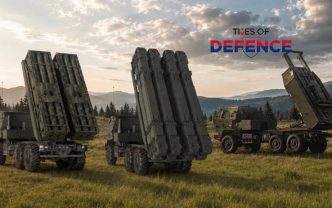
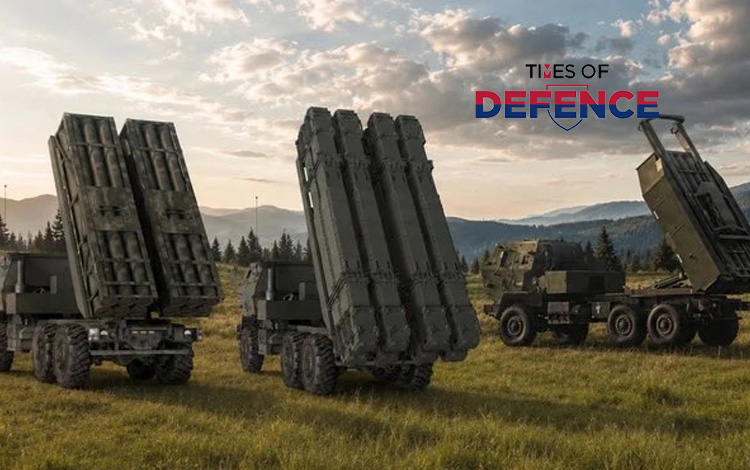
Unveiled in 2026, the new configuration replaces the traditional single-pod launcher arrangement with a dual-pod configuration mounted on the XM1140 chassis. Despite the increased weapons capacity, Lockheed Martin says the system remains C-130 transportable.
The concept is based around the company’s new FLEXFires technology ecosystem, which is designed to allow the launcher to accept different offensive and defensive munitions, integrate with joint fire-control networks and potentially incorporate autonomous functions.
Double the Rocket Capacity
Standard HIMARS carries a single pod containing six GMLRS rockets, two PrSM missiles or one ATACMS missile.
HIMARS FLEX places two pods on one launcher, substantially increasing the number of ready-to-fire weapons.
According to Lockheed Martin and reporting from Janes, the dual-pod configuration can carry:
- 12 GMLRS/ER GMLRS
- 4 PrSM
- 2 ATACMS
- 8 PAC-3 interceptors
- Potentially 12 or more IFPC interceptors, depending on the configuration
These figures describe different loadouts rather than a single mixed ammunition configuration.
That distinction is important: HIMARS FLEX is not simply a launcher carrying twice as many identical rockets. Its architecture is intended to allow the same vehicle to be configured for different missions.
From Rocket Artillery to Air Defense
Perhaps the most significant change is the expansion into air and missile defense.
Lockheed Martin says HIMARS FLEX can employ PAC-3 and IFPC interceptors in addition to the GMLRS, ER GMLRS, PrSM and ATACMS families.
This creates an unusual combination.
The same mobile launcher architecture can potentially support:
Long-range precision fires → PrSM
Deep precision strike → ATACMS
Tactical rocket artillery → GMLRS / ER GMLRS
Air and missile defense → PAC-3
Indirect Fire Protection → IFPC interceptors
The launcher itself therefore becomes less tied to a single weapon category and more closely resembles a mobile precision-fires and defensive-fires node.
Why the XM1140 Chassis Matters
The XM1140 chassis preserves one of HIMARS’s most important operational characteristics: strategic and tactical mobility.
Lockheed Martin specifically states that HIMARS FLEX remains C-130 transportable on the XM1140 chassis.
That means the increased weapons capacity does not necessarily require moving to a much heavier tracked launcher.
For expeditionary forces, this is significant. A C-130-compatible system can be transported into relatively austere locations and then rapidly repositioned as the tactical situation changes.
The concept also retains the traditional HIMARS “shoot-and-scoot” philosophy.
A launcher can fire, relocate, reload and reconnect to the wider fire-control network rather than remaining in a fixed firing position. Lockheed Martin identifies distributed and survivable fires as one of the central design objectives of HIMARS FLEX.
FLEXFires and Autonomy
HIMARS FLEX is not only about adding another launch pod.
Lockheed Martin describes FLEXFires as an ecosystem intended to support scalable launcher configurations, new munitions and optional autonomy.
The company says customers can choose between:
- Single-pod configurations
- Dual-pod FLEX configurations
- Different vehicle platforms
- Mobile or containerized launchers
- Indigenous chassis integration
- Autonomous reload options
This potentially allows the same basic fire-control architecture to be adapted to different national requirements.
For NATO forces, interoperability is another major component. Lockheed Martin says HIMARS FLEX is designed to share NATO-standard munitions and integrate with joint fire-control networks.
Implications for the British Army
The system is particularly relevant to discussions about Britain’s future long-range fires capability.
The British Army already operates the M270B1 MLRS, but the HIMARS family offers a wheeled, highly mobile alternative with access to the same broader MLRS ammunition ecosystem.
The introduction of HIMARS FLEX changes the procurement equation because a future operator would not necessarily be buying a launcher exclusively for rocket artillery.
A FLEX-equipped vehicle could potentially contribute to:
Long-range fires + air defense + missile defense + networked fires
from the same mobile platform family.
However, there is no public British Army decision to procure HIMARS FLEX, and the number of launchers Britain might require has not been announced.
Combat Experience and the HIMARS Concept
The HIMARS family has accumulated extensive combat experience in Ukraine, where its mobility and precision have made it an important element of Ukrainian long-range fires.
The system’s operational value comes from more than missile range. A typical kill chain requires target detection, identification, coordinates, communications, fire-control processing, launch and rapid relocation.
The survivability of the launcher therefore depends heavily on the wider network surrounding it.
The broader U.S. combat experience of the HIMARS/MLRS ecosystem has also expanded with the use of newer precision weapons.
Lockheed Martin says PrSM achieved its combat debut during Operation Epic Fury. Independent reporting has subsequently examined an apparent PrSM strike in Iran, although the circumstances and effects of the specific incident remain contested.
This is an important distinction: the combat record belongs to the HIMARS/MLRS launcher and its various munitions, rather than proving that every capability advertised for HIMARS FLEX has already been operationally demonstrated.
A Different Kind of HIMARS
Traditional HIMARS is fundamentally a mobile precision rocket and missile launcher.
HIMARS FLEX moves toward something broader: a modular launcher capable of switching between offensive and defensive weapons according to the mission.
Its key advantages are therefore:
- Two launch pods
- C-130 transportability
- GMLRS and ER GMLRS
- PrSM
- ATACMS
- PAC-3
- IFPC interceptor compatibility
- Networked fire control
- Potential autonomous functions
- Rapid relocation
- Common NATO ammunition ecosystem
The concept effectively attempts to combine precision fires and air-defense effects on a single mobile architecture.
For militaries seeking to increase the number of mobile launchers without creating entirely separate vehicle fleets for every mission, that flexibility could become an important consideration.
Technical note: HIMARS FLEX is a Lockheed Martin product evolution and should not be confused with an already fielded U.S. Army standard configuration. The dual-pod, PAC-3 and IFPC capabilities are part of the FLEX concept and integration roadmap; they should not automatically be interpreted as fully operational capabilities on every existing HIMARS vehicle.