

Norway Simulation Demonstrates Prototype Dual-Launcher Configuration
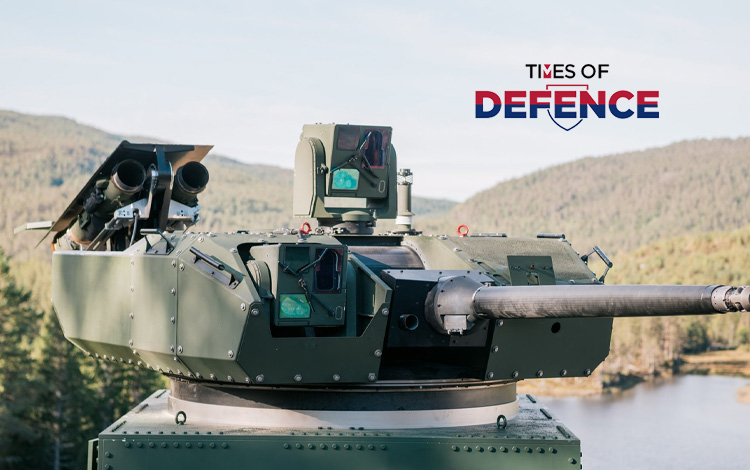
The Javelin Joint Venture (JJV), the partnership between Raytheon and Lockheed Martin, has completed a simulation demonstration in Norway involving a Kongsberg PROTECTOR Medium-Caliber Turret (MCT) equipped with a prototype dual Javelin launcher assembly.
The demonstration represents the first phase of an ongoing integration effort aimed at expanding how the Javelin anti-tank missile can be employed from turreted and vehicle-mounted platforms. No live missile firing was reported as part of this specific demonstration, and the companies have not announced a target vehicle or timeline for subsequent testing.
From Shoulder-Launched Missile to Networked Vehicle Weapon
Javelin was originally designed as a man-portable, fire-and-forget anti-tank weapon. The missile uses an imaging infrared seeker and can engage targets without requiring the operator to guide the missile after launch.
According to Lockheed Martin, Javelin’s published engagement envelope is approximately 65 meters to 4 kilometers in most operating conditions. The weapon is designed to defeat a broad range of targets and can be employed in top-attack or direct-attack modes depending on the engagement.
The new integration effort moves the weapon further toward a vehicle-based employment model, allowing the missile to become part of a larger combat vehicle’s sensor, fire-control and weapon architecture.
Kongsberg PROTECTOR MCT
The Kongsberg PROTECTOR MCT is an unmanned medium-caliber turret designed primarily for infantry fighting vehicles and amphibious combat vehicles.
Kongsberg’s current configuration supports either a 30 mm or 40 mm cannon, together with a coaxial machine gun and optional missile systems.
The turret incorporates:
- Day and night electro-optical sensors
- Thermal imaging
- Laser rangefinder
- Stabilized weapon control
- Under-armour operation and reloading
- Integrated fire-control architecture
- Optional anti-tank guided weapons
- Counter-UAS capabilities
Kongsberg describes the MCT as a modular system capable of integrating additional weapons and mission equipment as requirements evolve.
The turret is already associated with major armoured-vehicle programmes, including the U.S. Marine Corps’ Amphibious Combat Vehicle and other international platforms. Kongsberg’s 2026 materials also identify U.S. Army Stryker programmes and counter-UAS applications among MCT reference programmes.
Why a Dual Javelin Launcher Matters
The prototype configuration demonstrated in Norway uses two ready-to-fire Javelin missiles on the turret.
This is significant because a turret-mounted launcher can integrate the anti-tank missile into the vehicle’s existing sensor and fire-control chain rather than requiring soldiers to dismount and operate a separate Javelin launcher.
A dual launcher also potentially gives the vehicle two immediately available anti-armour shots before requiring a reload.
However, the Norwegian demonstration does not yet establish an operational capability. The launcher is described as a prototype, and further testing would be required to validate the complete system under field conditions.
A Longer Evolution of Vehicle-Mounted Javelin
The concept itself is not entirely new.
The Javelin Joint Venture and Kongsberg have been working on vehicle-mounted Javelin integration for more than a decade. Earlier demonstrations involved Javelin missiles fired from Kongsberg remote weapon stations installed on armoured vehicles.
More recent tests have also demonstrated Javelin integration with unmanned ground vehicles.
The new MCT configuration represents a further step toward integrating the missile with a larger, stabilized medium-caliber turret, potentially allowing the vehicle’s primary gun, sensors and anti-tank missiles to operate as a single combat system.
Potential Battlefield Architecture
A future operational configuration could give an infantry fighting vehicle multiple layers of direct and anti-armour firepower.
A typical engagement architecture could combine:
30/40 mm cannon → medium-range direct fire
Coaxial machine gun → close-range targets
Javelin → armoured targets at longer engagement distances
Electro-optical/IR sensors → target detection and identification
The advantage is not simply carrying another weapon. The deeper integration allows the vehicle’s sensors and fire-control system to contribute to the missile engagement process.
This could be particularly relevant to modern battlefields where armoured vehicles must rapidly respond to tanks, fortified positions and other high-value targets while remaining under armour.
Javelin Production Is Also Expanding
The integration effort comes as Javelin production continues to expand.
The Javelin Joint Venture delivered the first Lightweight Command Launch Units (LWCLU) to the U.S. Army in May 2026. The new launcher provides approximately twice the target detection and recognition range of the legacy unit while reducing size by 30% and weight by 25%.
Lockheed Martin states that the Javelin production line in Troy has reached a capacity of approximately 3,000 missiles per year, while the companies continue expanding the supply chain.
What Comes Next?
The Norway demonstration should be viewed as an integration milestone rather than an operational deployment.
The next stages would likely involve further hardware integration, vehicle testing, fire-control validation and eventually live-fire qualification. However, JJV and Kongsberg have not publicly announced the exact vehicle platform, test schedule or procurement programme associated with this prototype.
The significance of the demonstration is therefore less about a new Javelin variant and more about how an existing precision anti-armour weapon can be integrated deeper into modern armoured-vehicle architectures.
Technical note: The dual-launcher configuration demonstrated in Norway remains a prototype. No public information currently confirms a specific operational vehicle, procurement decision, live-fire qualification or final production configuration.