

Boeing Begins Delivery of 12-Aircraft Fleet to Modernize Egypt’s Heavy-Lift Capability
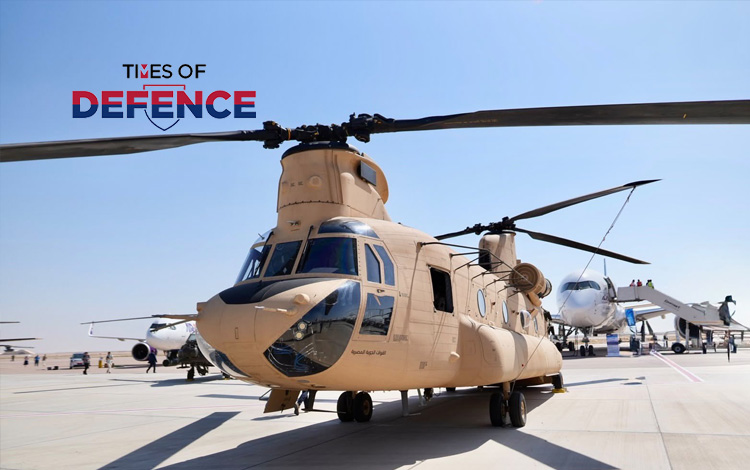
Egypt has begun receiving its new CH-47F Chinook heavy-lift helicopters, marking the start of a major modernization of the Egyptian Air Force’s heavy transport fleet.
The United States Embassy in Cairo confirmed on September 17 that the first CH-47F had been handed over to Egypt. However, more recent defense reporting indicates that five of the 12 aircraft covered by the contract have now been delivered, with the first aircraft formally presented during the El Alamein International Airshow, held September 8–10, 2026.
The remaining seven helicopters are still to be delivered. The Egyptian government and U.S. Embassy have not publicly released a detailed delivery schedule for the remaining aircraft.
$426 Million Foreign Military Sale
The program originated from a U.S. Foreign Military Sale. In January 2023, the U.S. Army awarded Boeing a $426 million contract for 12 new CH-47F Chinooks for the Egyptian Air Force.
The aircraft are intended to replace Egypt’s existing CH-47D fleet, providing a newer digitalized platform with improved avionics, cargo-handling systems and maintainability. Boeing originally announced that deliveries were expected to begin in 2026.
The program followed a much larger U.S. approval in May 2022 covering a possible sale of up to 23 CH-47F helicopters valued at approximately $2.6 billion. Egypt ultimately contracted for 12 aircraft in the 2023 agreement.
What Makes the CH-47F Different?
The CH-47F is the latest production evolution of the Chinook family and introduces a substantially modernized cockpit and airframe compared with Egypt’s older CH-47Ds.
Boeing identifies several key features, including:
- Common Avionics Architecture System (CAAS)
- Fully integrated digital cockpit management
- Advanced cargo-handling equipment
- Improved airframe design
- Modern flight and mission systems
- Improved maintainability and reliability
The CAAS architecture provides a common digital avionics environment and allows future upgrades to be incorporated more easily than on older-generation aircraft.
Heavy-Lift Performance
The Chinook’s distinctive tandem-rotor configuration uses two counter-rotating rotors mounted at the front and rear of the fuselage.
Unlike conventional helicopters, the CH-47 does not require a tail rotor to counteract engine torque. This allows the aircraft to devote its available engine power primarily to lift and forward flight.
Open-source figures for the CH-47F indicate a cruise speed of approximately 170 knots, while the aircraft can carry very heavy internal or external loads. Published figures vary by configuration, but the CH-47F family is capable of carrying up to approximately 24,000 lb (10.9 tonnes) internally and around 26,000 lb (11.8 tonnes) as an external sling load.
Its heavy-lift capability allows the Chinook to transport:
- Troops and equipment
- Vehicles
- Artillery and other heavy loads
- Cargo pallets
- Humanitarian supplies
- Special operations equipment
Modernization of Egypt’s Chinook Fleet
Egypt has operated Chinooks for decades, with its existing fleet based primarily around the CH-47D standard.
Boeing’s current information lists Egypt’s existing fleet at 18 CH-47Ds, while some historical fleet accounts differ because of previous acquisitions and upgrades. The new F-model aircraft are intended to modernize this capability rather than introduce an entirely new heavy-lift mission.
The transition also creates a more modern digital logistics and maintenance architecture for a fleet that has relied on earlier-generation Chinooks.
A Flexible Heavy-Lift Platform
The CH-47F can perform considerably more than conventional cargo transport.
Its large cabin, rear loading ramp and external cargo hook allow it to support tactical logistics, troop movement, disaster response and special operations.
The aircraft can also be configured with additional survivability and mission equipment. The broader CH-47F family can incorporate systems such as missile-warning sensors, radar-warning receivers and countermeasure dispensers, although the precise configuration of Egypt’s aircraft has not been publicly detailed.
The platform’s heavy-lift capability is particularly valuable for moving equipment between locations that may not have suitable road infrastructure or where ground transportation would be too slow.
Egypt’s Broader Boeing Fleet
The Chinook delivery also reinforces a long-standing U.S.-Egyptian military aviation relationship.
Boeing currently identifies Egypt as operating AH-64D Apache attack helicopters and CH-47D Chinooks, while the company displayed the AH-64 Apache, CH-47 Chinook and KC-46A Pegasus at the 2026 El Alamein Airshow.
The introduction of the CH-47F therefore adds a new-generation heavy-lift platform to an existing American-built helicopter ecosystem.
What Comes Next?
With the first five aircraft delivered, Egypt has begun transitioning from its legacy CH-47D fleet toward the newer F-model.
The remaining seven helicopters are expected to complete the 12-aircraft contract, but an official detailed delivery timeline has not been released publicly.
The modernization gives Egypt a more capable heavy-lift platform while preserving the basic Chinook mission architecture that its forces have operated for decades.
Technical note: Performance figures such as payload and range can vary according to configuration, fuel load, environmental conditions and mission equipment. Egypt’s exact CH-47F configuration, including the final defensive-aids and mission-system fit, has not been fully disclosed publicly.
