


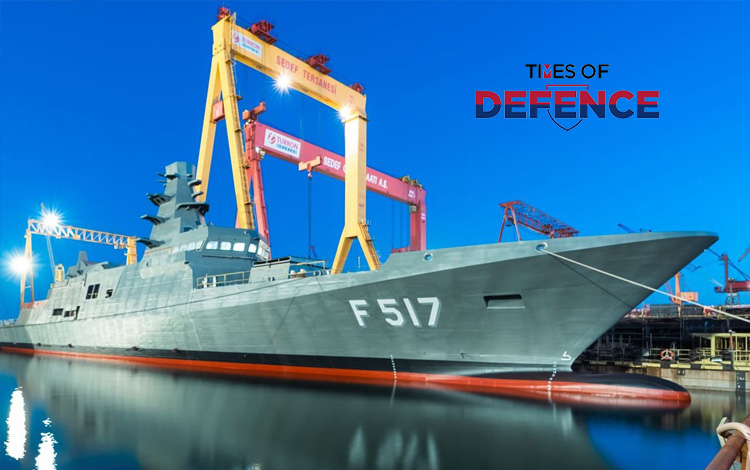
Türkiye’s naval shipbuilding program has reached another important milestone with the start of sea acceptance trials for TCG İZMİT (F-517), the third İstif-class frigate being built under the MİLGEM 6–12th Ships Procurement Project.
According to the information released by the Turkish Ministry of National Defence, the ship’s sea acceptance trials began on 15 September 2026. Construction and outfitting activities are continuing at Sedef Shipyard, where the frigate is being built as part of the TAİS–STM industrial partnership.
TCG İZMİT is the seventh vessel of the overall MİLGEM program and the third ship of the İstif (I)-class frigate family, following TCG İSTANBUL (F-515) and TCG İZMİR (F-516). The frigate was launched at Sedef Shipyard on 11 January 2025 and subsequently entered the outfitting phase.
Technical Characteristics
The İstif-class is designed as a multi-role frigate, expanding on the capabilities of Türkiye’s Ada-class corvettes while incorporating a substantially larger hull, greater endurance and a vertical-launch air-defence capability.
According to STM’s published specifications, the class has an overall length of approximately 113.2 metres, a maximum beam of 14.4 metres and a displacement of around 3,150 tonnes. The ship is designed for a maximum speed of 29+ knots and a cruising speed of approximately 14 knots, with an advertised range of 5,700 nautical miles at 14 knots.
The propulsion system uses a CODAG configuration, combining a gas turbine and diesel engines, driving two shafts with controllable-pitch propellers. Four diesel generators provide electrical power for the ship’s systems.
Weapons and Combat Systems
The İstif-class architecture incorporates a significant number of Turkish-developed combat systems.
The published configuration includes a 16-cell MİDLAS vertical launch system, intended for the launch of the HİSAR family of surface-to-air missiles. The ships are also equipped with ATMACA anti-ship missiles, providing a long-range surface-strike capability.
The reported combat-system configuration also includes:
- CENK-series AESA radar
- ADVENT combat management system
- ASELSAN GÖKDENİZ close-in weapon system
- 76 mm naval gun
- ASELSAN STOP 25 mm remote weapon systems
- FERSAH hull-mounted sonar
- HIZIR torpedo countermeasure system
- ASELSAN ARES electronic support measures
- electro-optical and infrared sensor systems
- 324 mm lightweight torpedo launchers
- helicopter operations capability
This combination gives the class a multi-mission profile covering air defence, anti-surface warfare, anti-submarine warfare, electronic warfare and maritime surveillance.
The MİDLAS system is particularly significant because it provides the frigate with an indigenous vertical-launch architecture. Türkiye is progressively integrating this system with its domestically developed missile family, reducing dependence on foreign launch systems for future naval platforms.
What Do Sea Acceptance Trials Mean?
The start of sea acceptance trials marks a transition from shipyard construction and harbour-based testing to comprehensive testing at sea.
During this phase, the ship’s propulsion, navigation, manoeuvring, electrical systems, sensors, communications, combat-management architecture and other mission systems can be evaluated under operational conditions. Weapons and combat-system trials can also form part of the wider acceptance process, depending on the stage of integration.
For TCG İZMİT, the beginning of sea trials therefore represents an important step toward eventual delivery to the Turkish Naval Forces Command.
The wider MİLGEM 6–12 program is being executed through multiple Turkish shipyards. STM stated that three additional İstif-class frigates under the initial follow-on contract were to be constructed concurrently at different private shipyards, with delivery to the Turkish Navy. The broader program has subsequently expanded, with eight İstif-class frigates now forming part of STM’s involvement in the program.
With TCG İZMİT entering sea acceptance trials, Türkiye’s second-generation national frigate program is moving from ship construction toward system validation and fleet integration.
