


General Atomics Aeronautical Systems Inc. (GA-ASI) is rapidly expanding its uncrewed combat-aircraft portfolio around a central requirement of future high-end warfare: combining range, persistence, payload, survivability, autonomy and affordable mass.
The company’s current lineup spans the long-endurance MQ-9B SkyGuardian and SeaGuardian, the expeditionary Mojave STOL, the U.S. Air Force’s FQ-42A Collaborative Combat Aircraft, and the newly unveiled Wildfire Massed Modular Aircraft (MMA). GA-ASI says the portfolio is designed to provide different layers of capability, from persistent ISR and maritime surveillance to autonomous air combat and long-range strike.
Wildfire: The New Attritable Combat Aircraft
The newest addition is Wildfire, a clean-sheet uncrewed aircraft that GA-ASI is proposing for the U.S. Air Force and Defense Innovation Unit’s Massed Modular Aircraft requirement.
GA-ASI describes Wildfire as a scalable, attrition-tolerant aircraft intended to provide significant combat capability at lower cost and in larger numbers than traditional high-end platforms.
Its most striking feature is its weapons capacity.
GA-ASI says Wildfire can carry:
- 2 × AGM-158C LRASM long-range anti-ship missiles
- 4 × JSM Joint Strike Missiles
- Other combinations of weapons, sensors, launched effects, electronic-warfare equipment or communications payloads
The company states that Wildfire has a ferry range exceeding 8,000 nautical miles (14,816 km). This is a ferry-range figure, not a combat radius with weapons and operational reserves.
The aircraft is also being designed around autonomous collaborative operations. GA-ASI says its autonomy architecture is intended to allow dozens of Wildfires to operate as a networked force, while human operators provide mission direction rather than continuously flying every aircraft through a conventional control station.
Gambit and the FQ-42A
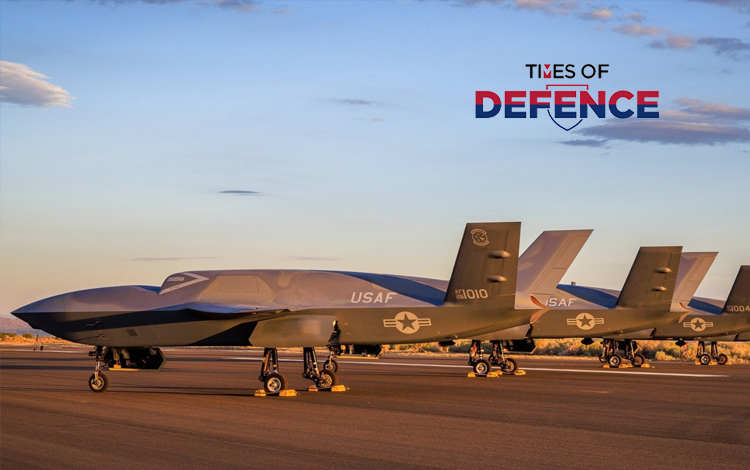
At the higher end of the portfolio is GA-ASI’s Gambit family, which provides the technological foundation for the FQ-42A Collaborative Combat Aircraft.
The Gambit concept uses a common core with approximately 70% commonality across variants. Different configurations can then be optimized for ISR, air-to-air combat, adversary-air training or combat reconnaissance.
The U.S. Air Force selected GA-ASI’s aircraft as the FQ-42A, alongside Anduril’s FQ-44, for CCA Increment 1.
In June 2026, the Air Force awarded engineering, manufacturing and production contracts for the two aircraft. In September, the service officially named the FQ-42 Vengeance and the FQ-44 Fury. The Air Force says it intends to procure approximately 150 Increment 1 aircraft, with a broader objective of approximately 1,000 combat-ready semi-autonomous systems and 500 in service by 2032.
Unlike Wildfire, detailed public specifications for the production FQ-42 — including maximum speed, range, payload and sensor configuration — remain limited.
Its intended role is different as well. The CCA is designed to operate alongside crewed combat aircraft, extending their sensor coverage, weapons capacity and operational reach.
MQ-9B: From ISR to Standoff Strike
GA-ASI is also modifying its established MQ-9B platform for increasingly demanding missions.
The MQ-9B SkyGuardian and SeaGuardian have a 24-meter wingspan, a maximum gross takeoff weight of approximately 5,670 kg, a payload capacity of up to 2,177 kg, and a maximum endurance of approximately 40 hours in the SkyGuardian configuration. The aircraft uses a Honeywell TPE331-10 turboprop engine and can operate beyond line of sight through satellite communications.
GA-ASI is now integrating larger standoff weapons.
The company has developed the aircraft around new pylons with 30-inch lug spacing for weapons such as LRASM and JSM. JSM integration reached the System Requirements Review and Preliminary Design Review stages in June 2026. GA-ASI has said it intended to fly at least one of the new long-range weapons in 2026, meaning the capability should be regarded as under development rather than a fully operational MQ-9B weapon configuration.
The SeaGuardian variant also supports maritime missions, including surface surveillance and anti-submarine warfare. Recent U.S. Navy-supported testing demonstrated expanded sonobuoy deployment and processing capabilities.
Mojave: Taking the Runway Out of the Equation
The Mojave STOL addresses another vulnerability: dependence on conventional airbases.
The aircraft has a 16-meter wingspan, a maximum gross takeoff weight of 3,175 kg, a useful load of approximately 1,542 kg, and more than 25 hours of endurance. It is powered by a Rolls-Royce M250 engine producing approximately 450 shp. GA-ASI lists a maximum speed of 140 knots and a maximum operating altitude of 25,000 feet.
Mojave can carry up to 16 Hellfire missiles in its published configuration and can also carry EO/IR, SAR/GMTI, SIGINT and communications-relay payloads.
Its defining feature is its ability to operate from short and relatively austere surfaces. GA-ASI says the aircraft can operate from short runways, semi-improved strips, beaches, highways and even naval carrier decks.
That concept was demonstrated again in September 2026 when GA-ASI and Hanwha Aerospace conducted Mojave operations from a simulated battlefield site in South Korea, including landing and taking off again from a tank and artillery live-fire range.
Why GA-ASI Is Keeping Large UAS Relevant
GA-ASI President David Alexander argues that the emergence of small drones does not eliminate the need for larger aircraft.
His argument is based on the physics of long-range operations: aircraft expected to carry large payloads, significant fuel reserves and persistent sensors require sufficient wing area, internal volume and propulsion capacity.
That logic is reflected in the company’s portfolio.
Rather than replacing the MQ-9 with a single smaller aircraft, GA-ASI is developing several layers:
MQ-9B → persistent ISR and standoff sensing/strike
Mojave → expeditionary and short-field operations
Wildfire → affordable theater-range combat mass
Gambit/FQ-42 → autonomous operations in highly contested airspace
The result is a portfolio covering different combinations of range, survivability, payload and cost rather than a single universal aircraft.
The Role of Attritable Mass
Wildfire is particularly important because it reflects a broader shift in U.S. airpower concepts toward attritable mass.
An attritable aircraft is not necessarily designed to be disposable in every mission. Instead, its acquisition and production cost is intended to be low enough that commanders can accept a significantly higher level of operational risk than they would with a highly expensive crewed aircraft.
This changes the calculation for both sides.
A large number of relatively affordable autonomous aircraft can provide additional sensors, weapons, electronic warfare effects and decoys while forcing an adversary to expend high-value defensive weapons.
GA-ASI is explicitly designing Wildfire around this model, with modular payload interfaces and production scalability intended to support larger numbers.
Manufacturing Becomes a Combat Capability
Production capacity is another major element of the strategy.
GA-ASI says it has more than 5 million square feet of manufacturing capacity that can be leveraged for Wildfire and has previously demonstrated production rates of up to 100 aircraft per year across its portfolio. The company argues that this industrial base allows Wildfire to be delivered substantially faster and in larger quantities than the original MMA timeline envisioned.
The company also reports nearly 10 million total flight hours, mostly accumulated through combat operations across its UAS family.
What Changes in High-End Warfare?
The significance of GA-ASI’s portfolio is not simply that it is producing more drones.
The company is attempting to move uncrewed aircraft from the traditional remote-piloted ISR/strike model toward a layered combat architecture in which different aircraft perform complementary functions.
A future force could potentially combine:
- Long-endurance MQ-9B sensors
- Mojave expeditionary operations
- Wildfire long-range weapons
- FQ-42 autonomous combat aircraft
- Gambit-derived sensing and autonomy
- Networked satellite and tactical communications
- Human operators directing multiple aircraft simultaneously
The result would be a force designed to distribute sensing, weapons and risk across a much larger number of aircraft.
Key takeaway
GA-ASI’s September 2026 portfolio announcement shows a clear evolution from the traditional Reaper model toward a family of increasingly autonomous, networked and scalable combat aircraft.
Wildfire is the newest piece of that strategy, combining an 8,000+ nautical-mile ferry range with the ability to carry two LRASMs or four JSMs, while the FQ-42 moves GA-ASI into the U.S. Air Force’s next-generation autonomous combat-aircraft fleet. MQ-9B and Mojave provide complementary long-endurance, maritime and expeditionary capabilities.
However, several of the most ambitious capabilities — particularly Wildfire’s operational autonomy, large-scale collaborative control and some of the MQ-9B long-range weapon integrations — remain developmental rather than fully operational capabilities.
