



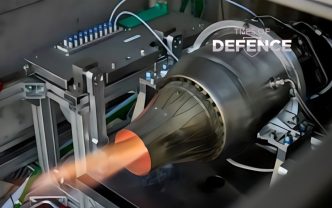
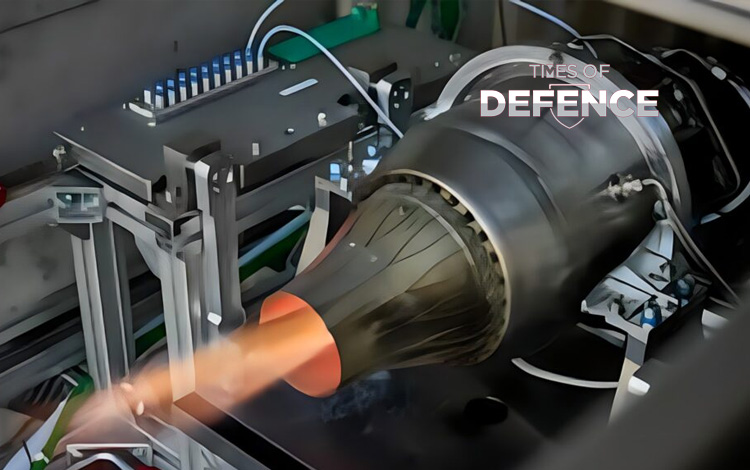
The United Kingdom has demonstrated a new approach to rapid military propulsion development, taking a domestically developed turbojet engine from concept to flight-ready status in less than seven months.
The programme, led by the UK Ministry of Defence’s Strategic Capabilities Office (SCO) in partnership with British technology company Alloyed, has produced a family of digitally designed and manufactured turbojet engines ranging from 30N to 2,000N of thrust.
The initiative is intended to create a sovereign British propulsion capability for future uncrewed aircraft, weapons and other defence systems while reducing dependence on overseas engine supply chains. The UK government announced the programme on 15 September 2026.
Two Engines Have Already Reached Advanced Stages
Two members of the new engine family have already progressed beyond the early development phase.
A 300N-class engine has completed flight testing and has now entered serial production in the UK.
A larger 1,100N-class engine has progressed from its initial concept to a flight-ready configuration in less than seven months.
The government has not publicly disclosed a complete technical specification for the 1,100N engine, including its final dry mass, dimensions, specific fuel consumption or demonstrated endurance.
The publicly disclosed thrust range, however, indicates that the technology is intended to cover a broad class of small and medium-sized turbine-powered systems.
From 30N to 2,000N
The programme’s most significant technical feature is not simply the individual engine designs, but the scalable propulsion architecture behind them.
The family is designed to cover approximately:
- 30N — micro/small propulsion applications
- 300N class — small UAVs and other compact systems
- 1,100N class — larger uncrewed aircraft and higher-thrust applications
- Up to 2,000N — future larger platforms
The Ministry of Defence says the family can support applications ranging from small drones to larger aircraft.
This approach could allow Britain to develop different propulsion systems around a common digital engineering and manufacturing methodology rather than starting from scratch for every new platform.
The 300N Engine: A300
Alloyed’s publicly available product information identifies the 300N-class engine as the A300.
The A300 is a lightweight turbojet designed around additive manufacturing and rapid integration.
Publicly disclosed A300 specifications
- Peak thrust: 300N
- Dry mass: 3.0kg
- TSFC at 300N: 44 g/kNs
- Start-up: less than 20 seconds to full throttle
- Fuel compatibility: diesel, kerosene and Jet A-1
- Operating temperature: -15°C to +50°C
- Ruggedisation: 20G
- Manufacturing: additive manufacturing / digital production
Alloyed says the engine’s hot-section components use its ABD-900AM material technology, allowing higher-temperature operation and potentially improved efficiency.
The company also describes the A300 as having an architecture designed specifically for additive manufacturing, reducing part count and allowing more optimised internal geometries.
Why Additive Manufacturing Matters
Traditional small turbine-engine development can require extensive tooling, machining, component qualification and supply-chain coordination.
The British programme is attempting to compress this process through a combination of:
Digital design → simulation/modelling → additive manufacturing → testing → rapid iteration
The UK government says the digital design and modelling capability developed through the programme can allow new propulsion systems and variants to be designed, assessed and brought into production in months rather than years.
The modular approach is also intended to allow individual elements of an engine to be changed or improved without requiring a complete redesign.
A Different Model for Defence Procurement
The programme is also notable because of its development model.
Rather than the Ministry of Defence simply issuing a conventional requirement for a finished engine, the SCO and Alloyed jointly invested in the development programme.
The government describes this as a co-investment model, combining MOD funding with matched funding from the company.
The objective is to create an industrial capability as well as an individual product.
That distinction could become increasingly important as Western militaries seek propulsion systems that can be manufactured rapidly and in large quantities for attritable and expendable platforms.
Designed for the Era of Mass Uncrewed Systems
The thrust range is particularly relevant to the growing demand for relatively inexpensive powered drones and other autonomous systems.
A 300N-class turbojet can provide propulsion for compact high-speed UAVs, while engines in the 1,000N-plus class can support significantly larger airframes.
The programme therefore creates a potential propulsion ladder covering multiple categories of uncrewed systems.
However, the UK government has not announced a specific operational weapon or drone that will use the 1,100N engine.
That distinction is important: the technology has demonstrated rapid development, but a direct connection to a particular future missile or UAV should not be assumed unless officially confirmed.
Sovereign Supply Chain
Another major objective is reducing Britain’s dependence on foreign propulsion suppliers.
The programme currently involves more than 40 UK suppliers, most of them small and medium-sized enterprises.
More than 60 engineering and advanced manufacturing jobs have already been created, with another 45 positions expected during the next 12 months as production expands.
The government says the programme is designed to provide Britain with the ability to design, manufacture, test and sustain these propulsion systems domestically.
Potential for Rapid Production
Alloyed’s current Argive propulsion business describes its approach as mission-optimised propulsion designed for affordable mass, with digital manufacturing, scalable production and secure supply chains.
The company says its propulsion technology is based around rapid customisation and significantly shorter development cycles.
This is particularly relevant to modern defence concepts involving large numbers of relatively inexpensive autonomous systems.
Instead of treating the engine as a highly bespoke component that takes years to develop, the British approach seeks to make propulsion a digitally configurable part of the platform design process.
Strategic Significance
The UK’s new turbojet programme represents more than the rapid development of a single engine.
Its strategic significance lies in establishing a domestic ecosystem capable of developing multiple propulsion variants across a 30N–2,000N thrust class.
The successful transition of the A300 into serial production and the rapid maturation of the 1,100N-class engine demonstrate that the programme has already moved beyond laboratory development.
The bigger question now is how quickly this manufacturing architecture can be scaled to support operational programmes.
If the UK can combine rapid digital engineering with high-volume additive manufacturing, the technology could become an important enabler for future attritable UAVs, loitering systems, autonomous aircraft and other mass-produced defence platforms.
For now, however, the confirmed achievement is clear:
Britain has established a sovereign turbojet development programme capable of taking a 1,100N-class engine from concept to flight-ready status in under seven months, while its 300N-class A300 has already entered UK serial production.
