



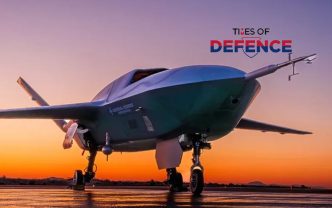
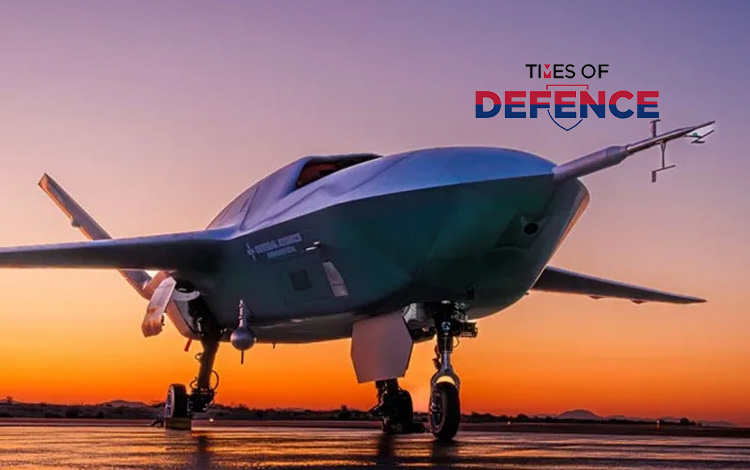
The U.S. Air Force is dramatically expanding its plans for autonomous combat aircraft, with Secretary of the Air Force Troy Meink announcing a target of having at least 500 Collaborative Combat Aircraft (CCA) in service by 2032.
The service also plans to field 500 Massed Modular Aircraft (MMA) by the same year, creating a potential fleet of at least 1,000 new autonomous or semi-autonomous aircraft designed to provide affordable mass, intelligence, surveillance, reconnaissance and combat capability.
The announcements were made by Meink on September 14 at the Air & Space Forces Association’s Air, Space & Cyber Conference in National Harbor, Maryland.
FQ-42 Vengeance and FQ-44 Fury
The first CCA Increment 1 aircraft are being developed and produced by General Atomics Aeronautical Systems and Anduril.
The Air Force has officially named the two aircraft:
- FQ-42A Vengeance — General Atomics
- FQ-44A Fury — Anduril
Both aircraft have entered production following U.S. Air Force engineering, manufacturing and production contracts awarded in June 2026. General Atomics said manufacturing of the FQ-42A was already well underway, while the Air Force confirmed that both Increment 1 platforms were moving into production.
The FQ designation is significant. Under the U.S. military aircraft designation system, “F” identifies a fighter while “Q” identifies an unmanned aircraft.
What Is a Collaborative Combat Aircraft?
CCA is designed around a fundamentally different concept from traditional fighter procurement.
Rather than replacing crewed fighters, the aircraft are intended to operate alongside them as autonomous or semi-autonomous teammates.
The Air Force envisions CCAs performing missions such as:
- Air-to-air combat
- Intelligence, surveillance and reconnaissance
- Electronic warfare
- Strike
- Suppression of Enemy Air Defenses (SEAD)
- Destruction of Enemy Air Defenses (DEAD)
- Targeting and sensing
- Additional mission-specific roles
The objective is to increase the number of aircraft available to a combat formation without requiring every aircraft to carry a human pilot.
The Air Force describes CCA as a way to extend the reach, awareness and survivability of American airpower in highly contested environments.
FQ-42A Vengeance: Technical Picture
General Atomics has released relatively limited detailed performance data for the FQ-42A.
The aircraft is a purpose-built uncrewed fighter designed around modularity and mission autonomy. GA-ASI says the design allows mission systems and autonomy software to be integrated rapidly for different missions.
The company’s broader Gambit CCA concept includes variants intended for air-to-air superiority, long-endurance surveillance, air-to-ground strike and other missions.
General Atomics has also stated that its production facility was transitioned to a rate capable of producing six CCAs per month, while a low-observable coating facility has been completed.
Publicly confirmed FQ-42 information
Manufacturer: General Atomics Aeronautical Systems
Designation: FQ-42A Vengeance
Role: Uncrewed fighter / Collaborative Combat Aircraft
Program: CCA Increment 1
Guidance concept: Autonomous/semi-autonomous operation with human-machine teaming
Architecture: Modular and designed for rapid mission-system integration
Production: Underway
Production capacity announced by GA-ASI: Up to six aircraft per month at its transitioned facility
Exact official figures for maximum speed, combat radius, ceiling, internal fuel capacity, payload and weapon load have not been publicly disclosed by the Air Force or GA-ASI.
FQ-44A Fury: Technical Picture
The second CCA is Anduril’s FQ-44A Fury.
Anduril describes Fury as an autonomous air vehicle built around a modular architecture and designed to support multiple mission configurations.
The company states that Fury can be configured for different RF, infrared and other sensor/payload capabilities, allowing the aircraft to be adapted for different missions.
Anduril also says Fury uses commercially available jet-engine technology and modular commercial-off-the-shelf subsystems to support scalable production and sustainment.
One publicly stated performance figure is particularly notable: Anduril says Fury is capable of flying at speeds of up to Mach 0.95 and performing fighter-like turn rates.
Publicly confirmed FQ-44 information
Manufacturer: Anduril Industries
Designation: FQ-44A Fury
Role: Uncrewed fighter / Collaborative Combat Aircraft
Program: CCA Increment 1
Maximum stated speed: Up to Mach 0.95
Architecture: Modular
Mission configurations: RF, IR and other payloads
Autonomy: Flight and mission autonomy
Production: Underway
Anduril has also demonstrated FQ-44 operations with Air Force personnel through the Experimental Operations Unit, including launch, recovery, sustainment and mission-tasking exercises.
The Software May Be as Important as the Aircraft
One of the most important elements of the CCA program is not the airframe itself but the government-owned autonomy architecture.
The Air Force has been developing an Autonomy Government Reference Architecture, or A-GRA, designed to separate mission-autonomy software from the aircraft itself.
This means that, in principle, an autonomy algorithm developed for one CCA platform can be integrated onto another compatible platform without completely redesigning the aircraft’s software ecosystem.
The Air Force says this approach is intended to prevent vendor lock-in, accelerate technology insertion and create greater competition between manufacturers.
This is a major change from traditional military aircraft acquisition, where the aircraft, mission systems and software are often tightly integrated into a single platform.
500 CCA Aircraft by 2032
The latest target represents a major increase in the Air Force’s previously announced plans.
Earlier targets had envisioned approximately 100 CCAs by 2029, while Secretary Meink had more recently discussed having more than 150 combat-capable aircraft by the end of the decade.
The new objective is at least 500 CCAs in service by 2032.
The Air Force has also stated an overall intent to acquire approximately 1,000 combat-ready semi-autonomous systems, suggesting that the 500-aircraft 2032 target is only part of the longer-term CCA force structure.
A Second Fleet: Massed Modular Aircraft
Alongside the CCA program, the Air Force is accelerating development of the Massed Modular Aircraft (MMA).
The MMA is intended to provide a much cheaper and less complex autonomous aircraft capable of taking over some of the missions currently performed by the MQ-9A Reaper.
The current plan calls for:
- 100 MMA aircraft by 2029
- 500 MMA aircraft by 2032
Air Force officials have indicated that the basic MMA air vehicle could cost approximately $10 million, compared with around $20 million for a CCA air vehicle, before additional sensors and mission equipment.
Unlike the CCA, which is optimized as an uncrewed fighter operating alongside crewed combat aircraft, MMA is being positioned as a lower-cost platform for ISR and strike missions, with affordability and mass as central design priorities.
Why the Two Programs Matter
The combination of CCA and MMA represents a major shift in U.S. Air Force force planning.
The concept is essentially to build a layered unmanned force:
CCA → higher-end autonomous combat aircraft
MMA → lower-cost massed ISR/strike aircraft
This could allow the Air Force to deploy large numbers of unmanned platforms without relying exclusively on extremely expensive crewed fighters.
The approach also reflects lessons from modern conflicts, where relatively inexpensive unmanned systems can be deployed in large numbers and where aircraft losses in contested airspace can rapidly become prohibitively expensive.
The Cost Equation
The Air Force is deliberately pursuing a different cost model from traditional fighter aircraft.
Current public estimates put the basic vehicle cost at approximately:
CCA: ~$20 million
MMA: ~$10 million
These figures should not be interpreted as the complete cost of a fully equipped combat aircraft. Sensors, communications systems, weapons, autonomy software, support equipment and sustainment can significantly increase the total program cost.
Nevertheless, the intended economics are clear: build large numbers of unmanned aircraft that can be risked in missions where sending a crewed fighter would be more costly or operationally dangerous.
The Strategic Picture
If the Air Force achieves its current objectives, by 2032 the service could have:
500+ Collaborative Combat Aircraft
500 Massed Modular Aircraft
1,000+ new autonomous/semi-autonomous combat aircraft
This would represent one of the most significant transformations of U.S. tactical airpower in decades.
The FQ-42 Vengeance and FQ-44 Fury are therefore not simply new drones. They are the first operational building blocks of a broader U.S. strategy centered on human-machine teaming, autonomous combat capability and affordable mass.
However, the 2032 figures remain force-planning targets rather than guaranteed inventory numbers. Actual fleet size will depend on testing, production performance, budgets, congressional funding and the maturity of the aircraft and autonomy systems.
