



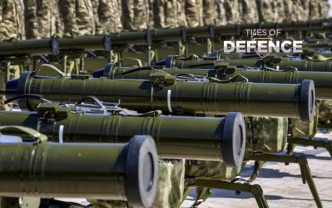
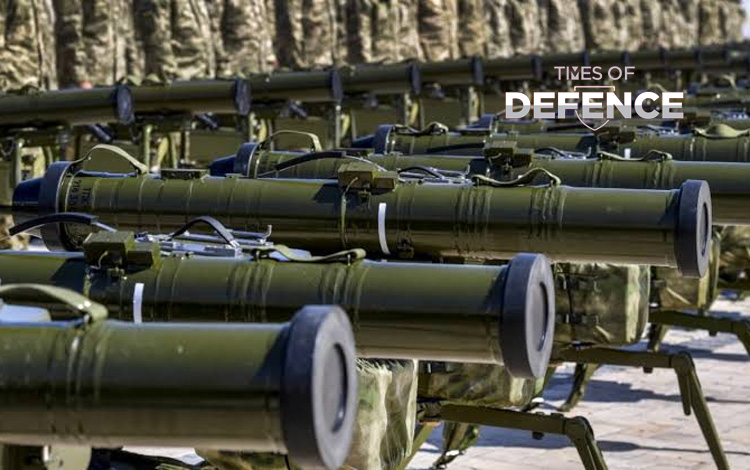
Ukrainian engineers have adapted the Stugna-P anti-tank guided missile system into a new air-defense configuration intended to engage slow-moving aerial targets, including Russian Geran-2 and Gerbera attack drones.
The development reflects a broader Ukrainian effort to create lower-cost counter-drone systems that can supplement expensive surface-to-air missile systems against the growing number of Russian one-way attack UAVs. The new configuration has been reported by Ukrainian sources and defense-focused accounts, although detailed information about its sensors, fire-control architecture, missile modifications and operational performance has not yet been publicly released.
From Anti-Tank Missile to Air-Defense Weapon
The Stugna-P, developed by Ukraine’s Luch Design Bureau, was originally designed primarily as a portable anti-tank guided missile system.
However, the system has previously demonstrated an ability to engage aerial targets. During the war, Ukrainian forces have used Stugna-P against helicopters, including low-flying and hovering aircraft. Its combination of electro-optical observation, laser beam-riding guidance and remote operation gives the system characteristics that can potentially be adapted for selected aerial engagements.
Ukraine’s National Guard has also described Stugna-P training as involving the detection and engagement of aerial targets, while highlighting the system’s remote-control architecture, which allows the operator to remain separated from the launcher.
The latest adaptation takes this concept further by specifically targeting slow-moving UAVs, rather than armored vehicles.
Intended Targets: Geran-2 and Gerbera
The new configuration is reportedly intended primarily for Russian drones such as the Geran-2, the Russian designation for the Shahed-136 family of one-way attack UAVs, and the Gerbera decoy/auxiliary UAV.
This is significant because Russia has dramatically increased the scale of its drone campaign. Ukrainian officials reported that nearly 6,000 drones and missiles were launched against Ukraine during June 2026 alone, with Shahed/Geran, Gerbera and related UAVs forming a major part of the threat.
The Geran-2 is particularly important because it is relatively inexpensive compared with conventional cruise missiles and can be produced and deployed in large numbers. Analysts have also documented continuing Russian efforts to increase Geran production and introduce improved variants.
Stugna-P: Technical Background
The standard Stugna-P is a Ukrainian man-portable ATGM system developed by Luch Design Bureau.
Publicly available specifications include:
| Specification | Stugna-P |
|---|---|
| Type | Anti-tank guided missile system |
| Developer | Luch Design Bureau, Ukraine |
| Missile calibers | 130 mm / 152 mm variants |
| Maximum range | Approximately 5–5.5 km, depending on missile |
| Guidance | Laser beam-riding / SACLOS |
| Launch platform | Tripod or vehicle-mounted |
| Targeting | Electro-optical / thermal imaging |
| Remote operation | Yes |
| Warheads | Tandem HEAT; other variants include HE-fragmentation and thermobaric options |
| Typical missile weight | Approximately 29.5–38 kg depending on variant |
The system can be operated remotely, with the launcher and operator’s control position separated by cable. This allows the crew to remain in a more protected position while observing and guiding the missile.
An important distinction is that these are baseline Stugna-P specifications. They should not automatically be attributed to the newly reported air-defense configuration.
What Has Been Changed?
The precise modifications have not been publicly disclosed.
Based on the available reporting, the key change is mission specialization rather than simply using the original ATGM unchanged.
The system needs to detect, track and engage an aerial target rather than a ground vehicle. This potentially requires adaptations to:
- target acquisition and tracking;
- electro-optical/thermal observation;
- fire-control software;
- engagement algorithms;
- missile-target tracking procedures;
- operator interface and cueing.
However, there is currently insufficient public evidence to confirm exactly which components have been changed.
The missile’s original laser beam-riding guidance system is particularly interesting in this role because it does not depend on the missile carrying an independent seeker. The operator/system keeps the target in the engagement geometry while the missile follows the laser guidance beam.
Why This Could Matter
The biggest advantage is potentially cost efficiency.
Using a high-end surface-to-air missile against a relatively inexpensive one-way attack drone creates an unfavorable cost exchange. Ukraine therefore increasingly needs systems that can destroy drones without consuming scarce and expensive air-defense interceptors.
A modified Stugna-P could occupy a different layer of Ukraine’s air-defense architecture:
Detection → Tracking → Low-cost missile engagement → Higher-end air defense for more difficult targets
This approach is consistent with Ukraine’s broader movement toward layered and cost-conscious counter-UAV defenses, including interceptor drones, electronic warfare, guns and other locally developed systems.
An Important Limitation
There is currently no reliable public data confirming the new system’s kill probability, effective altitude, maximum engagement range against drones, reaction time or production numbers.
Likewise, there is no verified public information establishing that the modified system has achieved a particular number of combat kills.
Therefore, claims about a specific engagement range or interception success rate should be treated cautiously until Ukrainian authorities or the developers release technical data.
The Bigger Picture
The Stugna-P adaptation illustrates an increasingly important trend in the Ukraine war: existing weapons are being rapidly repurposed to meet new battlefield requirements.
A system originally optimized for armored vehicles is now being adapted for the counter-UAV mission, while Russia continues to increase the number, variety and sophistication of its attack drones.
The result is an accelerating technological race in which affordability, production volume and the ability to rapidly modify existing weapons can be just as important as maximum technical performance.
