



The global proliferation of low-cost drones is forcing militaries to rethink how they defend troops, bases and critical infrastructure—and Türkiye is responding with a layered close-range air defence system designed to combine electronic warfare, guns, lasers and missiles against the next generation of aerial threats.
Developed by Türkiye’s state-owned defence manufacturer MKE, TOLGA is being positioned within the Çelik Kubbe integrated air defence architecture as a solution for the lower-altitude battlespace, particularly against small drones, loitering munitions and other unmanned aerial systems.
The system is designed to operate against threats at altitudes of up to approximately 3,000 metres and brings detection, tracking, electronic attack and physical interception into a single command-and-control architecture.
The significance of TOLGA extends beyond Türkiye. As drone warfare becomes increasingly defined by mass attacks, low-cost platforms and rapidly evolving tactics, air-defence forces worldwide are facing the same fundamental problem: how to defeat large numbers of relatively inexpensive aerial threats without exhausting high-value interceptors.
The cost problem is reshaping air defence
Recent conflicts have demonstrated how inexpensive unmanned systems can threaten assets worth many times their cost.
Drones can be deployed for reconnaissance, targeting, electronic warfare and direct attack, while loitering munitions can remain over an area before striking a selected target. Swarm tactics further complicate the defensive problem by forcing air-defence networks to detect and engage multiple targets simultaneously.
This has created growing demand for systems that can combine different effectors and select the most appropriate response for each threat.
TOLGA is being developed around precisely this concept.
Detect, disrupt, destroy
The system’s architecture combines GÖKBÖRÜ AESA radar, electro-optical and acoustic sensors, electronic warfare, gun systems, specialised ammunition, directed-energy weapons and missile capabilities.
GÖKBÖRÜ provides the primary radar detection and tracking layer, while electro-optical sensors support target confirmation and tracking. The acoustic subsystem adds another detection and classification capability by analysing the sound signatures of airborne platforms.
The resulting data is processed through TOLGA’s command-and-control architecture before an engagement option is selected.
That allows the system to move beyond the traditional model of simply detecting a target and firing a missile.
Electronic attack can come first
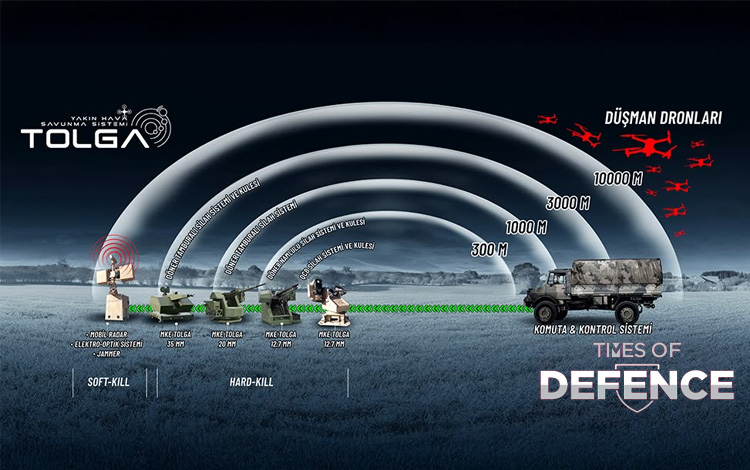
TOLGA’s soft-kill capability is based on electronic jamming.
Against suitable targets, the system can attempt to disrupt communications or control links, potentially neutralising a drone without firing a kinetic interceptor.
If electronic warfare does not provide the required effect, TOLGA can shift to hard-kill options.
This layered approach is increasingly important as drone attacks become more frequent and ammunition expenditure becomes a major consideration for air-defence forces.
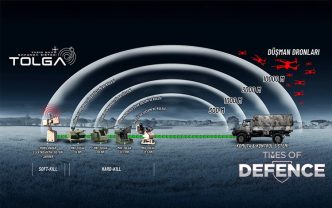
A gun-based shield from 12.7 mm to 35 mm
TOLGA can employ different gun configurations depending on the operational requirement.
Its architecture includes 12.7 mm QCB and rotary-barrel systems, a 20 mm rotary system and a 35 mm rotary system.
The 12.7 mm configurations are designed for engagements at approximately 300 metres, while the 20 mm system extends the range to around 1 kilometre. The 35 mm configuration is designed to engage targets at ranges of up to approximately 3 kilometres.
MKE has also developed dedicated counter-drone ammunition intended to increase effectiveness against small and manoeuvring aerial targets.
The objective is straightforward: provide commanders with a range of engagement options rather than forcing every target into the same, potentially expensive, interceptor chain.
Lasers and missiles expand the engagement envelope
TOLGA is also being developed with directed-energy and missile capabilities.
Its 20 kW fibre-laser system is intended to provide several effects against aerial threats, ranging from optical disruption to physical destruction.
The system’s architecture also incorporates the ENFAL electro-optically guided missile, adding another option for engaging suitable targets.
Together, these capabilities allow TOLGA to combine electronic, kinetic and directed-energy effects within a single layered defence concept.
From military bases to naval platforms
The system is designed for both fixed and mobile protection missions.
Potential applications include ground-force protection, critical infrastructure, military bases and facilities, mobile convoys and naval platforms.
That mobility is particularly significant in an era when front-line units can be exposed to persistent drone surveillance and attacks. A close-range air-defence system must increasingly be capable of moving with the force it protects rather than remaining tied to a fixed defensive position.
Türkiye’s answer to the low-altitude drone battlefield
The emergence of drone warfare has changed the economics of air defence.
The challenge is no longer limited to defeating aircraft and missiles at long range. Modern forces must also protect themselves against small, difficult-to-detect and relatively inexpensive unmanned platforms operating close to the ground.
This is where systems such as TOLGA are becoming strategically relevant.
Its concept is built around a simple sequence:
Detect the threat. Classify it. Disrupt it when possible. Destroy it when necessary—and use the most appropriate effector for the target.
For Türkiye, TOLGA forms part of the lower layer of the Çelik Kubbe air-defence architecture.
For the wider defence industry, however, its development reflects a much larger global trend: the race to build affordable, scalable and multi-layered counter-UAS systems capable of surviving the era of drone saturation.
As unmanned warfare continues to evolve, the battlefield advantage may increasingly belong not to the side with the most expensive interceptor, but to the side capable of defeating the greatest number of threats with the right combination of sensors, electronic warfare and low-cost effectors.
MKE TOLGA is being developed for that battlefield.
